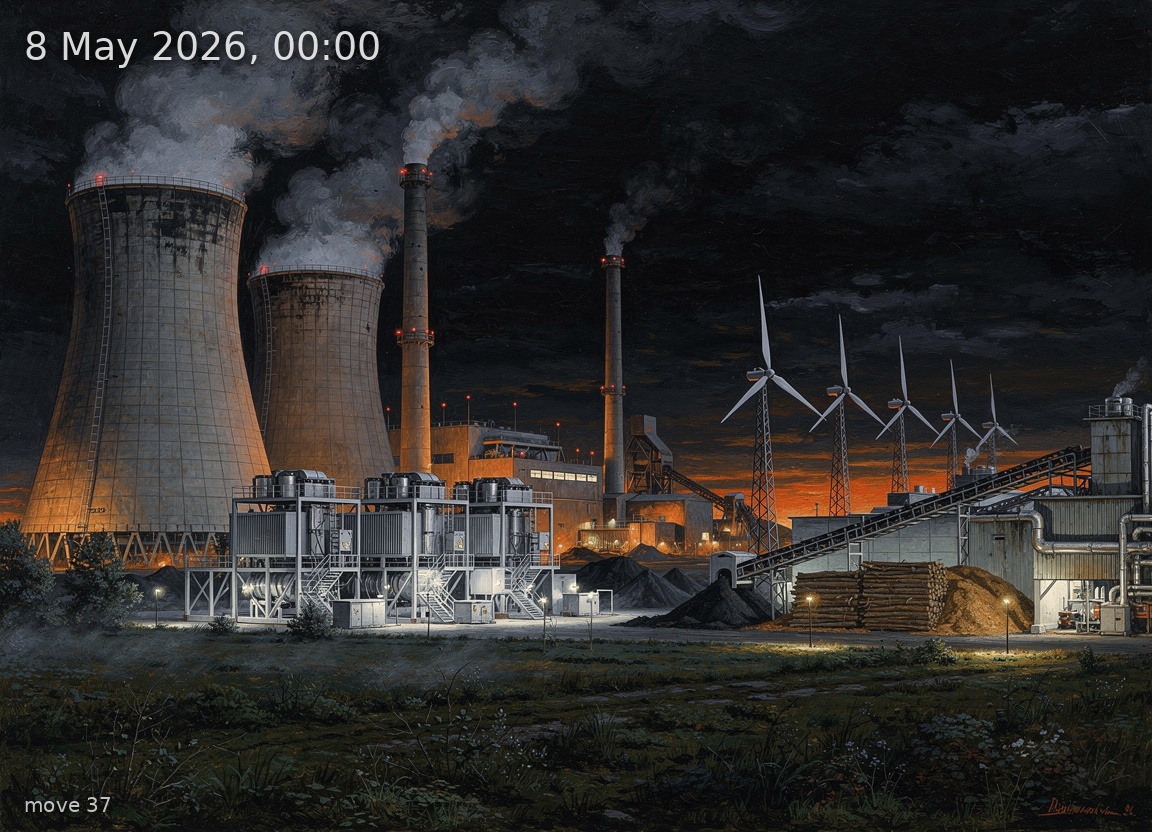
Brown coal and gas dominate midnight generation as light winds and high imports drive prices above 130 EUR/MWh.
Back
Generation mix
Wind onshore 15%
Wind offshore 2%
Biomass 14%
Hydro 5%
Natural gas 25%
Hard coal 12%
Brown coal 27%
36%
Renewable share
5.5 GW
Wind (on + offshore)
0.0 GW
Solar
31.5 GW
Total generation
-15.1 GW
Net import
130.3 €/MWh
Day-ahead price
8.5°C / 4 km/h
Temp / Wind speed
Open-Meteo, Kassel (51.3°N 9.5°E)
100.0% / 0.0 W/m²
Cloud cover / Radiation
434
gCO₂/kWh
Image prompt
Brown coal 8.6 GW dominates the left third of the scene as massive hyperbolic cooling towers with thick steam plumes rising into the darkness; natural gas 7.8 GW fills the center-left as a cluster of compact CCGT power stations with tall single exhaust stacks glowing with internal flue light; wind onshore 4.8 GW occupies the center-right as a modest row of three-blade turbines on lattice towers turning slowly in light breeze; biomass 4.3 GW appears as a mid-sized industrial plant with a wood-chip conveyor and a single smokestack emitting pale vapor in the right-center; hard coal 3.7 GW sits behind the brown coal as a conventional boiler house with rail-mounted coal hoppers and a shorter cooling tower; hydro 1.5 GW is suggested at the far right as a concrete dam spillway with dim safety lighting; wind offshore 0.7 GW is barely visible as distant turbine silhouettes on the far horizon. The setting is completely dark — midnight in central Germany in early May, black sky with total overcast obscuring all stars, no moonlight, no twilight glow whatsoever. All structures are lit only by harsh sodium-orange industrial lighting, red aviation warning beacons on turbine nacelles and stacks, and the faint amber glow from plant windows. The landscape is flat north-German terrain with fresh spring grass barely visible in the artificial light, temperature around 8°C suggesting cool dampness with light mist clinging to the ground around the cooling towers. The atmosphere is heavy and oppressive, dense low cloud ceiling pressing down, reflecting the orange industrial glow back onto the scene, conveying the high electricity price as a weight over the land. Highly detailed oil painting in the tradition of 19th-century German Romantic landscape painters — Caspar David Friedrich's sublime darkness meets industrial reality — rich deep color palette of blacks, deep navy, warm amber, and cold grey, with visible impasto brushwork and atmospheric depth. Each energy technology rendered with meticulous engineering accuracy: three-blade rotor profiles, nacelle housings, aluminium-framed structures, reinforced concrete cooling towers with correct hyperboloid geometry, gas turbine exhaust diffusers. No text, no labels.