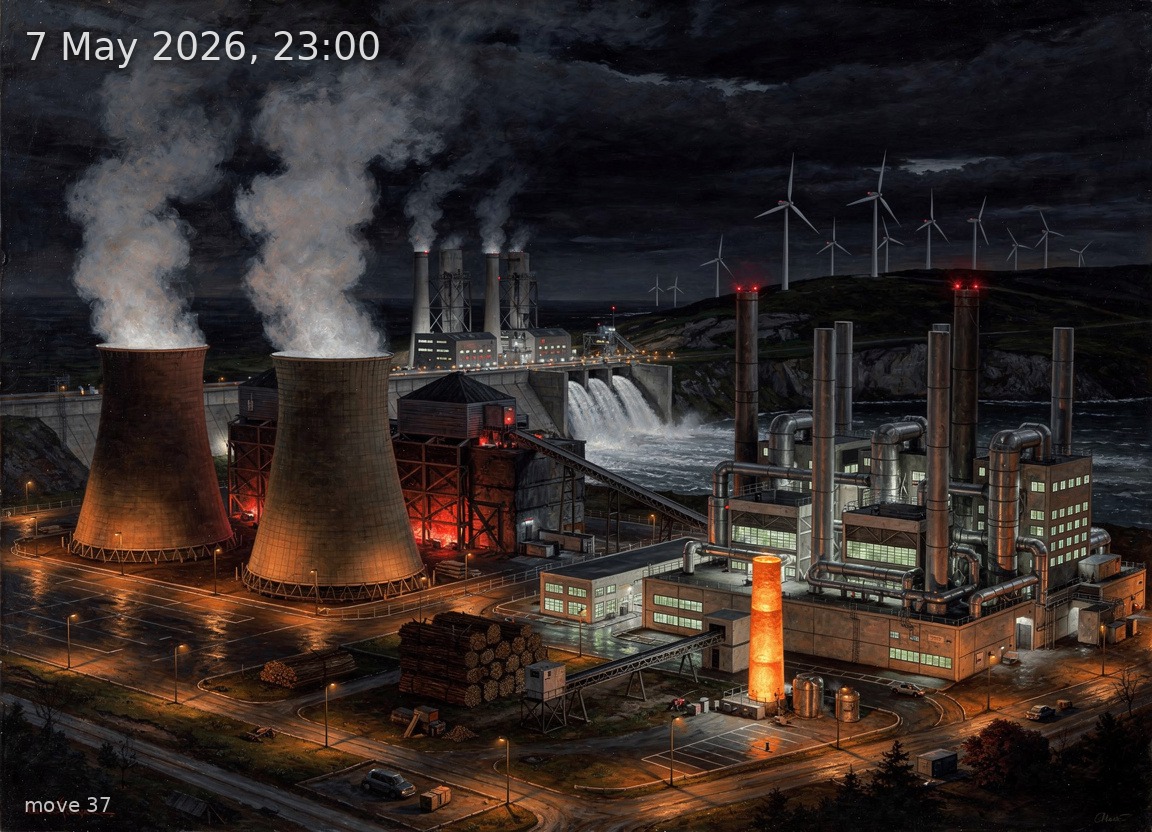
Gas and brown coal dominate overnight generation as weak wind and high imports drive prices above 140 EUR/MWh.
Back
Generation mix
Wind onshore 15%
Wind offshore 1%
Biomass 14%
Hydro 5%
Natural gas 27%
Hard coal 12%
Brown coal 27%
35%
Renewable share
5.2 GW
Wind (on + offshore)
0.0 GW
Solar
32.3 GW
Total generation
-16.0 GW
Net import
142.8 €/MWh
Day-ahead price
8.3°C / 6 km/h
Temp / Wind speed
Open-Meteo, Kassel (51.3°N 9.5°E)
100.0% / 0.0 W/m²
Cloud cover / Radiation
439
gCO₂/kWh
Image prompt
Natural gas 8.7 GW dominates the centre-right as a cluster of compact CCGT power plants with tall single exhaust stacks venting pale heat shimmer into the darkness; brown coal 8.6 GW occupies the centre-left as massive hyperbolic cooling towers with thick white steam plumes billowing upward, lit from below by orange sodium lamps; onshore wind 4.8 GW appears as a row of three-blade turbines on a distant ridge, their rotors turning slowly, each nacelle marked by a blinking red aviation light; biomass 4.4 GW is rendered as a mid-sized industrial facility with a wood-chip conveyor and a single smokestack glowing warmly; hard coal 3.8 GW sits behind the brown coal plant as a second, slightly smaller group of cooling towers and a visible coal bunker structure; hydro 1.5 GW appears as a concrete dam with illuminated spillway in the far background valley; offshore wind 0.4 GW is a faint silhouette of two turbines on a distant dark horizon line. The scene is set at 23:00 — completely dark, black sky with total cloud cover obscuring all stars and moon, no twilight whatsoever. The only illumination comes from industrial sodium-vapour streetlights casting harsh orange pools on wet asphalt, the red glow of furnace mouths, blinking red turbine lights, and the pale fluorescent glow from plant control-room windows. The atmosphere is heavy and oppressive, reflecting high electricity prices — low clouds press down on the steam plumes, trapping them close to the ground. Temperature is a cool 8°C in early May: fresh green foliage on scattered birch and linden trees at the margins, damp spring grass glistening in the artificial light. Wind is nearly calm at 5.9 km/h — smoke and steam rise almost vertically. High-voltage transmission pylons recede into the murk, carrying imported power. Style: highly detailed oil painting in the tradition of 19th-century German Romantic landscape painters — rich, dark palette of deep navy, burnt sienna, ochre, and charcoal grey — visible impasto brushwork, atmospheric sfumato in the steam and cloud layers, meticulous engineering detail on every turbine nacelle, cooling tower, and exhaust stack. No text, no labels.