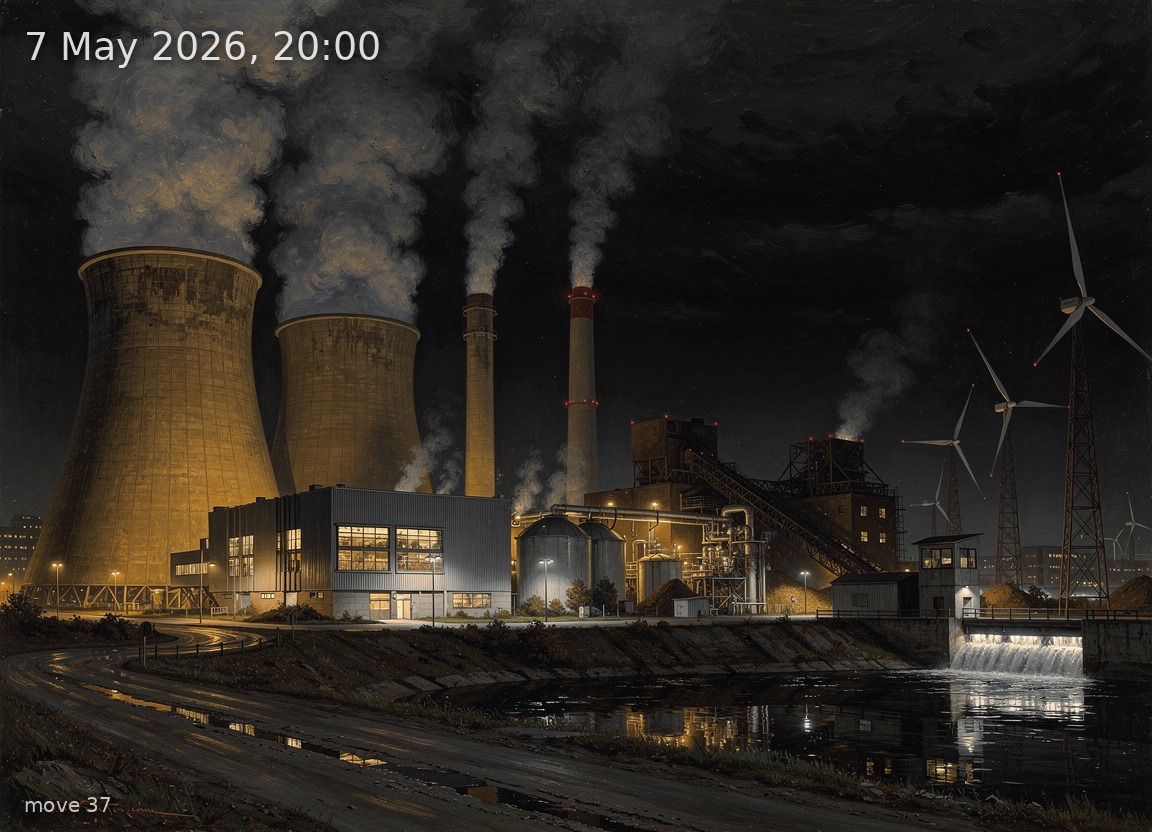
Lignite, gas, and coal dominate domestic generation as large net imports fill a 26 GW gap at nightfall.
Back
Generation mix
Wind onshore 11%
Wind offshore 1%
Solar 2%
Biomass 15%
Hydro 5%
Natural gas 27%
Hard coal 12%
Brown coal 27%
34%
Renewable share
3.8 GW
Wind (on + offshore)
0.5 GW
Solar
31.2 GW
Total generation
-26.2 GW
Net import
221.5 €/MWh
Day-ahead price
8.9°C / 9 km/h
Temp / Wind speed
Open-Meteo, Kassel (51.3°N 9.5°E)
100.0% / 0.0 W/m²
Cloud cover / Radiation
446
gCO₂/kWh
Image prompt
Brown coal 8.5 GW dominates the left third of the scene as a cluster of massive hyperbolic cooling towers with thick white-grey steam plumes rising into the black night sky, lit from below by amber sodium lights revealing their concrete ribbing. Natural gas 8.3 GW fills the centre-left as a row of compact CCGT power plants with tall single exhaust stacks emitting thin heat shimmer, their rectangular turbine halls glowing with warm interior light through high windows. Hard coal 3.8 GW appears centre-right as a dark industrial complex with conveyor belts, coal bunkers, and a single wide chimney with a faint red aviation light. Biomass 4.6 GW is rendered in the middle ground as a cluster of medium-scale wood-chip combustion plants with domed storage silos and modest stacks trailing wispy smoke, illuminated by floodlights. Onshore wind 3.6 GW occupies the right quarter as a line of tall three-blade turbines on lattice towers, their rotors turning slowly in light wind, red warning lights blinking on each nacelle against the darkness. Hydro 1.6 GW appears as a small concrete dam and powerhouse at far right with illuminated spillway. The sky is completely black, 100% overcast — no stars, no moon, no twilight glow — a heavy oppressive ceiling of invisible cloud pressing down, conveying the extreme price pressure. The season is early May but the 8.9°C chill shows in mist pooling in low ground between the facilities. Fresh green spring foliage on scattered birch and beech trees is barely visible under the industrial sodium and LED lighting. High-voltage transmission pylons recede into the dark background toward the borders, their cables sagging under heavy current, representing the enormous import flow. The foreground is a damp rural road with puddles reflecting the amber glow of the power stations. Highly detailed oil painting in the tradition of 19th-century German Romantic landscape painters — rich, dark palette of deep navy, burnt sienna, and ochre — with visible impasto brushwork, atmospheric depth, and meticulous engineering accuracy on every turbine nacelle, cooling tower, and exhaust stack. No text, no labels.