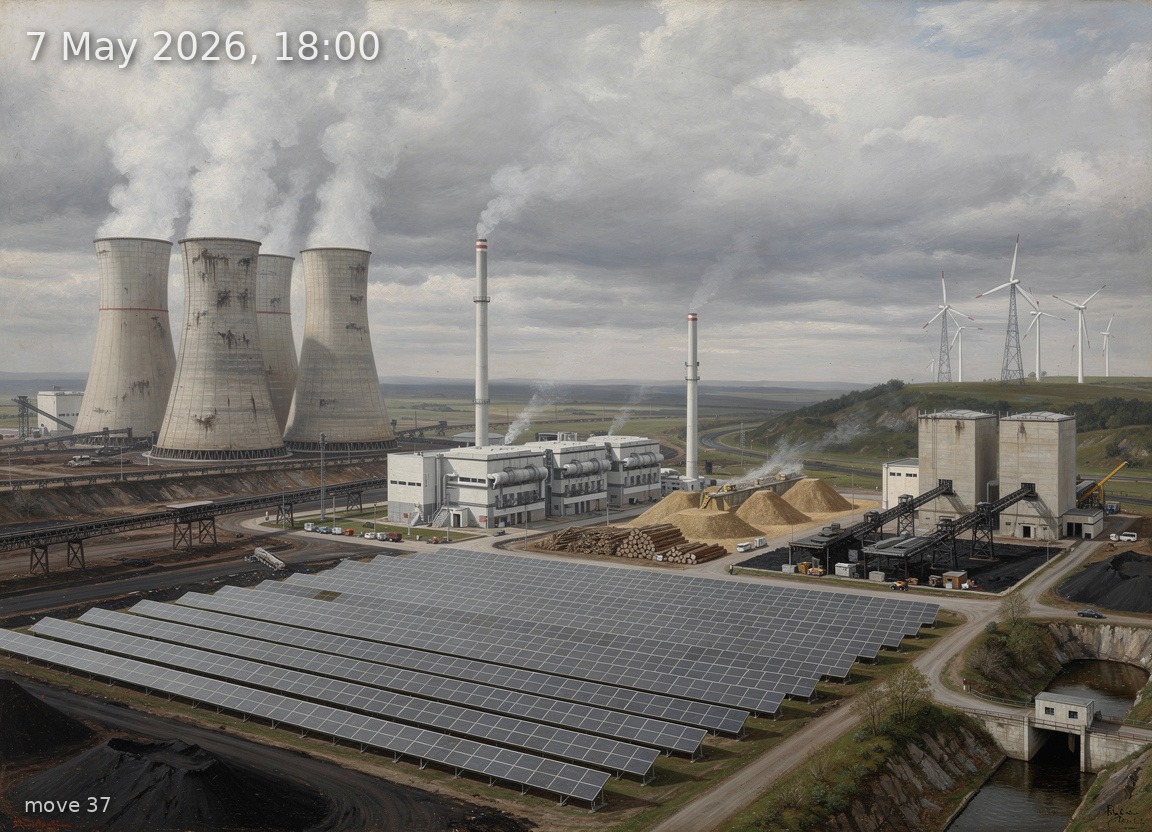
Brown coal and gas dominate as overcast skies and light winds force heavy thermal dispatch and 21 GW net imports.
Back
Generation mix
Wind onshore 9%
Wind offshore 1%
Solar 24%
Biomass 11%
Hydro 4%
Natural gas 19%
Hard coal 10%
Brown coal 22%
49%
Renewable share
3.7 GW
Wind (on + offshore)
9.0 GW
Solar
38.0 GW
Total generation
-21.3 GW
Net import
148.7 €/MWh
Day-ahead price
9.2°C / 10 km/h
Temp / Wind speed
Open-Meteo, Kassel (51.3°N 9.5°E)
100.0% / 6.0 W/m²
Cloud cover / Radiation
349
gCO₂/kWh
Image prompt
Brown coal 8.2 GW dominates the left third of the scene as a cluster of massive hyperbolic cooling towers with thick white steam plumes rising into heavy overcast sky, surrounded by conveyor belts and lignite stockpiles; natural gas 7.4 GW occupies the centre-left as three compact CCGT power blocks with tall single exhaust stacks emitting thin heat shimmer; solar 9.0 GW spans the centre as a wide field of aluminium-framed crystalline silicon photovoltaic panels angled on racks, their surfaces dull grey reflecting only diffuse cloud light with no sunshine; biomass 4.3 GW appears centre-right as a wood-chip-fed power station with a modest smokestack and timber storage yard; hard coal 3.9 GW sits to the right as a coal-fired plant with a pair of large rectangular cooling towers and coal conveyors; wind onshore 3.5 GW is represented by a small cluster of three-blade turbines on lattice and tubular towers in the far right background, blades turning slowly in light wind; hydro 1.6 GW appears as a small concrete dam and penstock visible in a valley at far right edge. The sky is completely overcast, a low oppressive blanket of uniform grey-white stratus at 18:00 in May—dusk light: a narrow band of fading orange-red glow along the lower horizon on the left, the sky above darkening rapidly to slate grey and deep blue-grey overhead, all natural light indirect and diffuse. Temperature is cool at 9°C; spring vegetation is fresh green but muted under the heavy clouds, budding deciduous trees and damp meadow grass. The atmosphere feels heavy, oppressive, and expensive—thick humid air presses down on the industrial landscape. Transmission lines with lattice steel pylons recede into the hazy distance, symbolising import flows. Style: highly detailed oil painting in the tradition of 19th-century German Romantic landscape painters—Caspar David Friedrich meets industrial sublime—rich sombre colour palette of greys, slate blues, warm ochre from the horizon glow, and the white of steam; visible confident brushwork with atmospheric depth and haze; meticulous engineering detail on every turbine nacelle, cooling tower curvature, PV panel frame, and smokestack. No text, no labels.