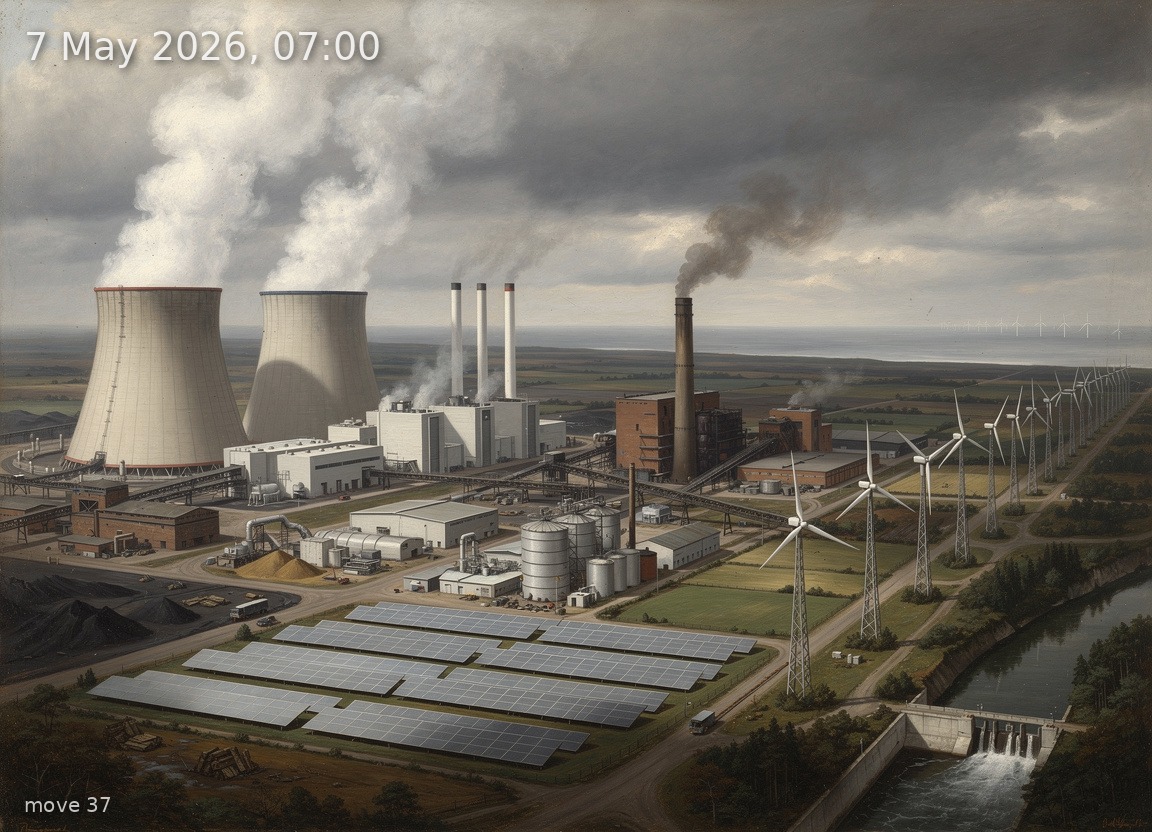
Brown coal, gas, and imports dominate as full overcast suppresses solar and a 21.5 GW import gap lifts prices.
Back
Generation mix
Wind onshore 18%
Wind offshore 2%
Solar 12%
Biomass 12%
Hydro 4%
Natural gas 20%
Hard coal 10%
Brown coal 23%
47%
Renewable share
7.6 GW
Wind (on + offshore)
4.4 GW
Solar
37.7 GW
Total generation
-21.5 GW
Net import
167.3 €/MWh
Day-ahead price
8.7°C / 14 km/h
Temp / Wind speed
Open-Meteo, Kassel (51.3°N 9.5°E)
100.0% / 0.0 W/m²
Cloud cover / Radiation
360
gCO₂/kWh
Image prompt
Brown coal 8.6 GW dominates the left third of the scene as a massive lignite power station with four hyperbolic cooling towers emitting thick white steam plumes into heavy grey air; natural gas 7.4 GW fills the centre-left as a row of combined-cycle gas turbine plants with tall single exhaust stacks venting heat shimmer; hard coal 3.9 GW appears centre-right as a traditional coal plant with rectangular boiler houses and a single large chimney trailing darker smoke; wind onshore 6.8 GW stretches across the right third of the composition as a line of modern three-blade turbines on lattice-and-tubular towers, blades turning steadily in moderate wind; wind offshore 0.8 GW is barely visible as tiny turbines on the far-right horizon over a sliver of grey sea; solar 4.4 GW is represented by large fields of aluminium-framed crystalline silicon panels in the mid-ground but they reflect only flat grey light, producing little; biomass 4.4 GW appears as a cluster of medium-sized industrial buildings with wood-chip silos and modest stacks near the centre; hydro 1.5 GW is a small concrete dam and spillway nestled in a forested valley at far right. The sky is entirely overcast at 100% cloud cover, a single oppressive blanket of dark pewter-grey stratus pressing low — no sun visible, no blue anywhere. The lighting is early dawn at 07:00 in May: a pale, diffuse blue-grey pre-dawn glow filters through the clouds from the east, barely illuminating the landscape, with no direct sunlight or warm tones. The atmosphere feels heavy and expensive — the overcast is dense and suffocating, hinting at the 167 EUR/MWh price. Temperature is a cool 8.7°C: spring vegetation is green but muted, grass damp, trees in early leaf but colours subdued under the flat light. Foreground shows ploughed fields and low hedgerows typical of central German agricultural plains. Painted in the style of a highly detailed 19th-century German Romantic oil painting — rich, layered brushwork in the tradition of Caspar David Friedrich and Carl Blechen, with atmospheric depth and mist between industrial structures, dramatic tonal contrast between the pale eastern horizon and the dark western sky, meticulous engineering detail on every turbine nacelle, cooling tower, and smokestack. No text, no labels.