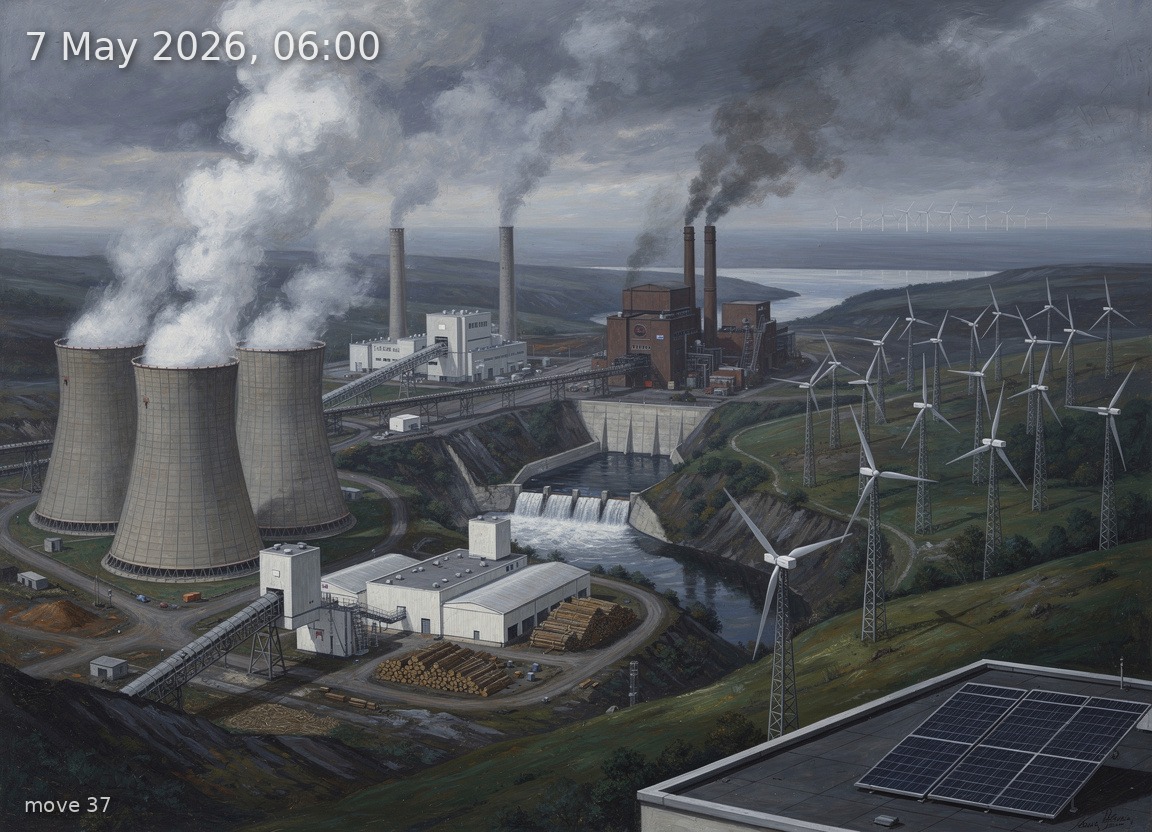
Brown coal, gas, and wind dominate as full overcast and heavy imports drive a 151 EUR/MWh morning price.
Back
Generation mix
Wind onshore 22%
Wind offshore 3%
Solar 3%
Biomass 12%
Hydro 4%
Natural gas 21%
Hard coal 11%
Brown coal 24%
44%
Renewable share
8.6 GW
Wind (on + offshore)
1.1 GW
Solar
35.1 GW
Total generation
-19.0 GW
Net import
151.0 €/MWh
Day-ahead price
8.7°C / 13 km/h
Temp / Wind speed
Open-Meteo, Kassel (51.3°N 9.5°E)
100.0% / 0.0 W/m²
Cloud cover / Radiation
384
gCO₂/kWh
Image prompt
Brown coal 8.5 GW dominates the left third of the scene as a massive lignite power station with four hyperbolic cooling towers emitting thick white steam plumes; natural gas 7.4 GW occupies the centre-left as two compact CCGT units with tall single exhaust stacks venting thin grey exhaust; wind onshore 7.7 GW spans the right third as a long row of three-blade turbines on lattice towers across rolling green hills, rotors turning moderately in the breeze; hard coal 3.8 GW appears centre-right as a dark brick coal-fired plant with a pair of chimneys trailing smoke; biomass 4.2 GW is rendered as a mid-ground industrial facility with timber storage yards and a single square stack; hydro 1.4 GW appears as a small concrete dam with spillway in the far middle distance nestled in a valley; wind offshore 1.0 GW is a faint cluster of turbines barely visible on a grey horizon line beyond a sliver of North Sea; solar 1.1 GW is represented only by a few aluminium-framed crystalline PV panels on a rooftop near the foreground, their surfaces dull and reflectionless under the overcast. Time is early dawn at 06:00 in May — the sky is deep blue-grey with the faintest pale luminescence along the eastern horizon, no direct sun visible, no warm tones, only cold pre-dawn half-light. The sky is entirely blanketed in 100% low stratus cloud, heavy and oppressive, pressing down on the landscape to evoke the high electricity price. Temperature is 8.7°C in spring — fresh green grass and budding deciduous trees but with a raw, chilly dampness; patches of morning mist cling to the valleys. Wind is moderate, bending young leaves and rippling puddles. High-voltage transmission pylons with bundled conductors march across the midground, symbolising the massive import flows. Style: highly detailed oil painting in the tradition of 19th-century German Romantic landscape art — Caspar David Friedrich meets industrial sublime — rich dark blues, steel greys, and muted greens with visible impasto brushwork, atmospheric depth achieved through layered mist and receding ridgelines, meticulous engineering detail on every turbine nacelle, cooling tower fluting, and transformer yard. No text, no labels.