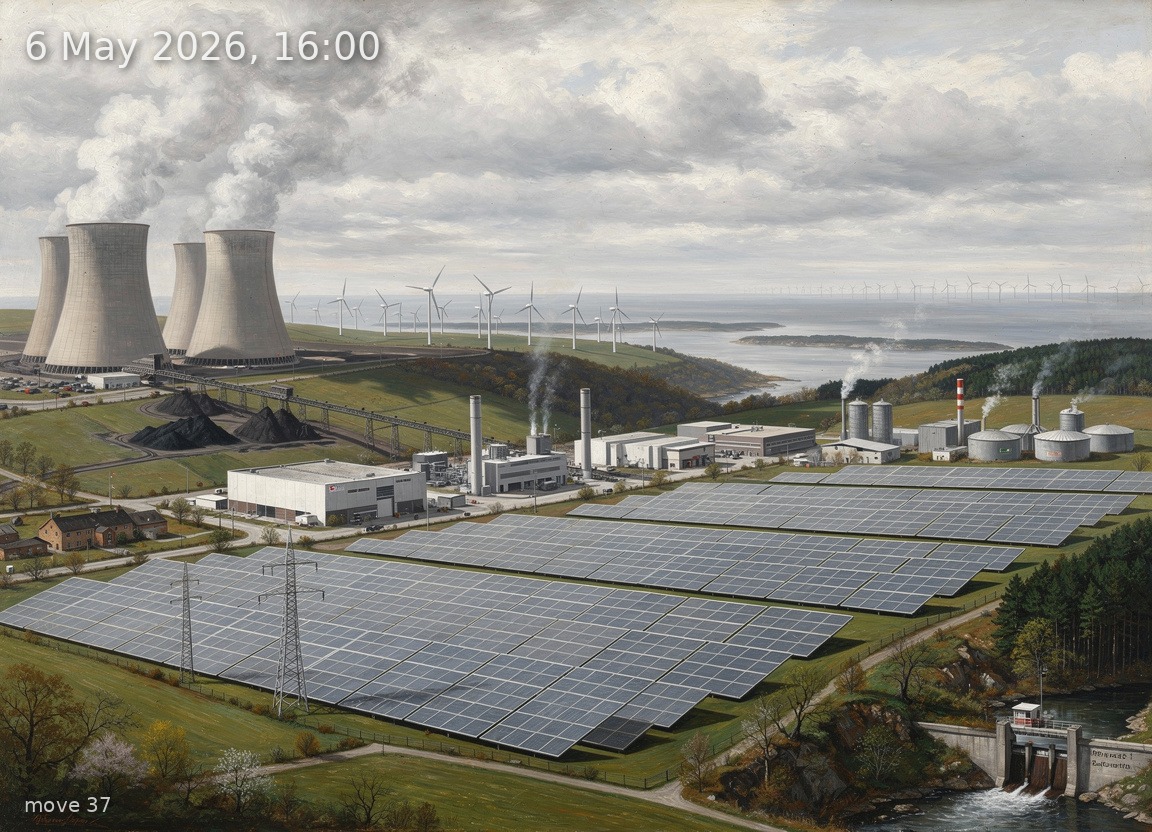
Overcast solar leads at 16.6 GW alongside 12.5 GW wind, but 9.9 GW net imports fill the consumption gap.
Back
Generation mix
Wind onshore 19%
Wind offshore 7%
Solar 34%
Biomass 8%
Hydro 3%
Natural gas 7%
Hard coal 7%
Brown coal 15%
71%
Renewable share
12.6 GW
Wind (on + offshore)
16.6 GW
Solar
49.3 GW
Total generation
-9.9 GW
Net import
112.7 €/MWh
Day-ahead price
13.2°C / 11 km/h
Temp / Wind speed
Open-Meteo, Kassel (51.3°N 9.5°E)
99.0% / 39.0 W/m²
Cloud cover / Radiation
212
gCO₂/kWh
Image prompt
Solar 16.6 GW dominates the centre-right as vast fields of aluminium-framed crystalline silicon PV panels stretching across gently rolling farmland, their surfaces reflecting flat grey light; brown coal 7.6 GW occupies the left quarter as a cluster of massive hyperbolic cooling towers with thick white-grey steam plumes merging into the overcast sky, flanked by conveyor belts carrying dark lignite; wind onshore 9.2 GW appears as dozens of three-blade turbines on lattice and tubular towers scattered across the mid-ground hills, blades slowly rotating in moderate wind; wind offshore 3.3 GW is visible far in the background as a row of turbines on the hazy horizon above a distant grey sea inlet; natural gas 3.6 GW stands as two compact CCGT plants with tall single exhaust stacks and thin heat shimmer; hard coal 3.3 GW appears as a single large power station with square cooling towers and a coal stockyard; biomass 4.1 GW is rendered as several smaller industrial facilities with rounded silos and modest chimneys trailing pale smoke; hydro 1.6 GW is a small dam and powerhouse nestled in a forested valley at the far right edge. The sky is entirely overcast at 99% cloud cover — a uniform, heavy, oppressive ceiling of pale grey-white stratus pressing down, no blue visible, no direct sunlight, only diffuse flat daylight consistent with 16:00 afternoon. The atmosphere feels thick and weighty, conveying the high electricity price. Spring vegetation is fresh green — young leaves on birch and beech trees, bright grass — at 13°C mild temperature. The landscape is a panoramic German lowland-to-upland transition. Highly detailed oil painting in the tradition of 19th-century German Romantic landscape painters — rich saturated colour in the greens and industrial greys, visible confident brushwork, deep atmospheric perspective with layers of haze between foreground coal infrastructure and distant wind turbines. Each technology rendered with meticulous engineering accuracy: turbine nacelles with three-blade rotors, PV panel grid patterns, cooling tower parabolic curves, CCGT exhaust geometry. The mood is sombre, industrious, heavy but not menacing — a working landscape under a leaden spring sky. No text, no labels.