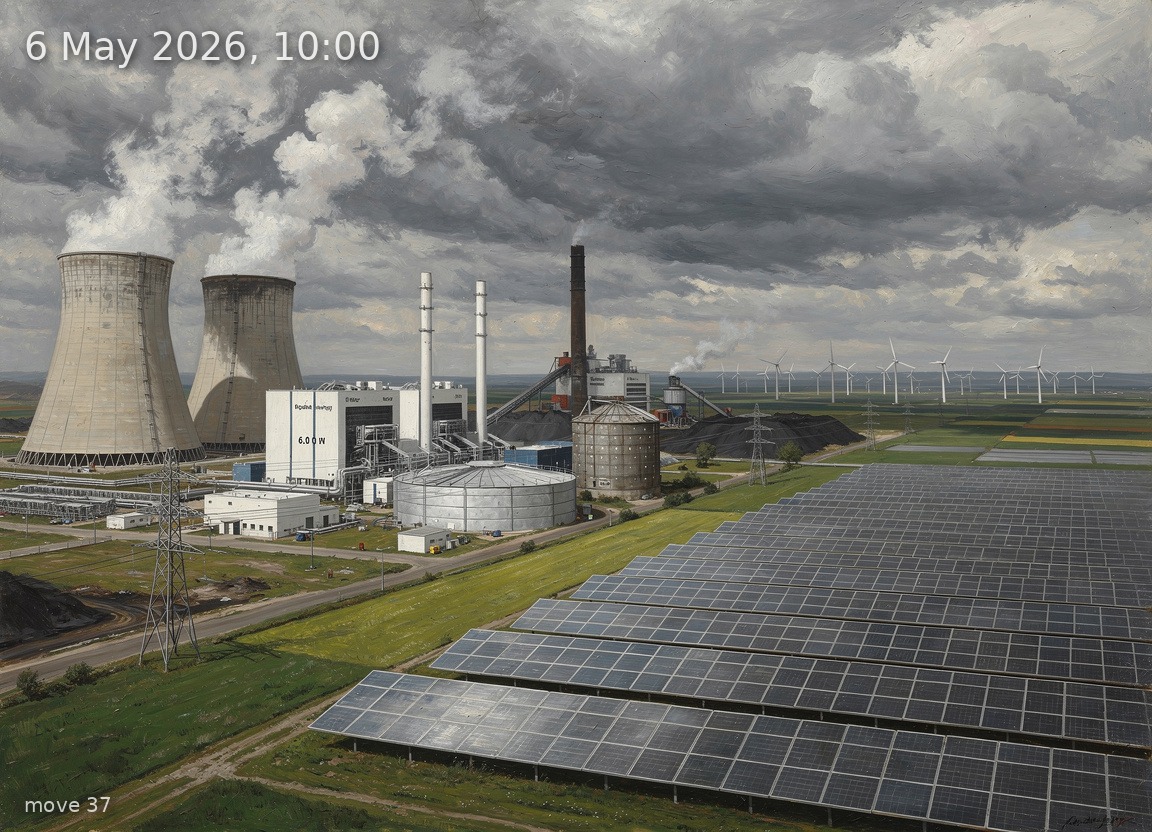
Overcast skies limit solar yield; wind, brown coal, and gas collectively meet a 65 GW spring demand.
Back
Generation mix
Wind onshore 19%
Wind offshore 6%
Solar 34%
Biomass 7%
Hydro 3%
Natural gas 10%
Hard coal 6%
Brown coal 14%
70%
Renewable share
15.0 GW
Wind (on + offshore)
20.5 GW
Solar
59.8 GW
Total generation
-5.3 GW
Net import
108.8 €/MWh
Day-ahead price
14.3°C / 14 km/h
Temp / Wind speed
Open-Meteo, Kassel (51.3°N 9.5°E)
100.0% / 17.0 W/m²
Cloud cover / Radiation
213
gCO₂/kWh
Image prompt
Brown coal 8.4 GW dominates the left quarter of the scene as a sprawling lignite power complex with four massive hyperbolic cooling towers emitting thick white steam plumes into the heavy sky; natural gas 6.0 GW occupies the centre-left as two modern combined-cycle gas turbine units with tall slender exhaust stacks and visible heat shimmer; hard coal 3.9 GW appears behind them as a classical coal plant with a single large smokestack and conveyor belts; solar 20.5 GW fills the entire right third and middle ground as vast fields of aluminium-framed crystalline silicon PV panels stretching across flat farmland, their surfaces reflecting only dull grey diffuse light under the overcast; wind onshore 11.6 GW spans the background as dozens of three-blade turbines on lattice and tubular towers turning steadily in moderate wind across rolling green hills; wind offshore 3.4 GW appears as a distant row of offshore turbines on the far horizon; biomass 4.4 GW is a medium-sized wood-fired plant with a rounded storage silo and thin wisp of exhaust near the centre; hydro 1.6 GW is a small run-of-river station with water cascading over a weir at the far right edge. Time is 10:00 AM in May: full daylight but completely overcast — the entire sky is a uniform, heavy, oppressive blanket of dense stratiform cloud in muted pewter-grey tones with no blue visible, light is flat and shadowless. The atmosphere feels heavy and close, befitting a high electricity price. Spring vegetation is lush bright green — beech and birch trees in fresh leaf, meadow grass tall — temperature around 14°C giving cool dampness. Moderate wind bends grasses and turns turbine blades at steady pace. Highly detailed oil painting in the tradition of 19th-century German Romantic landscape painters — rich saturated colour with visible impasto brushwork, atmospheric depth and aerial perspective, meticulous engineering accuracy on every turbine nacelle, panel frame, cooling tower contour, and smokestack rivet. The composition balances industrial grandeur with the vast pastoral plain, evoking Caspar David Friedrich's sense of sublime scale but applied to modern energy infrastructure. No text, no labels.