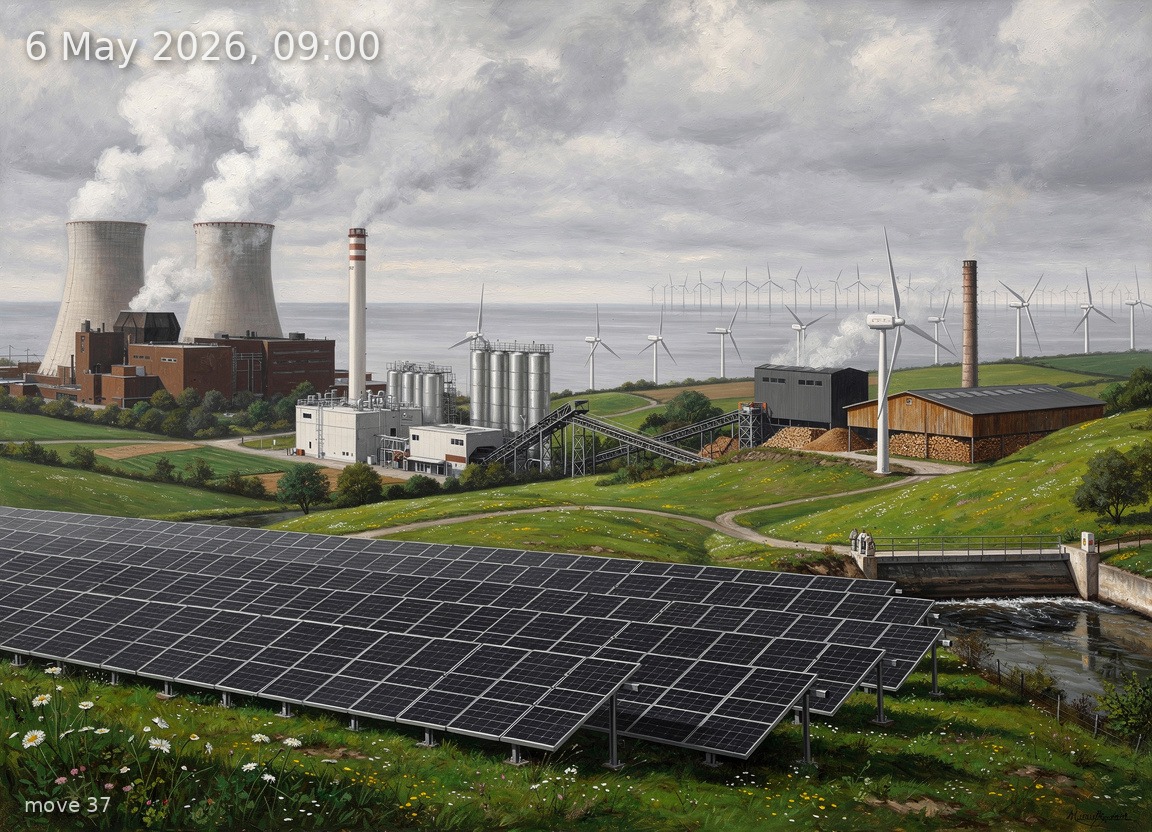
Wind and solar lead at 67% renewable share, but 8.6 GW net imports needed under heavy overcast skies.
Back
Generation mix
Wind onshore 21%
Wind offshore 6%
Solar 29%
Biomass 8%
Hydro 3%
Natural gas 11%
Hard coal 7%
Brown coal 15%
67%
Renewable share
15.6 GW
Wind (on + offshore)
16.1 GW
Solar
56.4 GW
Total generation
-8.6 GW
Net import
121.3 €/MWh
Day-ahead price
13.6°C / 14 km/h
Temp / Wind speed
Open-Meteo, Kassel (51.3°N 9.5°E)
86.0% / 10.0 W/m²
Cloud cover / Radiation
228
gCO₂/kWh
Records
#2
Dead Calm
Image prompt
Solar 16.1 GW fills the near foreground as vast fields of aluminium-framed crystalline silicon PV panels stretching across flat farmland, their surfaces reflecting only grey diffuse light under dense overcast; wind onshore 12.0 GW dominates the middle distance as dozens of tall three-blade turbines on lattice and tubular towers, rotors turning steadily in moderate wind across rolling green spring hills; wind offshore 3.6 GW appears as a cluster of turbines on the far horizon above a faint grey sea line; brown coal 8.4 GW occupies the left quarter as a massive lignite power station with three hyperbolic cooling towers emitting thick white steam plumes that merge into the low cloud ceiling; natural gas 6.3 GW stands centre-left as a compact CCGT plant with tall slender exhaust stacks releasing thin heat shimmer; hard coal 3.9 GW sits behind the gas plant as a smaller conventional station with a single rectangular cooling tower and conveyor belts; biomass 4.4 GW appears as a medium timber-clad biomass facility with a modest chimney and stacked wood-chip storage, positioned at centre-right; hydro 1.6 GW is rendered as a small concrete run-of-river weir with turbine house visible along a river in the right foreground. Full daytime at 09:00 but the sky is 86% overcast—a heavy, uniform layer of stratus clouds in silver-grey and lead tones creating flat, shadowless illumination across the landscape. Spring vegetation: fresh bright-green deciduous foliage, dandelions and wildflowers in meadows, temperature around 14°C suggested by light jackets on two distant workers. The atmosphere feels heavy and oppressive reflecting the high 121.3 EUR/MWh price—the air is thick, humid, the clouds press down close to the cooling tower plumes. Highly detailed oil painting in the tradition of 19th-century German Romantic landscape painters—Caspar David Friedrich's atmospheric depth combined with Adolph Menzel's industrial precision—rich colour palette of greens, greys, and muted whites, visible confident brushwork, atmospheric aerial perspective fading the offshore turbines into haze. Each technology rendered with meticulous engineering accuracy: turbine nacelles with correct proportions, PV panel grid patterns, cooling tower parabolic curves, CCGT exhaust geometry. No text, no labels.