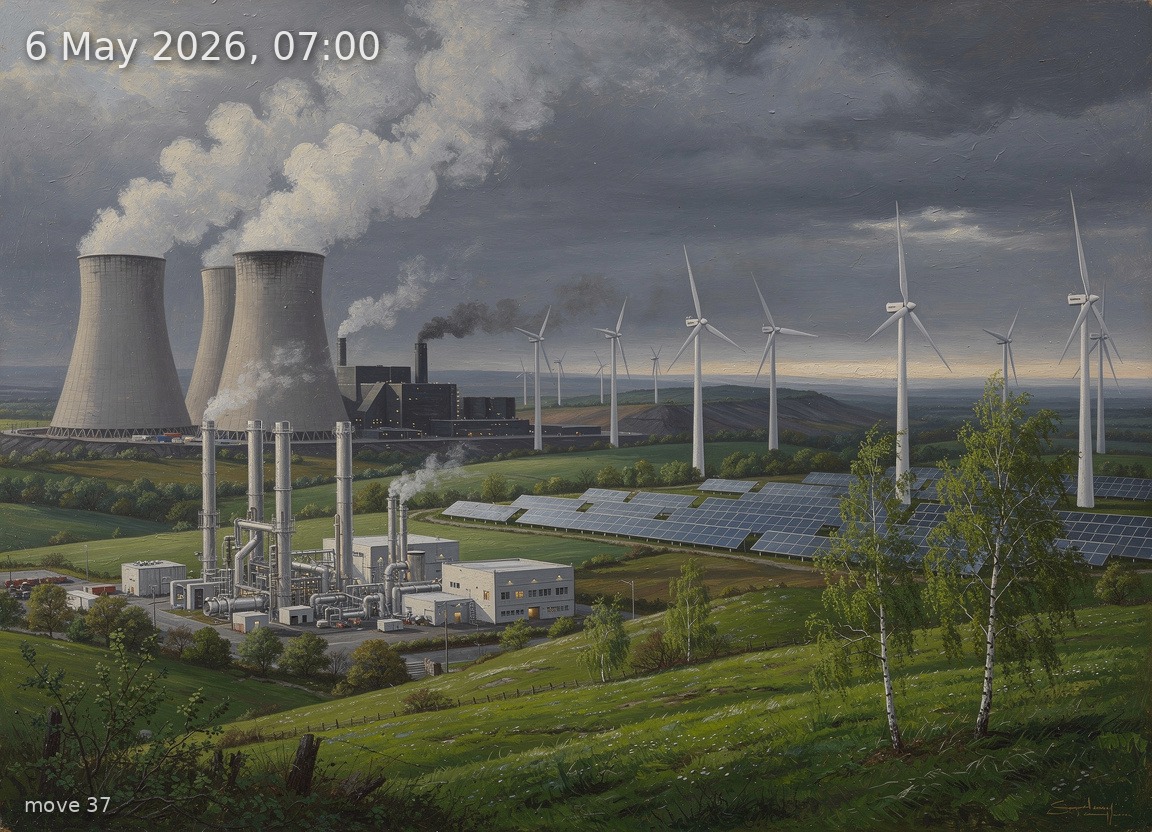
Wind leads at 17.9 GW but full overcast and 13.8 GW net imports keep coal and gas firmly dispatched.
Back
Generation mix
Wind onshore 29%
Wind offshore 9%
Solar 11%
Biomass 9%
Hydro 3%
Natural gas 13%
Hard coal 8%
Brown coal 18%
61%
Renewable share
17.9 GW
Wind (on + offshore)
5.0 GW
Solar
47.4 GW
Total generation
-13.8 GW
Net import
142.4 €/MWh
Day-ahead price
12.3°C / 15 km/h
Temp / Wind speed
Open-Meteo, Kassel (51.3°N 9.5°E)
100.0% / 0.0 W/m²
Cloud cover / Radiation
271
gCO₂/kWh
Image prompt
Wind onshore 13.9 GW dominates the right half of the canvas as dozens of tall three-blade turbines with white tubular towers and detailed nacelles stretching across rolling green spring fields; brown coal 8.5 GW occupies the left quarter as a massive lignite power station with three hyperbolic cooling towers emitting thick white steam plumes into the grey sky; natural gas 6.2 GW appears left-centre as a compact CCGT plant with tall slender exhaust stacks and smaller rectangular buildings with visible heat-recovery steam generators; solar 5.0 GW is represented in the mid-ground as rows of aluminium-framed crystalline silicon panels on a hillside, but reflecting only dull grey light—no sunshine; hard coal 3.9 GW sits behind the gas plant as a dark industrial block with a single large stack trailing thin smoke; wind offshore 4.0 GW is visible in the far background as a row of turbines standing in a distant hazy sea glimpsed through a gap between hills; biomass 4.4 GW appears as a mid-sized wood-fired plant with a conical chip silo and modest chimney emitting pale vapour near the centre-right; hydro 1.6 GW is a small run-of-river weir with white spillway water in the foreground stream. Time is early dawn at 07:00 in May: the sky is deep blue-grey with the faintest pale light along the eastern horizon, no direct sun visible, the entire sky covered by a thick unbroken 100% overcast layer pressing low and heavy, creating an oppressive atmosphere reflecting the 142 EUR/MWh price. Temperature is 12°C so spring vegetation is fresh and green but dewy; moderate wind at 14.7 km/h visibly sways the grass and young birch trees. High-voltage transmission pylons with bundled conductors cross the scene diagonally, symbolising the import flows. Rendered as a highly detailed oil painting in the tradition of 19th-century German Romantic landscape painters—rich, sombre colour palette of slate grey, moss green, ivory steam, and iron black, with visible impasto brushwork, atmospheric aerial perspective fading the offshore turbines into mist, and meticulous engineering accuracy on every nacelle, cooling tower, and panel frame. No text, no labels.