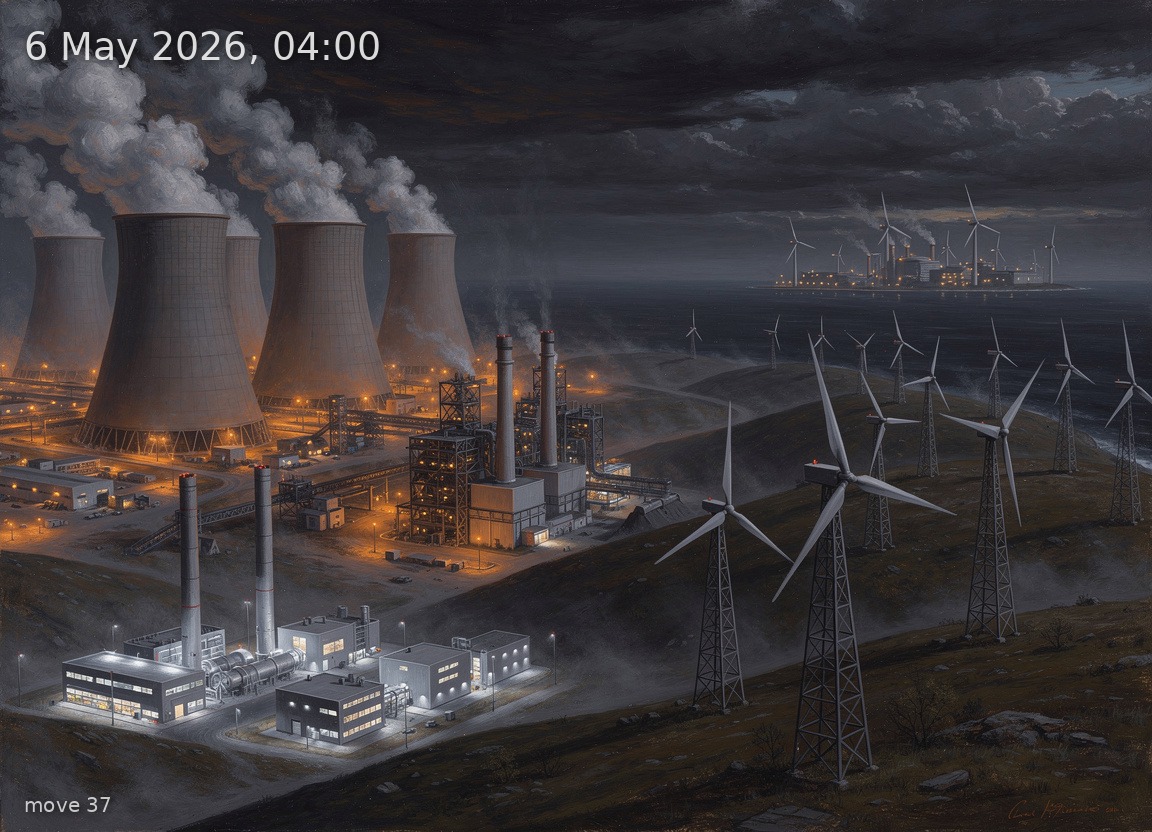
Wind leads at 17.7 GW with lignite and gas supporting; zero solar and 4.1 GW net imports at pre-dawn.
Back
Generation mix
Wind onshore 35%
Wind offshore 8%
Biomass 10%
Hydro 4%
Natural gas 14%
Hard coal 9%
Brown coal 20%
56%
Renewable share
17.7 GW
Wind (on + offshore)
0.0 GW
Solar
41.6 GW
Total generation
-4.0 GW
Net import
113.3 €/MWh
Day-ahead price
12.2°C / 12 km/h
Temp / Wind speed
Open-Meteo, Kassel (51.3°N 9.5°E)
100.0% / 0.0 W/m²
Cloud cover / Radiation
306
gCO₂/kWh
Image prompt
Wind onshore 14.4 GW dominates the right half of the scene as dozens of three-blade turbines on lattice towers stretching across rolling hills, rotors visibly turning in moderate wind; wind offshore 3.3 GW appears as a distant cluster of larger turbines on the far-right horizon above a dark sea. Brown coal 8.5 GW occupies the left quarter as massive hyperbolic cooling towers emitting thick white steam plumes, lit from below by orange sodium lamps of an industrial complex. Natural gas 5.9 GW fills the centre-left as a row of compact CCGT power plants with tall single exhaust stacks venting thin heat shimmer. Hard coal 3.8 GW appears beside the lignite plant as a smaller set of rectangular boiler houses with twin chimneys and coal conveyors. Biomass 4.1 GW is rendered as a mid-ground cluster of medium-sized industrial buildings with wood-chip silos and modest stacks with faintly lit emissions. Hydro 1.6 GW is a small dam and powerhouse nestled in a valley at the far centre, with water glinting under artificial light. Time is 04:00 — complete darkness, black sky with no twilight, no stars visible through total cloud cover; heavy overcast pressing low. All structures are illuminated only by warm sodium-orange and cool LED-white industrial lighting, casting pools of amber glow on wet spring grass and budding deciduous trees at roughly 12°C — lush early-May vegetation. The atmosphere is heavy and oppressive, reflecting the high electricity price: thick low clouds seem to weigh on the landscape, mist clings between cooling towers. No solar panels anywhere. Highly detailed oil painting in the tradition of 19th-century German Romantic landscape painters — rich, dark palette of deep navy, burnt umber, ochre, and slate grey — visible impasto brushwork, atmospheric depth with layers of industrial haze and fog, meticulous engineering detail on turbine nacelles, cooling tower parabolic profiles, CCGT exhaust geometry, and coal conveyor structures. The scene evokes Caspar David Friedrich's sublime darkness fused with industrial realism. No text, no labels.