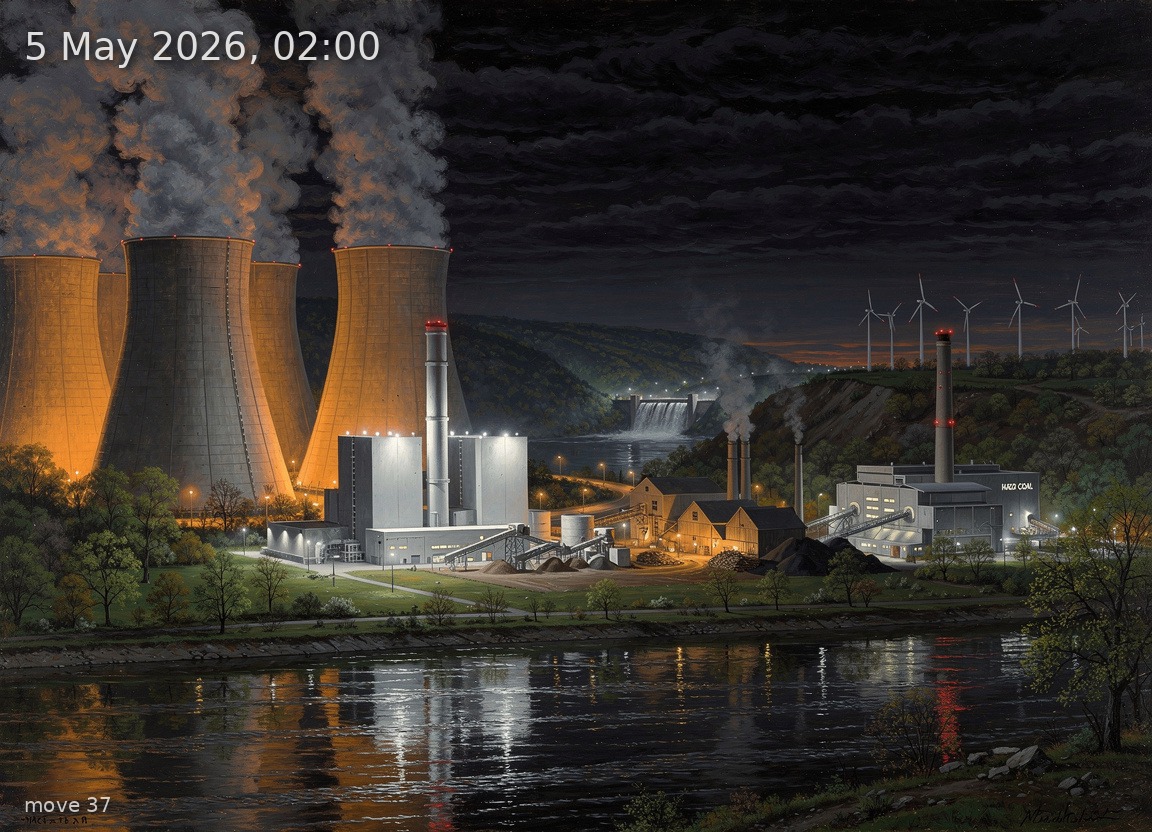
Brown coal and gas dominate overnight generation while 17 GW of net imports cover a wide supply gap under calm, overcast skies.
Back
Generation mix
Wind onshore 11%
Wind offshore 1%
Biomass 15%
Hydro 5%
Natural gas 23%
Hard coal 14%
Brown coal 31%
32%
Renewable share
3.3 GW
Wind (on + offshore)
0.0 GW
Solar
27.2 GW
Total generation
-17.3 GW
Net import
122.1 €/MWh
Day-ahead price
12.8°C / 3 km/h
Temp / Wind speed
Open-Meteo, Kassel (51.3°N 9.5°E)
100.0% / 0.0 W/m²
Cloud cover / Radiation
471
gCO₂/kWh
Image prompt
Brown coal 8.5 GW dominates the left third of the scene as a cluster of massive hyperbolic cooling towers with thick white-grey steam plumes billowing upward into the black overcast sky, their concrete shells lit by orange sodium floodlights at their bases; natural gas 6.2 GW fills the centre-left as two compact CCGT power blocks with tall single exhaust stacks emitting thin heat shimmer, illuminated by harsh industrial spotlights; biomass 4.1 GW appears centre-right as a group of smaller industrial buildings with wood-chip conveyors and squat chimneys releasing faint grey smoke, warmly lit by amber security lighting; hard coal 3.7 GW sits to the right as a coal-fired station with a single large stack and visible coal bunkers under floodlight; wind onshore 3.1 GW is represented by a sparse row of three-blade turbines on a distant ridge to the far right, their red aviation warning lights blinking faintly, rotors nearly still in the calm air; hydro 1.4 GW appears as a small illuminated dam structure nestled in a valley in the far background; wind offshore 0.2 GW is a barely visible pair of turbines on the extreme far-right horizon. The sky is completely dark — deep black-navy, no twilight, no moon, full 100% cloud cover forming a low oppressive ceiling that reflects the orange industrial glow from below. The atmosphere is heavy and humid at 12.8°C, with spring vegetation — fresh green grass and leafing deciduous trees — visible only where caught by artificial light pools. A wide river in the foreground reflects the sodium-orange and white industrial lights. Overhead high-voltage transmission lines on lattice pylons cross the scene, symbolising the massive import flows. The mood is tense and pressured, conveying the high electricity price through the oppressive low cloud base and dense industrial atmosphere. Highly detailed oil painting in the tradition of 19th-century German Romantic landscape painters — rich saturated colour, visible impasto brushwork, atmospheric depth and chiaroscuro — rendered with meticulous engineering accuracy for each power technology. No text, no labels.