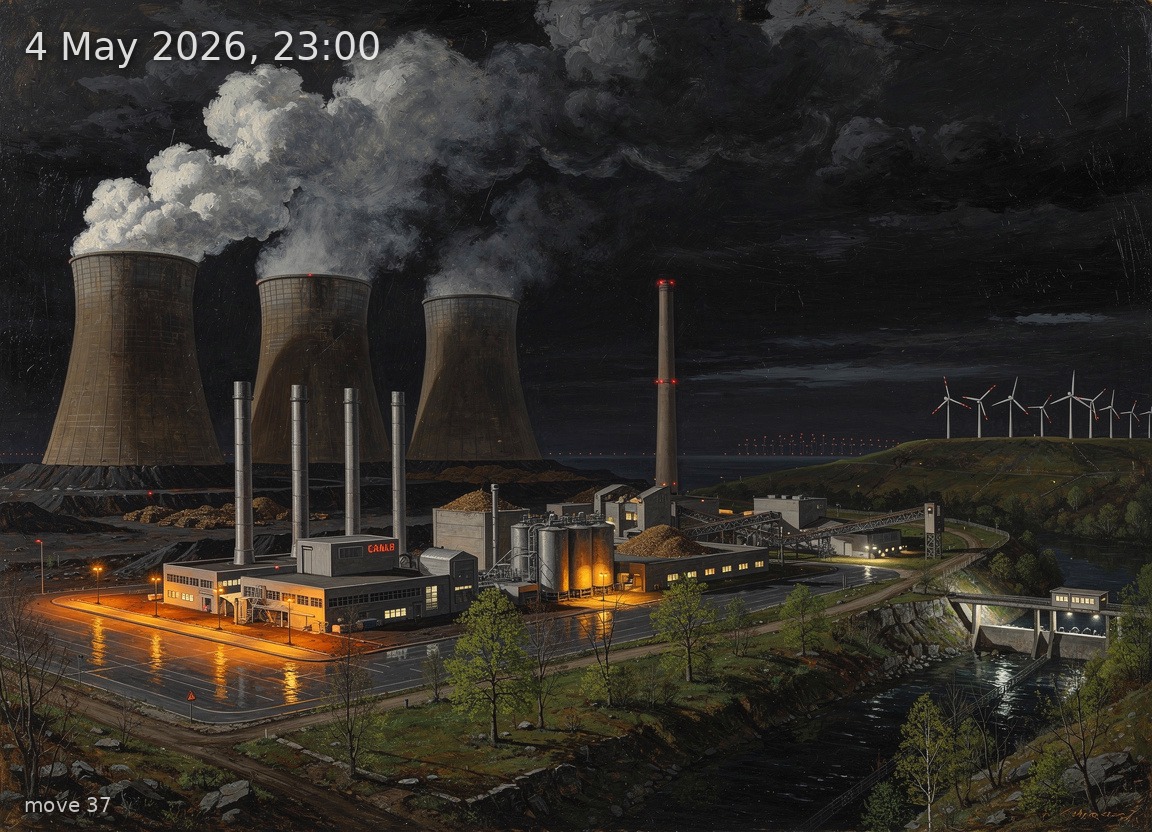
Brown coal and gas dominate a 29.2 GW domestic supply while 20.7 GW of net imports fill the late-night gap.
Back
Generation mix
Wind onshore 13%
Wind offshore 2%
Biomass 15%
Hydro 5%
Natural gas 24%
Hard coal 13%
Brown coal 29%
34%
Renewable share
4.3 GW
Wind (on + offshore)
0.0 GW
Solar
29.2 GW
Total generation
-20.7 GW
Net import
137.2 €/MWh
Day-ahead price
13.8°C / 5 km/h
Temp / Wind speed
Open-Meteo, Kassel (51.3°N 9.5°E)
98.0% / 0.0 W/m²
Cloud cover / Radiation
450
gCO₂/kWh
Image prompt
Brown coal 8.5 GW dominates the left third of the scene as a massive lignite power station with four hyperbolic cooling towers emitting thick white-grey steam plumes into the black sky; natural gas 6.9 GW occupies the centre-left as a compact CCGT facility with tall slender exhaust stacks venting heat shimmer, lit by harsh sodium-orange floodlights; biomass 4.4 GW appears centre-right as a cluster of industrial wood-chip-burning plants with rectangular silos and modest chimneys glowing amber from interior furnace light; hard coal 3.8 GW sits right of centre as a traditional coal plant with a single large smokestack and conveyor belts visible under industrial spotlights; wind onshore 3.8 GW is rendered as a sparse row of three-blade turbines on a low ridge in the far right background, their red aviation warning lights blinking against the darkness, blades barely turning in the still air; wind offshore 0.5 GW is suggested by a distant cluster of faint red dots on the far horizon line; hydro 1.4 GW appears as a small dam and powerhouse nestled in the far right valley, water faintly reflecting artificial light. The sky is completely black with 98 percent cloud cover obliterating all stars and moonlight, creating an oppressive heavy ceiling that presses down on the industrial landscape. The atmosphere is thick and humid at 13.8 degrees Celsius, with a faint green tinge of spring foliage on scattered deciduous trees barely visible in the peripheral sodium light. The mood is heavy and tense, reflecting the high electricity price — the air itself feels costly and strained. Puddles on asphalt roads reflect the orange glow of plant lighting. High-voltage transmission pylons recede into the murk toward the borders, symbolising the massive import flows. Highly detailed oil painting in the tradition of 19th-century German Romantic landscape painters — rich dark palette of umber, ochre, deep navy and furnace orange — visible impasto brushwork, dramatic chiaroscuro, atmospheric depth and industrial sublime grandeur. Meticulous engineering detail on all turbine nacelles, cooling tower parabolic profiles, CCGT stacks, and lattice transmission towers. No text, no labels.