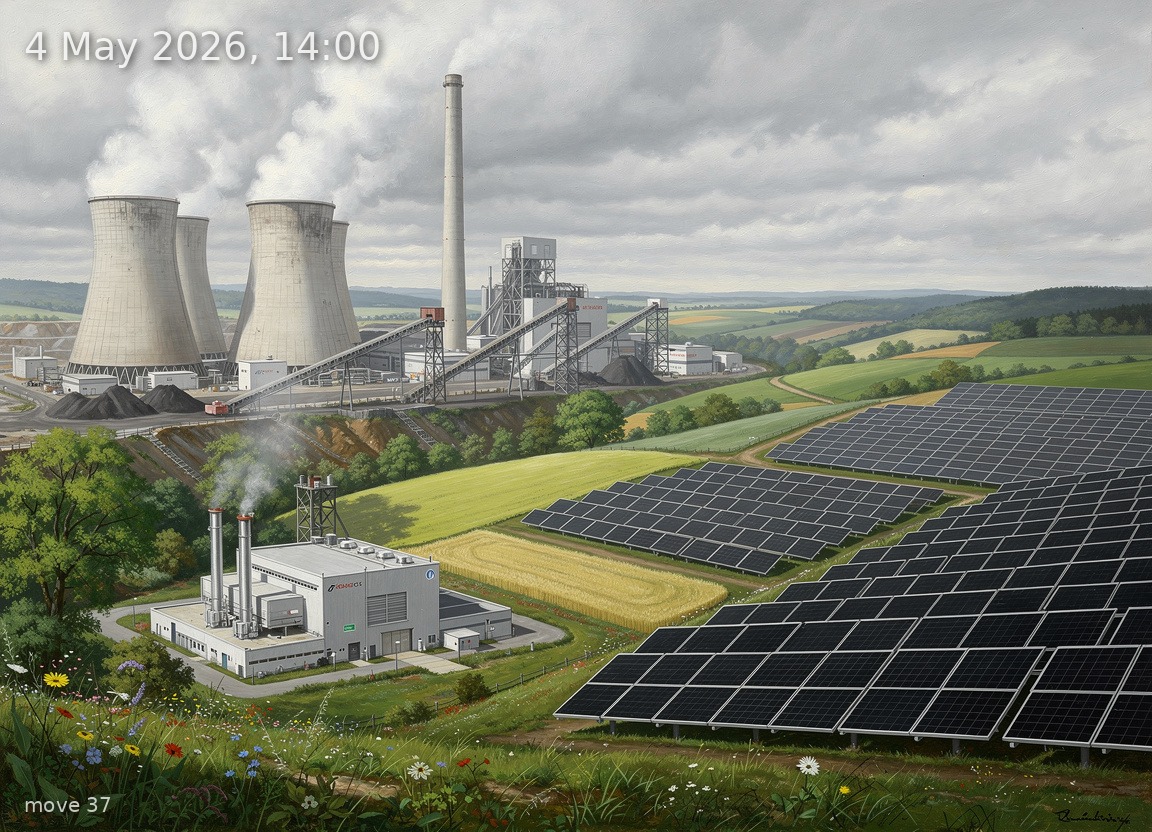
Solar leads at 34.5 GW under full overcast; coal and gas fill the gap alongside 6.4 GW net imports.
Back
Generation mix
Wind onshore 6%
Wind offshore 1%
Solar 63%
Biomass 7%
Hydro 3%
Natural gas 5%
Hard coal 6%
Brown coal 9%
80%
Renewable share
4.2 GW
Wind (on + offshore)
34.5 GW
Solar
55.1 GW
Total generation
-6.4 GW
Net import
81.1 €/MWh
Day-ahead price
21.3°C / 7 km/h
Temp / Wind speed
Open-Meteo, Kassel (51.3°N 9.5°E)
100.0% / 382.0 W/m²
Cloud cover / Radiation
145
gCO₂/kWh
Image prompt
Solar 34.5 GW dominates the right two-thirds of the scene as vast fields and rooftop arrays of aluminium-framed crystalline silicon PV panels stretching across gentle rolling hills; brown coal 4.9 GW occupies the far left as a cluster of massive hyperbolic cooling towers with thick white steam plumes rising into the overcast; hard coal 3.5 GW appears as a smaller coal-fired station with a tall smokestack and conveyor belts just left of centre; natural gas 2.8 GW is rendered as a compact CCGT plant with twin exhaust stacks emitting thin heat shimmer in the centre-left; biomass 3.9 GW appears as a mid-sized wood-chip-fed plant with a modest rectangular chimney and stacked timber beside it near the centre; hydro 1.4 GW is a small dam and spillway visible in a river valley in the middle distance; wind onshore 3.5 GW is a sparse line of five three-blade turbines on a ridge in the background, blades turning very slowly; wind offshore 0.7 GW is barely visible as two tiny turbines on the far horizon line. The sky is fully overcast with a thick, uniform layer of bright white-grey cloud at 14:00 in May — full diffuse daylight, no shadows, the atmosphere heavy and slightly oppressive suggesting the elevated 81 EUR/MWh price. Despite the overcast, the ambient light is strong and even, illuminating everything in flat, silvery tones. Temperature of 21°C is reflected in lush green late-spring vegetation — bright deciduous trees in full leaf, wildflowers in meadow edges, fresh green wheat fields around the solar arrays. Light wind barely stirs the grass. A broad German lowland landscape in Thuringia or Saxony-Anhalt. Style: highly detailed oil painting in the tradition of 19th-century German Romantic landscape painters — Caspar David Friedrich meets industrial modernity — rich colour palette of greens, greys, and muted whites, visible confident brushwork, atmospheric depth and aerial perspective, meticulous engineering detail on every turbine nacelle, PV module, cooling tower, and smokestack. No text, no labels.