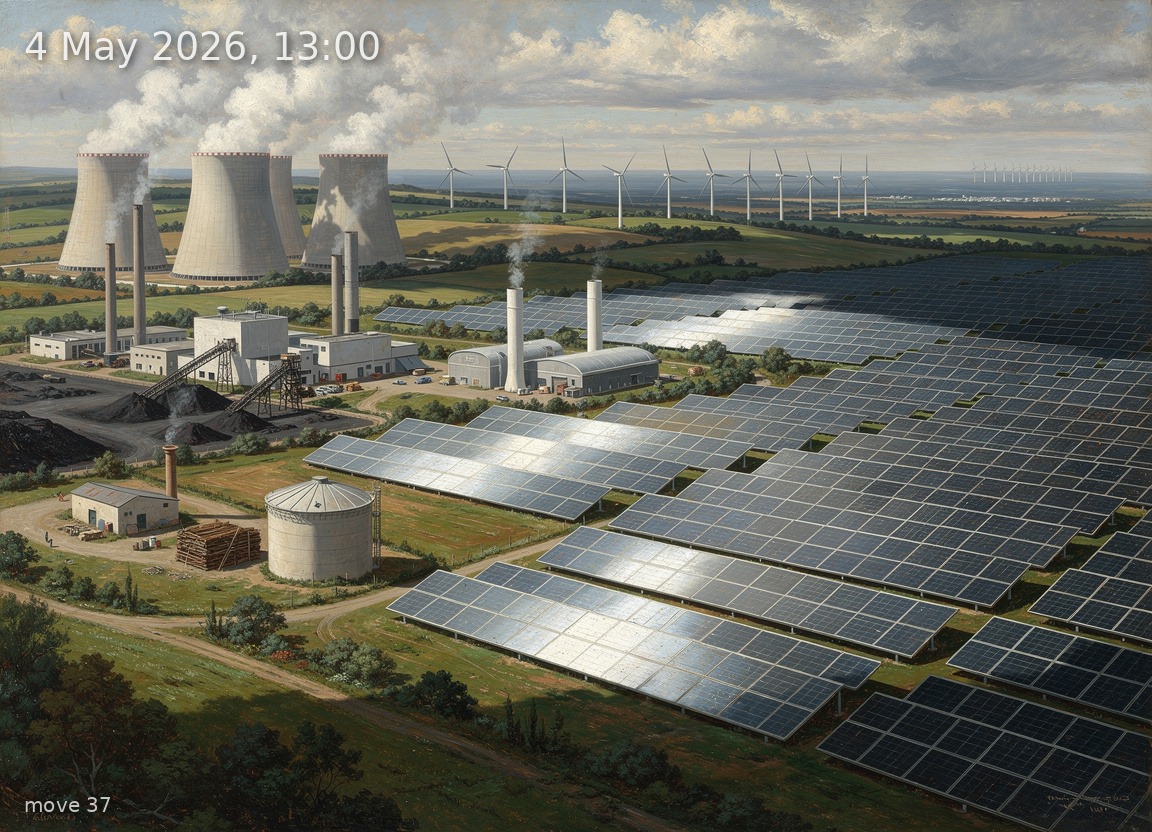
Solar at 38.4 GW leads an 81% renewable mix; light winds and moderate thermal dispatch support 62.7 GW demand.
Back
Generation mix
Wind onshore 6%
Wind offshore 1%
Solar 65%
Biomass 7%
Hydro 2%
Natural gas 5%
Hard coal 6%
Brown coal 8%
81%
Renewable share
4.1 GW
Wind (on + offshore)
38.4 GW
Solar
58.9 GW
Total generation
-3.9 GW
Net import
69.4 €/MWh
Day-ahead price
20.4°C / 6 km/h
Temp / Wind speed
Open-Meteo, Kassel (51.3°N 9.5°E)
69.0% / 309.0 W/m²
Cloud cover / Radiation
133
gCO₂/kWh
Image prompt
Solar 38.4 GW dominates the right two-thirds of the scene as vast rolling fields of aluminium-framed crystalline silicon photovoltaic panels stretching to the horizon, angled south, glinting under broken midday sunshine. Brown coal 4.8 GW occupies the far left as a cluster of massive hyperbolic cooling towers with thick white steam plumes rising into hazy air. Hard coal 3.3 GW sits just right of the brown coal as a smaller power station with rectangular chimneys and conveyor belts carrying dark fuel. Natural gas 2.9 GW appears as a compact CCGT facility with sleek exhaust stacks and a single thin heat-shimmer plume, positioned between the coal plants and the solar fields. Biomass 3.9 GW is rendered as a medium-sized wood-chip-fired plant with a rounded silo and modest smokestack near the coal district. Wind onshore 3.4 GW appears as a sparse line of tall three-blade turbines on a gentle ridge behind the solar fields, blades barely turning in the light breeze. Wind offshore 0.7 GW is suggested by tiny distant turbines on a hazy horizon line to the far right. Hydro 1.4 GW is a small run-of-river weir with a foaming spillway in the lower-left foreground. The sky is midday bright but patchy—roughly 70% covered by layered cumulus clouds drifting slowly, with dramatic shafts of direct sunlight breaking through gaps and illuminating sections of the solar arrays in brilliant white reflections. The landscape is late-spring central German countryside at 20°C: lush green deciduous trees in full leaf, wildflowers dotting meadow edges, warm air. The atmosphere is neither oppressive nor perfectly clear—moderate, workaday, the modest price reflected in an ordinary but luminous sky. Painted in the style of a highly detailed 19th-century German Romantic oil painting—rich saturated colour, visible impasto brushwork, atmospheric aerial perspective with depth—yet every turbine nacelle, every PV cell grid pattern, every cooling tower's parabolic curve rendered with precise engineering accuracy. No text, no labels.