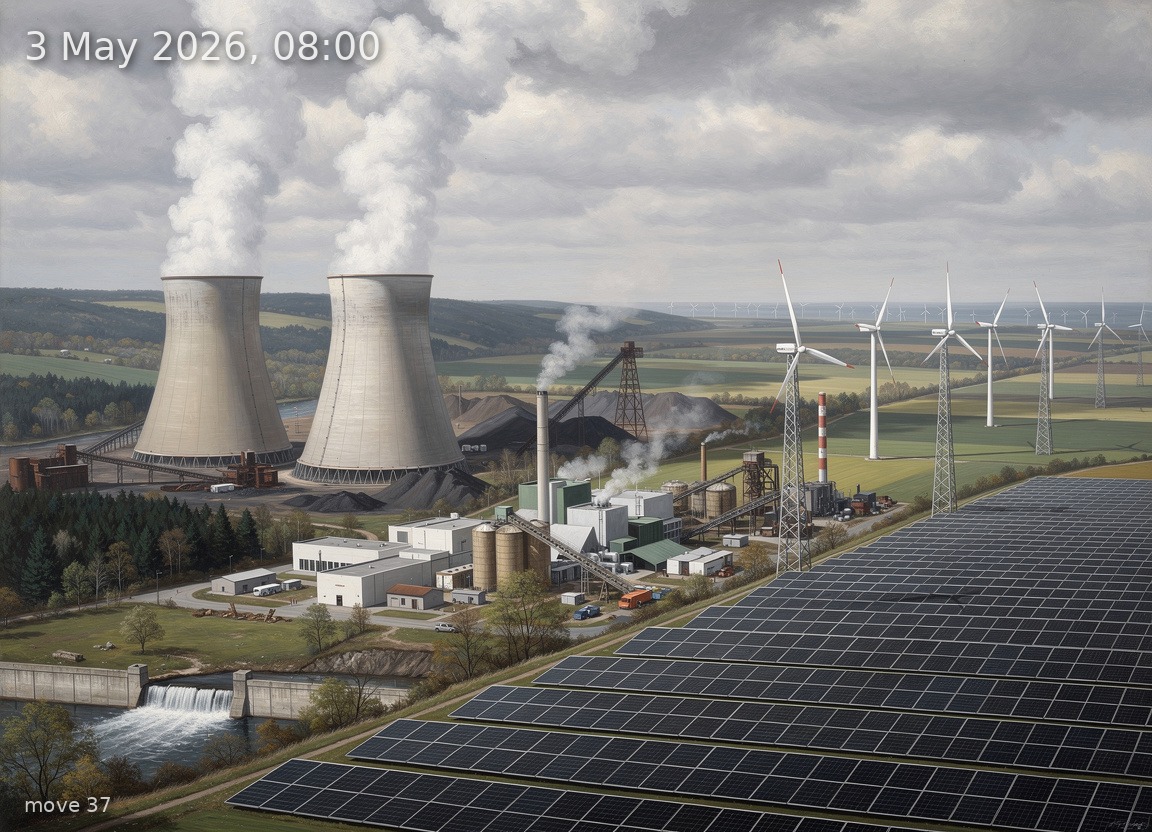
Solar leads at 17.9 GW under full overcast; wind and thermal fill gaps as Germany imports 5.2 GW.
Back
Generation mix
Wind onshore 20%
Wind offshore 1%
Solar 45%
Biomass 11%
Hydro 3%
Natural gas 7%
Hard coal 2%
Brown coal 10%
81%
Renewable share
8.4 GW
Wind (on + offshore)
17.9 GW
Solar
39.6 GW
Total generation
-5.2 GW
Net import
71.7 €/MWh
Day-ahead price
11.0°C / 16 km/h
Temp / Wind speed
Open-Meteo, Kassel (51.3°N 9.5°E)
100.0% / 48.0 W/m²
Cloud cover / Radiation
132
gCO₂/kWh
Image prompt
Solar 17.9 GW dominates the right half of the scene as vast fields of aluminium-framed crystalline silicon PV panels stretching across flat spring farmland, their surfaces reflecting a uniformly grey overcast sky; wind onshore 8.0 GW occupies the centre-right as dozens of tall three-blade turbines on lattice and tubular towers, rotors turning steadily in moderate wind; biomass 4.5 GW appears centre-left as a cluster of medium-scale biomass plants with wood-chip silos and low steam exhaust; brown coal 3.9 GW fills the far left as a pair of massive hyperbolic cooling towers trailing thick white steam plumes into the heavy cloud layer, with conveyor belts of dark lignite visible at their base; natural gas 2.9 GW is rendered as a compact CCGT facility with a single tall exhaust stack and modest heat shimmer, positioned between the biomass and brown coal; hydro 1.2 GW appears as a small concrete dam with spillway in the distant left background nestled in a wooded valley; hard coal 0.9 GW is a single smaller smokestack facility barely visible behind the lignite plant; wind offshore 0.3 GW is a faint suggestion of tiny turbines on the far horizon line. The sky is entirely overcast at 100% cloud cover — a flat, heavy blanket of pale grey stratus with no blue visible — yet it is full morning daylight at 08:00, so the scene is evenly and diffusely lit without shadows, giving everything a soft silvery tone. Temperature is 11°C in early May: fresh green spring foliage on scattered birch and beech trees, new grass in the meadows between installations, but the air feels cool and slightly oppressive. The atmosphere conveys moderate price tension — a heavy, weighty sky pressing down. Rendered as a highly detailed oil painting in the tradition of 19th-century German Romantic landscape painters — Caspar David Friedrich meets industrial realism — with rich layered colour, visible confident brushwork, atmospheric depth and aerial perspective, dramatic compositional balance between nature and technology. Meticulous engineering detail on every turbine nacelle, every PV cell grid line, every cooling tower's parabolic curve. No text, no labels.