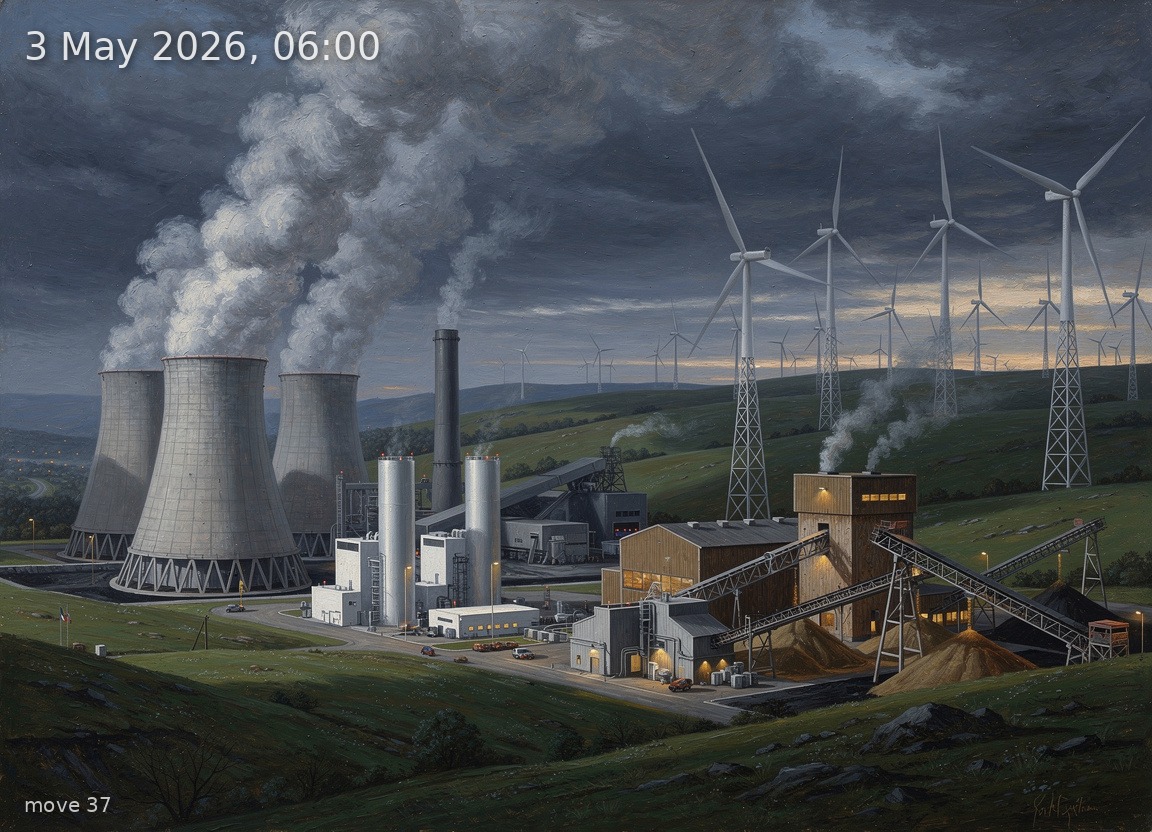
Onshore wind leads at 9.2 GW but heavy overcast, weak offshore, and 12.7 GW net imports define this costly early morning.
Back
Generation mix
Wind onshore 34%
Wind offshore 1%
Solar 7%
Biomass 16%
Hydro 5%
Natural gas 15%
Hard coal 4%
Brown coal 18%
63%
Renewable share
9.4 GW
Wind (on + offshore)
2.0 GW
Solar
26.8 GW
Total generation
-12.7 GW
Net import
101.7 €/MWh
Day-ahead price
8.1°C / 14 km/h
Temp / Wind speed
Open-Meteo, Kassel (51.3°N 9.5°E)
92.0% / 0.0 W/m²
Cloud cover / Radiation
253
gCO₂/kWh
Image prompt
Wind onshore 9.2 GW dominates the right third of the scene as dozens of tall three-blade turbines with white lattice towers stretching across rolling green spring hills, rotors turning steadily in moderate wind; brown coal 4.7 GW occupies the left foreground as a cluster of massive hyperbolic cooling towers emitting thick white-grey steam plumes rising into the overcast; biomass 4.2 GW appears as a mid-ground industrial plant with timber-clad walls, a tall square chimney, and visible wood-chip conveyor belts; natural gas 4.1 GW is rendered as two compact CCGT units with sleek cylindrical exhaust stacks and thin heat-shimmer plumes, positioned centre-left; solar 2.0 GW is shown as a modest field of aluminium-framed crystalline silicon panels in the middle distance, their surfaces dull and unreflective under the dark clouds; hard coal 1.2 GW appears as a single coal-fired plant with a rectangular stack and coal bunker behind the gas units; hydro 1.2 GW is depicted as a concrete dam with spillway nestled in a forested valley at far left; wind offshore 0.2 GW is a barely visible pair of turbines on a distant grey horizon line suggesting the North Sea. The sky is pre-dawn at 06:00 in early May: deep blue-grey with the faintest pale luminescence along the eastern horizon, no direct sunlight, 92% cloud cover rendered as a low, heavy, unbroken overcast pressing down oppressively, conveying the high electricity price. The landscape is spring-green with fresh deciduous foliage and damp meadows at 8°C. Atmosphere is thick, humid, slightly misty near the ground. Power transmission lines on steel lattice pylons run across the composition, symbolising the heavy import flows. Style: highly detailed oil painting in the tradition of 19th-century German Romantic landscape masters — Caspar David Friedrich's atmospheric depth merged with Adolph Menzel's industrial realism — rich colour palette of slate blues, mossy greens, warm amber from sodium lights still glowing on the industrial facilities, visible impasto brushwork, dramatic chiaroscuro between the dark sky and the pale steam plumes. Meticulous engineering detail on every technology. No text, no labels.