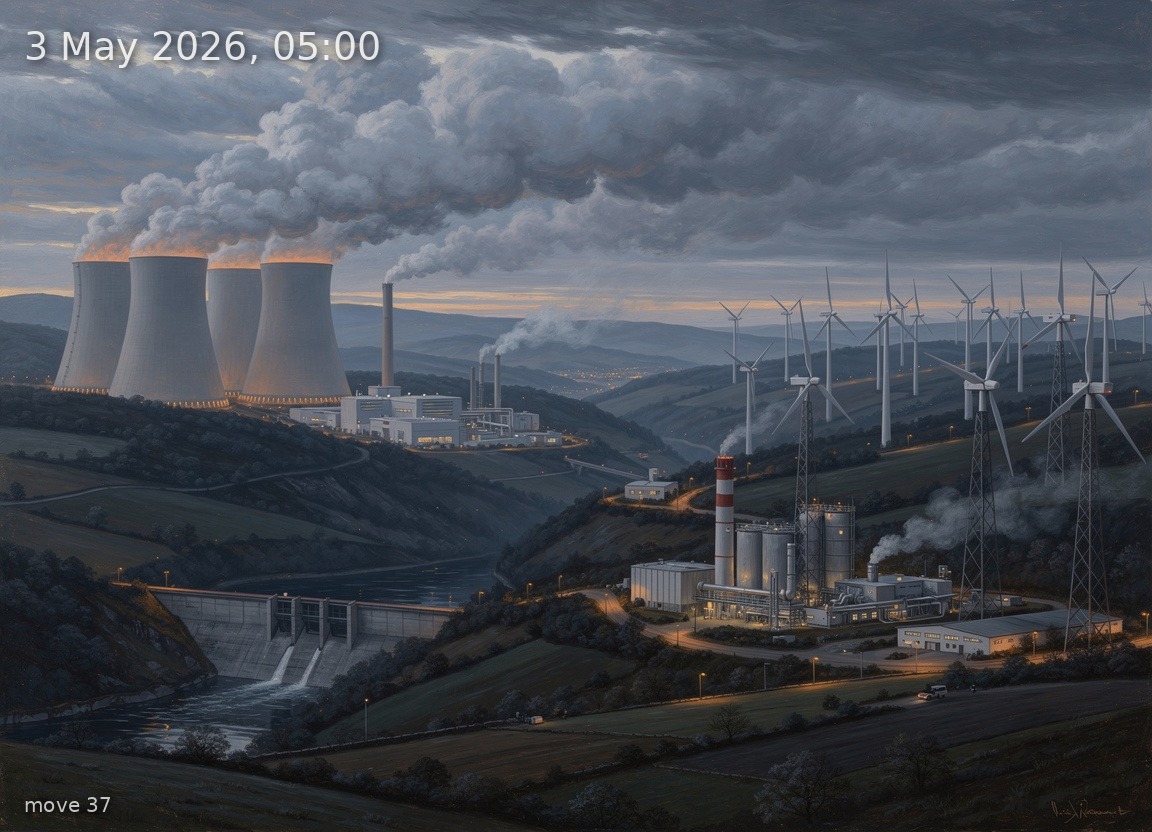
Pre-dawn import dependency: onshore wind leads at 8.8 GW but 13.5 GW net imports needed as coal and gas backstop overcast, windless offshore conditions.
Back
Generation mix
Wind onshore 36%
Wind offshore 1%
Solar 0%
Biomass 17%
Hydro 5%
Natural gas 17%
Hard coal 5%
Brown coal 19%
59%
Renewable share
9.0 GW
Wind (on + offshore)
0.1 GW
Solar
24.5 GW
Total generation
-13.5 GW
Net import
107.1 €/MWh
Day-ahead price
8.4°C / 12 km/h
Temp / Wind speed
Open-Meteo, Kassel (51.3°N 9.5°E)
100.0% / 0.0 W/m²
Cloud cover / Radiation
278
gCO₂/kWh
Image prompt
Onshore wind 8.8 GW dominates the right half of the scene as dozens of three-blade turbines on lattice and tubular towers stretching across rolling central-German hills, rotors turning in moderate breeze; brown coal 4.7 GW occupies the left quarter as a cluster of massive hyperbolic cooling towers emitting thick white-grey steam plumes into the heavy sky; natural gas 4.2 GW appears left-of-centre as compact CCGT plant blocks with tall single exhaust stacks venting thin heat shimmer; biomass 4.1 GW is rendered as a mid-ground industrial plant with rectangular silos and a modest smokestack trailing pale smoke; hydro 1.3 GW appears as a concrete dam and spillway nestled in a valley in the far middle distance; hard coal 1.2 GW is a smaller power station with a single hyperbolic tower and conveyor belt structure at far left edge. Time is 05:00 in early May: the sky is deep blue-grey pre-dawn with no direct sunlight, only the faintest pale luminescence along the eastern horizon; the rest of the sky is completely overcast at 100% cloud cover, oppressively low and heavy, conveying the high electricity price. No solar panels anywhere — no sun visible. Temperature is cool spring at 8.4°C: fresh green grass and budding deciduous trees but with dew and mist clinging to valley floors. Sodium-orange streetlights and industrial floodlights illuminate the power plants. Style: highly detailed oil painting in the tradition of 19th-century German Romantic landscape painters — Caspar David Friedrich meets industrial sublime — rich colour palette of slate blue, ash grey, warm amber from artificial lights, visible confident brushwork, atmospheric depth and aerial perspective, meticulous engineering detail on every turbine nacelle, cooling tower, and exhaust stack. No text, no labels.