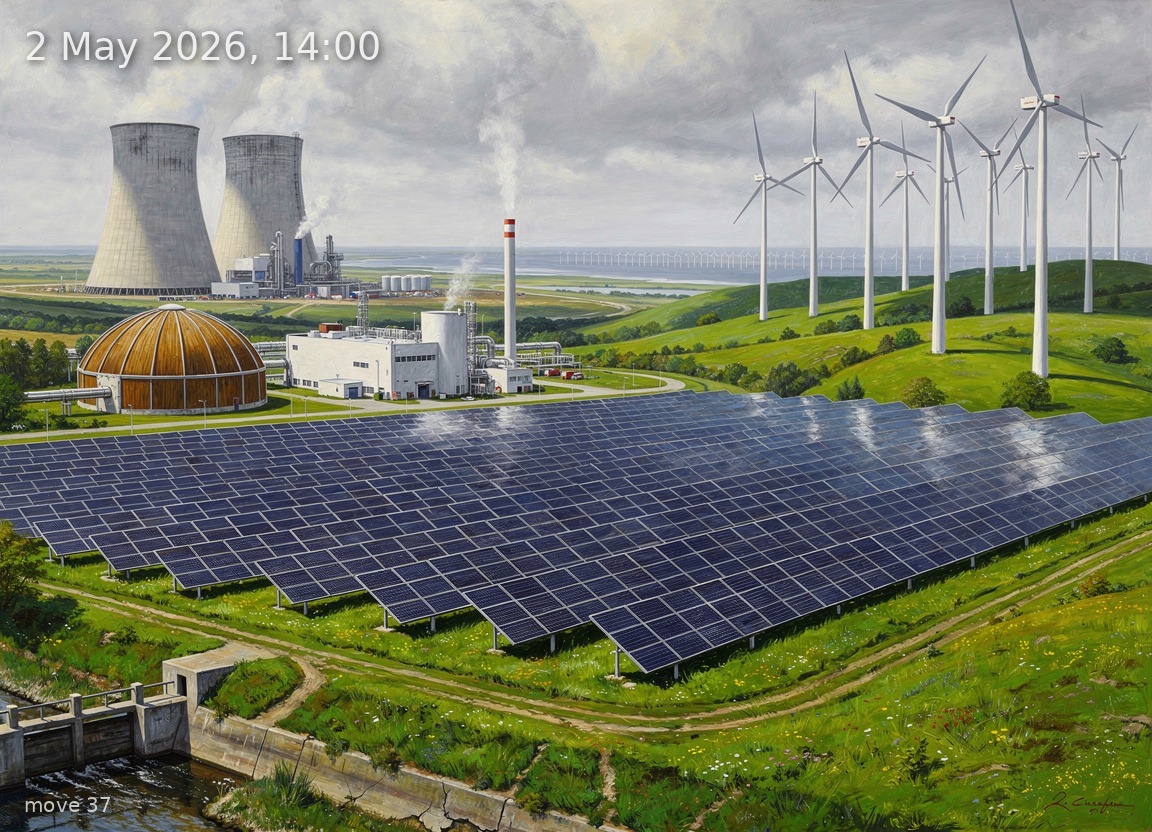
Massive solar output of 45.6 GW drives 13.3 GW net exports and deeply negative prices on a warm spring afternoon.
Back
Generation mix
Wind onshore 8%
Wind offshore 2%
Solar 75%
Biomass 7%
Hydro 2%
Natural gas 3%
Hard coal 1%
Brown coal 3%
93%
Renewable share
6.1 GW
Wind (on + offshore)
45.6 GW
Solar
60.8 GW
Total generation
+13.3 GW
Net export
-86.8 €/MWh
Day-ahead price
24.9°C / 14 km/h
Temp / Wind speed
Open-Meteo, Kassel (51.3°N 9.5°E)
100.0% / 680.0 W/m²
Cloud cover / Radiation
45
gCO₂/kWh
Image prompt
Solar 45.6 GW dominates the entire foreground and middle ground as vast fields of aluminium-framed crystalline silicon photovoltaic panels stretching across rolling green spring meadows, angled southward, catching bright diffused light; wind onshore 4.9 GW appears as a cluster of tall three-blade turbines with white tubular towers on gentle hills at right, blades turning slowly in moderate breeze; wind offshore 1.3 GW is visible as a small row of turbines on the distant hazy horizon line over flat terrain suggesting the North Sea coast; biomass 4.0 GW is rendered as a mid-sized industrial plant with a wooden-chip storage dome and single smokestack emitting thin white steam, positioned at centre-left; brown coal 1.9 GW appears as a pair of hyperbolic concrete cooling towers with modest steam plumes rising from them, placed in the left background; natural gas 1.8 GW is a compact CCGT facility with a slender exhaust stack and minimal visible emissions, adjacent to the cooling towers; hydro 1.0 GW is a small concrete weir with rushing water visible in a river cutting through the lower left corner; hard coal 0.4 GW is a barely visible small dark stack behind the lignite plant. The sky is fully overcast with a uniform bright white-grey cloud layer yet paradoxically luminous—high thin cirrostratus allowing strong direct radiation to filter through, creating a glowing silvery-white dome of light at 14:00 full midday brightness. The atmosphere feels eerily calm and open, reflecting deeply negative electricity prices—no oppressive weight, instead an almost unsettling stillness and excess of light. Late spring vegetation is lush bright green, wildflowers dotting meadow edges, temperature near 25°C suggested by shimmering heat haze over the panel fields. Highly detailed oil painting in the tradition of 19th-century German Romantic landscape painters—rich saturated colour, visible confident brushwork, atmospheric depth and aerial perspective, meticulous engineering detail on every turbine nacelle, every panel frame, every cooling tower's parabolic curve and concrete texture. The composition evokes Caspar David Friedrich's sense of sublime scale but applied to an industrial-renewable landscape. No text, no labels.