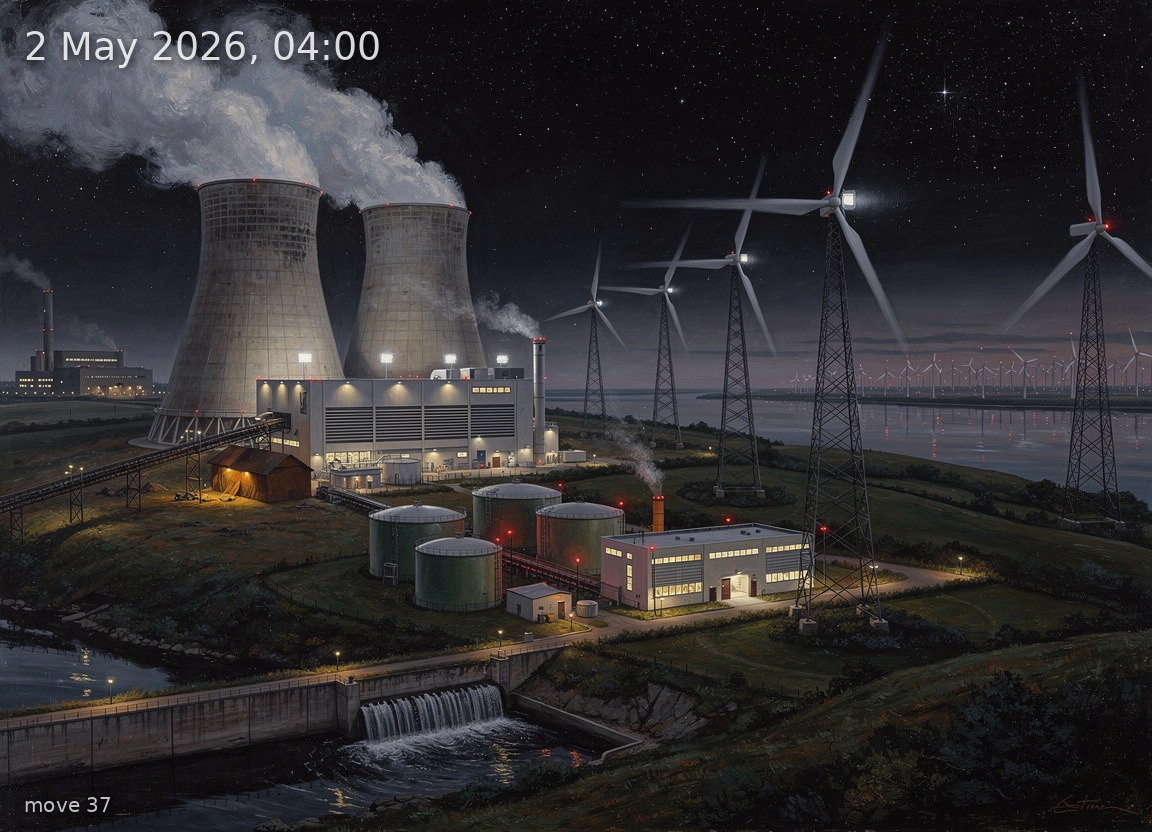
Wind dominates at 22.4 GW combined but 4.9 GW net imports needed as overnight demand outpaces domestic supply.
Back
Generation mix
Wind onshore 53%
Wind offshore 9%
Biomass 12%
Hydro 3%
Natural gas 8%
Hard coal 3%
Brown coal 11%
78%
Renewable share
22.3 GW
Wind (on + offshore)
0.0 GW
Solar
35.6 GW
Total generation
-4.9 GW
Net import
93.5 €/MWh
Day-ahead price
5.7°C / 16 km/h
Temp / Wind speed
Open-Meteo, Kassel (51.3°N 9.5°E)
0.0% / 0.0 W/m²
Cloud cover / Radiation
154
gCO₂/kWh
Image prompt
Wind onshore 19.0 GW dominates the right two-thirds of the scene as dozens of massive three-blade turbines on lattice towers stretching across rolling hills into the distance, rotors visibly spinning in strong wind; wind offshore 3.4 GW appears as a distant cluster of turbines on the far-right horizon above a faint river or lake reflection; brown coal 4.0 GW occupies the left middle ground as a pair of enormous hyperbolic cooling towers releasing thick white steam plumes into the dark sky, flanked by conveyor belts and a glowing lignite bunker; biomass 4.1 GW sits left-center as a cluster of industrial biogas domes and a modest stack with warm exhaust, orange safety lights glowing; natural gas 3.0 GW appears center-left as a compact CCGT plant with a single tall exhaust stack emitting a thin heat shimmer, its turbine hall lit by sodium-vapor lights; hard coal 1.0 GW is a small, partially darkened coal plant in the far left background with a single modest stack; hydro 1.2 GW is suggested by a small dam structure with spillway in the lower-left foreground, faintly illuminated. Time is 04:00 — completely dark, black sky with scattered cold stars visible through clear atmosphere (0% cloud cover), no moon glow, no twilight whatsoever. All structures lit only by artificial light: warm sodium streetlamps along access roads, white LED floodlights on turbine nacelles, orange aviation warning beacons blinking on turbine tips, and the amber industrial glow of the coal and gas facilities. Spring vegetation is barely discernible — fresh young grass and budding trees in the foreground caught in spill light. Temperature is near 6°C, a faint ground mist clings to low areas. The atmosphere feels oppressive and heavy despite the clear sky, suggesting high electricity prices — a brooding, tense quality to the darkness. Style: highly detailed oil painting in the tradition of Caspar David Friedrich and Carl Blechen — rich impasto brushwork, dramatic chiaroscuro between the deep navy-black sky and the warm industrial lights below, atmospheric depth receding into darkness, meticulous engineering detail on every turbine nacelle, cooling tower flute, and gas stack. No text, no labels.