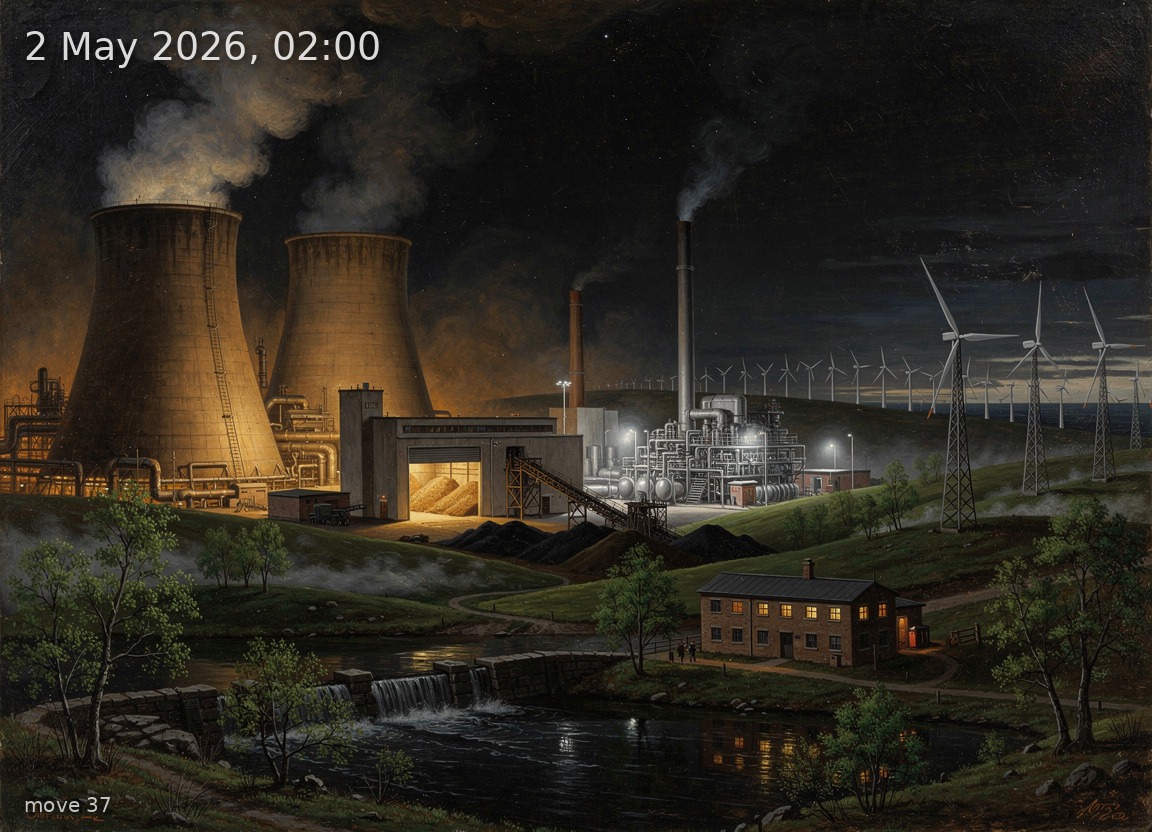
Strong overnight wind at 21.9 GW leads generation but 5.2 GW net imports fill the gap alongside coal and gas.
Back
Generation mix
Wind onshore 53%
Wind offshore 9%
Biomass 12%
Hydro 3%
Natural gas 9%
Hard coal 3%
Brown coal 11%
77%
Renewable share
21.9 GW
Wind (on + offshore)
0.0 GW
Solar
35.3 GW
Total generation
-5.2 GW
Net import
99.5 €/MWh
Day-ahead price
8.5°C / 16 km/h
Temp / Wind speed
Open-Meteo, Kassel (51.3°N 9.5°E)
0.0% / 0.0 W/m²
Cloud cover / Radiation
158
gCO₂/kWh
Image prompt
Wind onshore 18.6 GW dominates the scene as vast rows of three-blade turbines with lattice towers stretching across rolling hills from centre to far right, rotors turning briskly in moderate wind; wind offshore 3.3 GW appears as a distant cluster of taller turbines on the far-right horizon above a dark sea. Brown coal 4.0 GW occupies the left foreground as two massive hyperbolic cooling towers with pale steam plumes rising into the black sky, lit from below by amber sodium lights at their industrial base. Biomass 4.1 GW sits adjacent as a mid-sized industrial plant with a rectangular stack and warm interior glow visible through open bay doors, woodchip conveyors faintly illuminated. Natural gas 3.1 GW appears as a compact CCGT facility in the left-centre with a single tall exhaust stack emitting a thin heat shimmer, surrounded by pipe racks and lit by white industrial floodlights. Hard coal 1.1 GW is a smaller conventional plant behind the gas facility with a single modest chimney and coal yard. Hydro 1.2 GW is suggested by a dark river in the foreground with a small weir and powerhouse with lit windows. The sky is completely dark, deep navy-black, no twilight, no glow on the horizon, scattered stars partially visible between high thin clouds (0% cloud cover means a clear starfield). The atmosphere feels heavy and oppressive, hinting at the high electricity price—a subtle amber-brown industrial haze lingers around the thermal plants. Early May: fresh green deciduous foliage on scattered trees, spring grass on the hillsides, temperature around 8°C suggesting a cool night with faint ground mist in low areas. Painted in the style of a highly detailed 19th-century German Romantic oil painting—rich dark tones, visible impasto brushwork, dramatic chiaroscuro between industrial sodium lighting and the surrounding darkness, meticulous engineering detail on turbine nacelles, cooling tower concrete texture, and CCGT pipe geometry. No text, no labels.