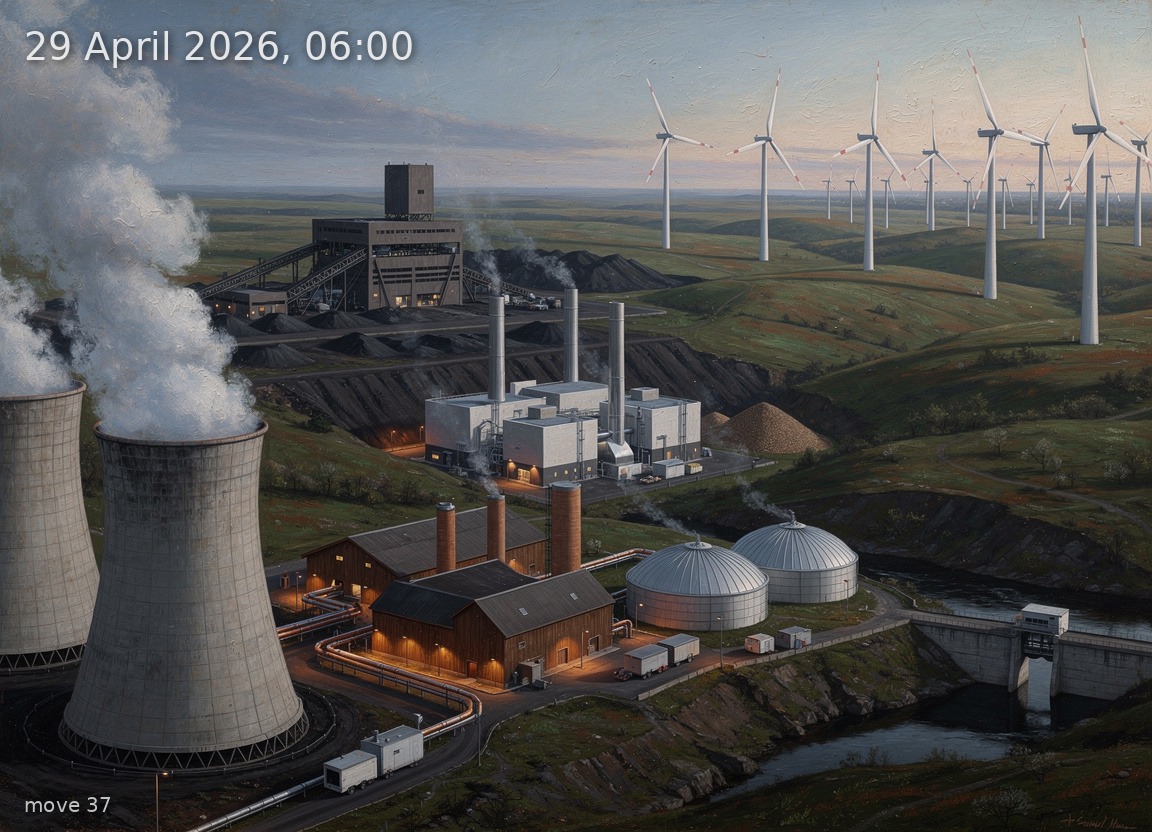
Onshore wind leads at 15.1 GW but a 17 GW import need and heavy thermal dispatch drive prices to 140 EUR/MWh.
Back
Generation mix
Wind onshore 39%
Wind offshore 1%
Solar 5%
Biomass 11%
Hydro 3%
Natural gas 13%
Hard coal 10%
Brown coal 18%
60%
Renewable share
15.6 GW
Wind (on + offshore)
1.9 GW
Solar
38.3 GW
Total generation
-17.0 GW
Net import
139.8 €/MWh
Day-ahead price
4.5°C / 16 km/h
Temp / Wind speed
Open-Meteo, Kassel (51.3°N 9.5°E)
0.0% / 0.0 W/m²
Cloud cover / Radiation
280
gCO₂/kWh
Image prompt
Wind onshore 15.1 GW dominates the right half of the scene as dozens of tall three-blade turbines with white tubular towers and nacelles stretching across rolling green-brown April hills, blades turning steadily in moderate wind; brown coal 6.8 GW occupies the left foreground as a massive lignite power station with four hyperbolic concrete cooling towers emitting thick white steam plumes rising into the still air; natural gas 4.9 GW appears centre-left as two compact CCGT plants with slim silver exhaust stacks venting thin heat shimmer; hard coal 3.7 GW sits behind the gas plant as a dark industrial block with a single large square chimney and conveyor belts feeding a coal yard; biomass 4.3 GW is rendered as a cluster of mid-sized timber-clad generation buildings with short cylindrical stacks and adjacent woodchip storage domes near the centre; hydro 1.2 GW appears as a small dam and penstock visible in a valley between hills at centre-right; wind offshore 0.5 GW is barely suggested as a faint row of turbines on the far horizon; solar 1.9 GW is shown as a modest field of aluminium-framed crystalline silicon panels on a hillside, their surfaces dark and unreflective in the pre-dawn gloom. The sky is deep blue-grey with the faintest pale lavender glow along the eastern horizon — no direct sun, no warm tones, purely the earliest hint of civil twilight at 06:00 in late April. Stars still visible overhead fading toward the east. The atmosphere feels heavy and oppressive, a low haze clings to the valley floor reflecting the high electricity price. Temperature is near freezing: frost edges the grass, breath-like mist rises from the cooling towers. Bare branches on scattered birch and beech trees show early spring buds. Rendered as a highly detailed oil painting in the tradition of 19th-century German Romantic landscape painting — Caspar David Friedrich meets industrial realism — rich impasto brushwork, deep atmospheric perspective, dramatic chiaroscuro between the glowing industrial facilities and the vast dark sky, meticulous engineering accuracy on every turbine nacelle, cooling tower, and exhaust stack. Sodium-orange lights illuminate the coal and gas plant grounds. No text, no labels.