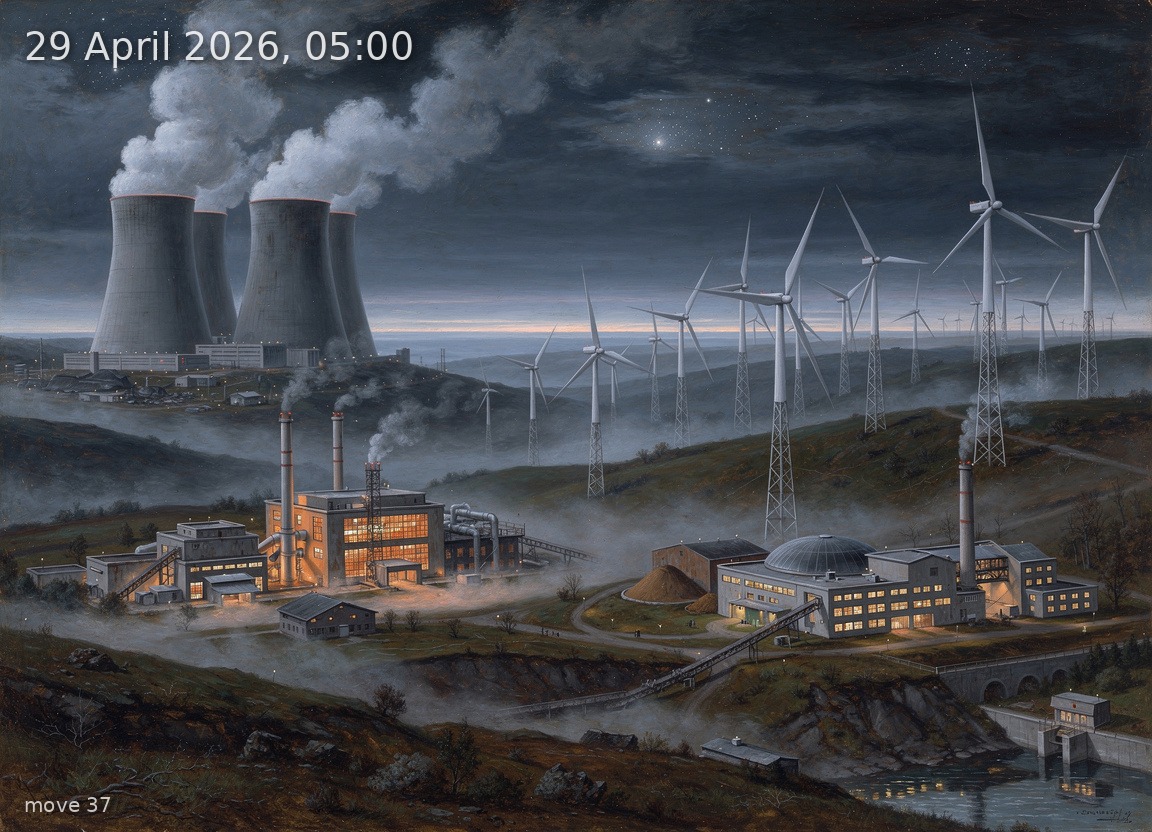
Pre-dawn wind leads at 15.7 GW but 13 GW net imports are needed as thermal plants and biomass support 49.8 GW demand.
Back
Generation mix
Wind onshore 43%
Wind offshore 2%
Solar 0%
Biomass 12%
Hydro 3%
Natural gas 12%
Hard coal 10%
Brown coal 18%
59%
Renewable share
16.3 GW
Wind (on + offshore)
0.0 GW
Solar
36.7 GW
Total generation
-13.0 GW
Net import
107.9 €/MWh
Day-ahead price
5.1°C / 16 km/h
Temp / Wind speed
Open-Meteo, Kassel (51.3°N 9.5°E)
0.0% / 0.0 W/m²
Cloud cover / Radiation
286
gCO₂/kWh
Image prompt
Wind onshore 15.7 GW dominates the right two-fifths of the scene as dozens of tall three-blade turbines with white lattice towers stretched across rolling central German hills, rotors spinning steadily in moderate wind. Brown coal 6.7 GW occupies the left background as a massive lignite power station with three hyperbolic cooling towers emitting thick white steam plumes into the dark sky. Natural gas 4.6 GW appears centre-left as a compact CCGT facility with twin slender exhaust stacks and warm orange-lit industrial buildings. Hard coal 3.7 GW sits beside it as a smaller coal plant with a single wide chimney trailing grey smoke. Biomass 4.3 GW is rendered centre-right as a cluster of mid-sized industrial buildings with a wood-chip storage dome and a modest smokestack, warmly lit from within. Hydro 1.2 GW appears as a small concrete dam and powerhouse nestled in a valley in the far right background. Wind offshore 0.6 GW is hinted at by a few distant turbines on the far horizon line. The time is 05:00 in late April — a pre-dawn scene with the sky a deep blue-grey, the faintest pale indigo band barely touching the eastern horizon, no direct sunlight whatsoever. Stars are fading overhead. The landscape is early spring: bare branches budding, new grass barely green, patches of frost on the ground reflecting sodium-yellow streetlights from a small nearby village. The atmosphere feels heavy and oppressive, with a high overcast haze diffusing the industrial steam into the dark sky, evoking the elevated electricity price. No solar panels anywhere — it is still night. Painted in the style of a highly detailed 19th-century German Romantic oil painting — rich, dark colour palette of Prussian blues, umber browns, and warm industrial oranges; visible impasto brushwork; atmospheric depth with mist layering between the turbines and cooling towers; meticulous engineering detail on every nacelle, rotor blade, cooling tower, and exhaust stack. The composition evokes Caspar David Friedrich's sense of sublime scale, but applied to the modern industrial energy landscape. No text, no labels.