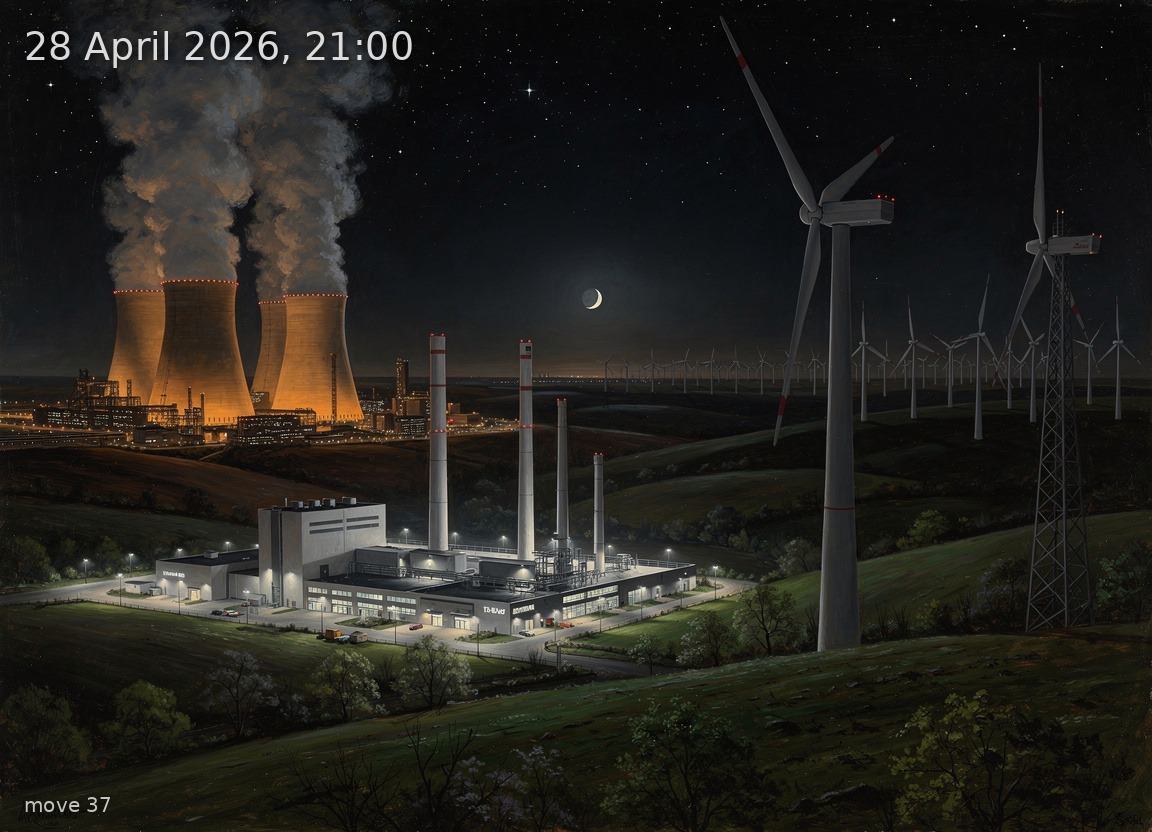
Strong wind leads generation but a 9.9 GW import need and coal dispatch push prices to 115.8 EUR/MWh.
Back
Generation mix
Wind onshore 48%
Wind offshore 8%
Biomass 10%
Hydro 3%
Natural gas 11%
Hard coal 7%
Brown coal 13%
68%
Renewable share
25.8 GW
Wind (on + offshore)
0.0 GW
Solar
46.4 GW
Total generation
-9.9 GW
Net import
115.8 €/MWh
Day-ahead price
12.1°C / 21 km/h
Temp / Wind speed
Open-Meteo, Kassel (51.3°N 9.5°E)
0.0% / 2.0 W/m²
Cloud cover / Radiation
217
gCO₂/kWh
Image prompt
Wind onshore 22.1 GW dominates the right two-thirds of the scene as vast ranks of three-blade turbines on lattice and tubular towers stretching across rolling central German hills, rotors spinning briskly in 20 km/h winds; brown coal 6.2 GW occupies the left background as a cluster of massive hyperbolic cooling towers with thick white steam plumes rising into the dark sky, lit from below by orange sodium lights of an industrial complex; natural gas 5.1 GW appears centre-left as a compact CCGT power station with tall slender exhaust stacks emitting thin heat shimmer, illuminated by floodlights; hard coal 3.3 GW is a smaller conventional power station with a single large chimney and conveyor gantries beside a dark coal pile, lit by yellowish industrial lamps, positioned behind the gas plant; biomass 4.7 GW is represented by a mid-sized wood-chip-fired plant with a modest stack and glowing furnace visible through an open bay, placed centre-right among the turbines; hydro 1.3 GW appears as a small dam and powerhouse with spillway at the far right edge, water catching faint reflected light; wind offshore 3.7 GW is suggested in the far distance as a row of turbines standing in a dark sea visible through a gap in the hills on the horizon. TIME: 21:00 in late April — fully dark, deep navy-to-black sky, no twilight glow, a scattering of stars visible through perfectly clear skies (0% cloud cover), a waning crescent moon low on the horizon. Spring vegetation: fresh green grass and budding deciduous trees on the hillsides, visible only where caught by artificial light. The atmosphere feels heavy and oppressive despite the clear sky, conveying the high electricity price — a subtle amber-brown haze clings low to the industrial sections, sodium and mercury-vapor lights casting harsh pools of orange and bluish-white. Style: highly detailed oil painting in the tradition of 19th-century German Romantic landscape art — Caspar David Friedrich meets industrial sublime — rich impasto brushwork, dramatic chiaroscuro between the lit industrial zones and the vast dark countryside, atmospheric depth receding into blackness, meticulous engineering detail on every turbine nacelle, cooling tower flute, and CCGT exhaust stack. No text, no labels.