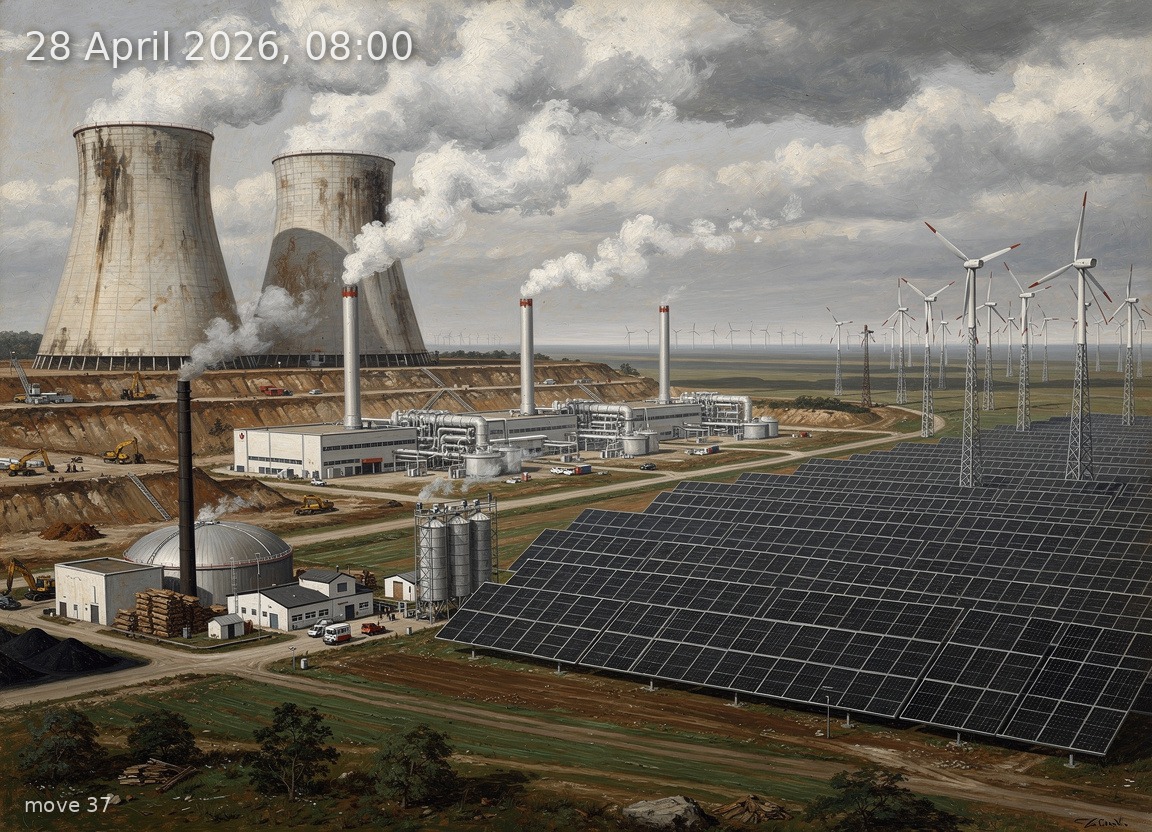
Overcast morning: diffuse solar and wind lead at 67.7% renewable share, but 7.8 GW net imports fill the gap.
Back
Generation mix
Wind onshore 20%
Wind offshore 4%
Solar 33%
Biomass 8%
Hydro 2%
Natural gas 11%
Hard coal 7%
Brown coal 14%
68%
Renewable share
13.0 GW
Wind (on + offshore)
17.9 GW
Solar
54.2 GW
Total generation
-7.8 GW
Net import
112.3 €/MWh
Day-ahead price
8.3°C / 14 km/h
Temp / Wind speed
Open-Meteo, Kassel (51.3°N 9.5°E)
100.0% / 11.0 W/m²
Cloud cover / Radiation
223
gCO₂/kWh
Image prompt
Solar 17.9 GW dominates the right third of the scene as vast fields of aluminium-framed crystalline silicon PV panels stretching across flat farmland, their surfaces reflecting only the dull grey of thick overcast sky, no direct sunlight; wind onshore 11.0 GW occupies the centre-right as dozens of three-blade turbines on lattice and tubular towers, blades turning steadily in moderate wind; wind offshore 2.0 GW appears as a distant cluster of turbines on the hazy horizon line; brown coal 7.6 GW fills the left portion as massive hyperbolic cooling towers emitting thick white steam plumes drifting eastward, adjacent open-pit mine terraces visible; natural gas 6.0 GW is rendered centre-left as a pair of compact CCGT plants with tall single exhaust stacks and thinner steam trails; hard coal 3.9 GW appears as a smaller coal-fired station with rectangular boiler buildings and a single smokestack beside a coal stockyard; biomass 4.6 GW is shown as a modest industrial facility with a rounded digester dome and wood-chip storage silos near the centre; hydro 1.3 GW appears as a small run-of-river weir with a powerhouse building at the edge of a slow river in the foreground. The sky is entirely blanketed by heavy, low stratus clouds at full 100% cover, uniformly grey-white, pressing down oppressively—consistent with the high electricity price—lit by diffuse full-daylight appropriate to 08:00 in late April, no sun disk visible, no shadows cast. Temperature is 8.3°C: early spring vegetation with fresh pale-green buds on birch and linden trees, last brown leaves on the ground, cool damp atmosphere. The landscape is flat northern German plain. Highly detailed oil painting in the tradition of 19th-century German Romantic landscape painters—Caspar David Friedrich meets industrial realism—rich layered colour, visible impasto brushwork, atmospheric aerial perspective with haze softening distant cooling towers, meticulous engineering accuracy on every turbine nacelle, PV module frame, and cooling tower shell. No text, no labels.