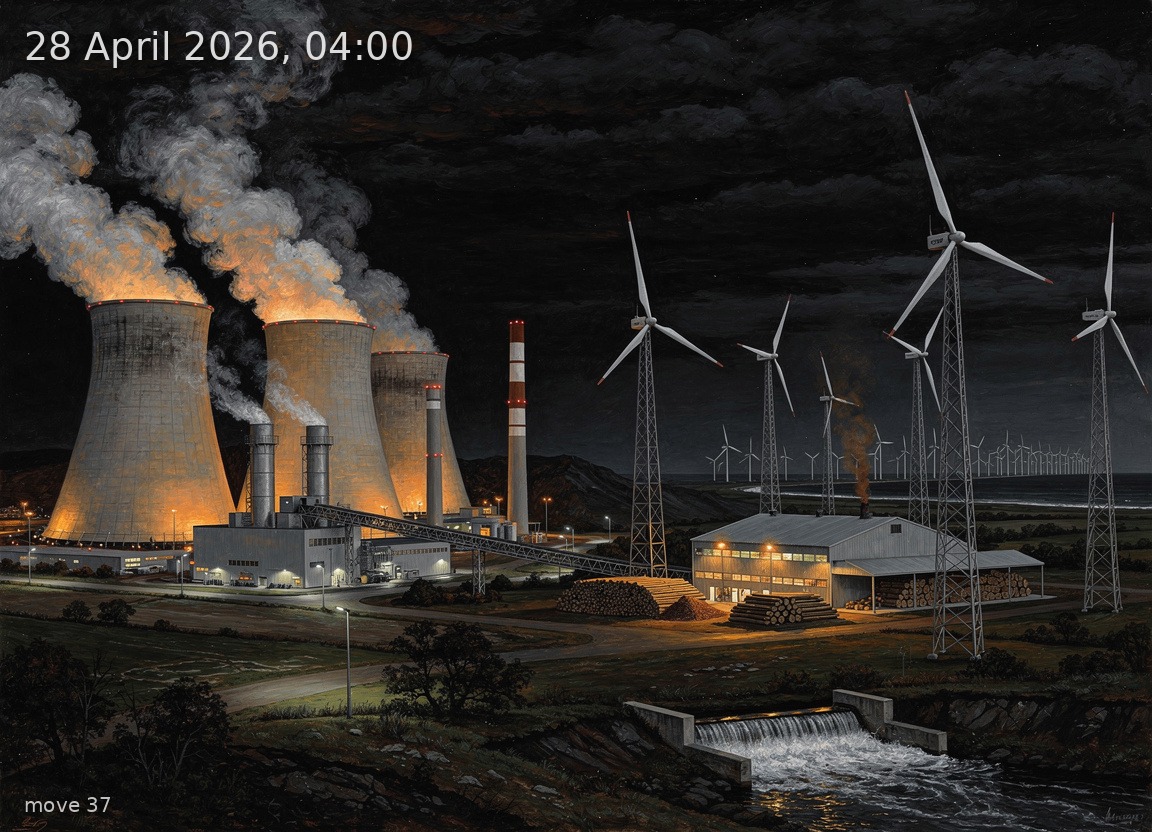
Wind leads at 14.7 GW but coal and gas fill the pre-dawn gap, driving 7 GW of net imports.
Back
Generation mix
Wind onshore 37%
Wind offshore 4%
Biomass 11%
Hydro 3%
Natural gas 15%
Hard coal 10%
Brown coal 20%
55%
Renewable share
16.3 GW
Wind (on + offshore)
0.0 GW
Solar
39.4 GW
Total generation
-7.0 GW
Net import
105.3 €/MWh
Day-ahead price
6.6°C / 15 km/h
Temp / Wind speed
Open-Meteo, Kassel (51.3°N 9.5°E)
87.0% / 0.0 W/m²
Cloud cover / Radiation
311
gCO₂/kWh
Image prompt
Wind onshore 14.7 GW dominates the right half of the scene as dozens of tall three-blade turbines on lattice and tubular towers stretching across a rolling German plain, blades visibly turning in moderate wind; brown coal 7.9 GW occupies the left quarter as a massive lignite power station with four hyperbolic cooling towers releasing thick white steam plumes into the dark sky; natural gas 5.9 GW appears centre-left as a compact CCGT facility with twin cylindrical exhaust stacks emitting thin heat shimmer and faint vapor; hard coal 3.9 GW sits behind the gas plant as a smaller coal station with a single large stack and conveyor belt infrastructure; biomass 4.2 GW is represented centre-right as a mid-sized industrial plant with a timber yard and a modest chimney with warm-toned exhaust; wind offshore 1.6 GW appears as a distant cluster of turbines on the far-right horizon; hydro 1.3 GW is suggested by a small dam structure with flowing water in the lower right foreground. Time is 04:00 — complete darkness, black sky with no twilight or sky glow, heavy 87% cloud cover obscuring all stars, deep navy-to-black overcast ceiling. All facilities are lit by sodium-orange industrial lighting, casting pools of amber glow on wet spring ground; cooling tower steam is illuminated from below by plant lights, glowing ghostly white-orange against the void. Temperature is 6.6°C — early spring with bare trees just beginning to bud, patches of mist clinging to low fields, damp grass. The atmosphere is heavy and oppressive, reflecting the high electricity price — the clouds press down on the landscape with palpable weight. Style: highly detailed oil painting in the tradition of 19th-century German Romantic landscape painters such as Caspar David Friedrich and Carl Blechen, with rich impasto brushwork, deep chiaroscuro, atmospheric depth, dramatic industrial sublime. Each technology is rendered with meticulous engineering accuracy — turbine nacelles, three-blade rotors, aluminium-framed details, hyperbolic concrete cooling tower geometry, CCGT exhaust stacks. No text, no labels.