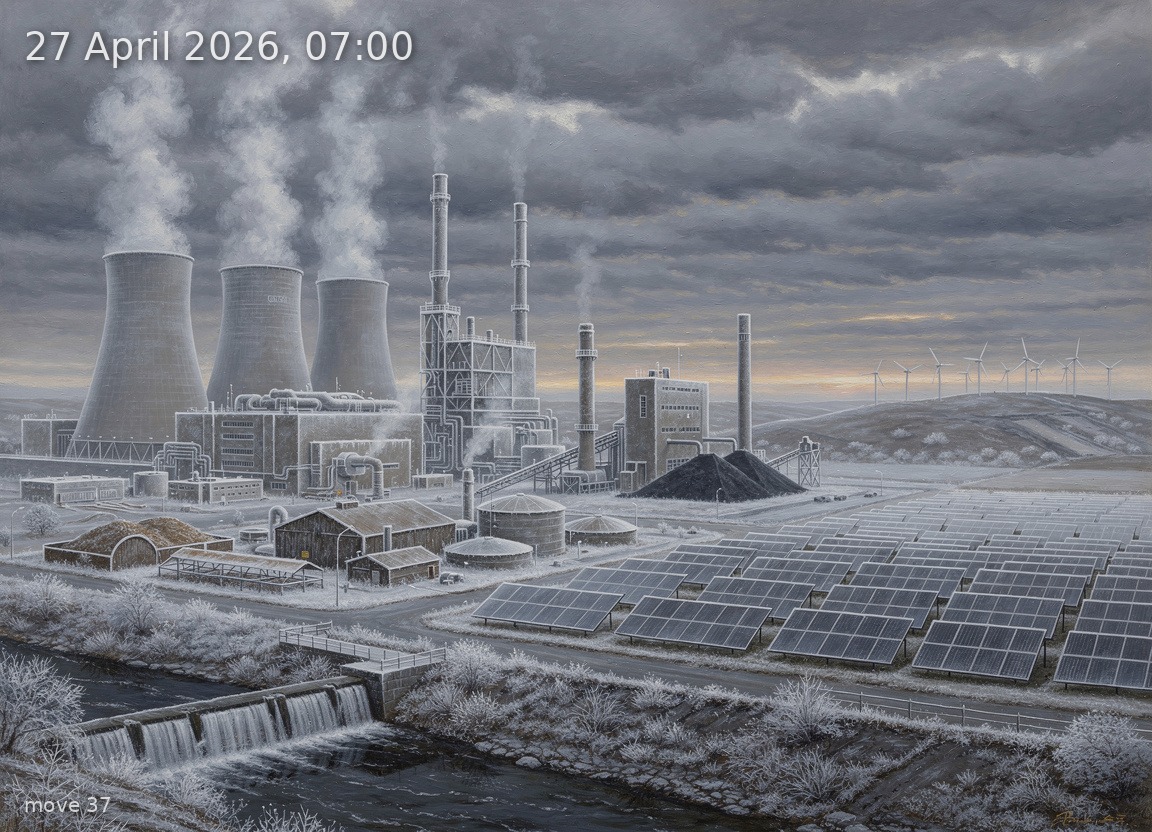
Coal, gas, and imports dominate as sub-zero cold, zero wind, and full overcast strain German supply at 7 a.m.
Back
Generation mix
Wind onshore 7%
Wind offshore 0%
Solar 25%
Biomass 13%
Hydro 3%
Natural gas 20%
Hard coal 10%
Brown coal 22%
48%
Renewable share
2.4 GW
Wind (on + offshore)
8.8 GW
Solar
35.0 GW
Total generation
-24.8 GW
Net import
153.7 €/MWh
Day-ahead price
-1.6°C / 1 km/h
Temp / Wind speed
Open-Meteo, Kassel (51.3°N 9.5°E)
100.0% / 0.0 W/m²
Cloud cover / Radiation
351
gCO₂/kWh
Image prompt
Brown coal 7.6 GW dominates the left quarter as a massive lignite power station with four hyperbolic cooling towers pouring thick white steam into the heavy sky; natural gas 7.0 GW occupies the centre-left as two compact CCGT plants with tall single exhaust stacks venting thin plumes; hard coal 3.5 GW appears centre-right as a smaller coal plant with a single rectangular boiler house and conveyor belts carrying dark fuel; solar 8.8 GW is represented across the right third by vast fields of aluminium-framed crystalline silicon PV panels stretching to the horizon, their surfaces dull and lightly frosted, reflecting no sunlight under total overcast; biomass 4.5 GW sits in the mid-ground as a cluster of wood-chip-fed combined heat and power stations with rounded storage silos and modest chimneys; wind onshore 2.4 GW appears as a sparse row of three-blade turbines on a distant ridge, rotors barely turning in the dead-calm air; hydro 1.2 GW is a small run-of-river weir visible along a dark, cold stream in the foreground. The scene is set at 07:00 dawn in late April: the sky is a uniform, oppressive blanket of low stratus cloud in tones of slate grey and pewter, with only the faintest pale pre-dawn luminosity at the eastern horizon — no direct sunlight anywhere. Frost coats every surface: rooftops, bare branches of half-budded deciduous trees, and stubble fields are white with rime. The temperature is visibly sub-zero — breath-like mist curls from vents, and puddles are iced over. High-voltage transmission lines recede into the murky distance in both directions, symbolizing the enormous cross-border power flows. The atmosphere is heavy, oppressive, and cold, matching the extreme price. Rendered as a highly detailed oil painting in the tradition of 19th-century German Romantic landscape art — Caspar David Friedrich meets industrial modernity — with rich, sombre colour palette of greys, slate blues, and muted ochres, visible impasto brushwork, atmospheric perspective fading into haze, and meticulous engineering accuracy on every turbine nacelle, cooling tower, and panel frame. No text, no labels.