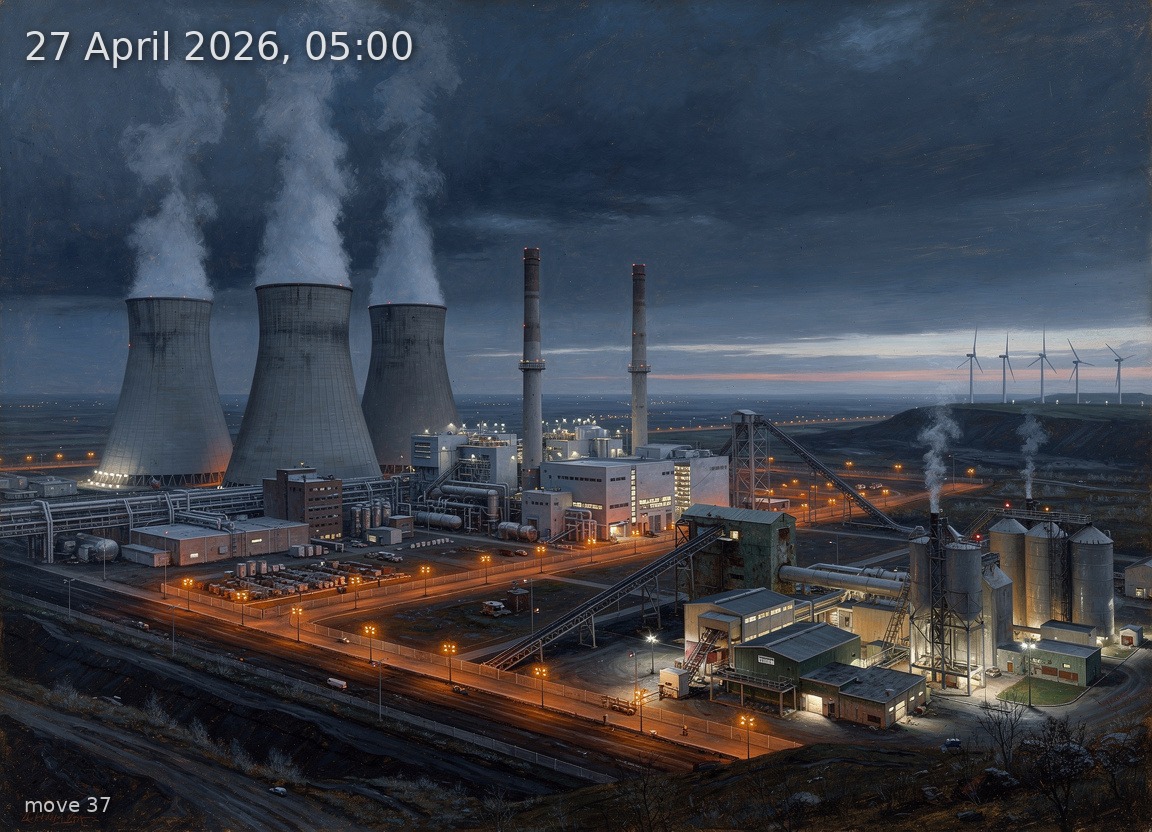
Brown coal, gas, and hard coal dominate a cold, windless pre-dawn hour requiring ~20 GW net imports.
Back
Generation mix
Wind onshore 11%
Wind offshore 0%
Solar 0%
Biomass 16%
Hydro 4%
Natural gas 25%
Hard coal 13%
Brown coal 30%
33%
Renewable share
3.1 GW
Wind (on + offshore)
0.0 GW
Solar
26.4 GW
Total generation
-20.1 GW
Net import
125.7 €/MWh
Day-ahead price
1.8°C / 2 km/h
Temp / Wind speed
Open-Meteo, Kassel (51.3°N 9.5°E)
0.0% / 0.0 W/m²
Cloud cover / Radiation
462
gCO₂/kWh
Image prompt
Brown coal 7.8 GW occupies the left third of the scene as a massive lignite power station with four hyperbolic cooling towers emitting thick white-grey steam plumes into the dark sky; natural gas 6.6 GW fills the centre-left as a pair of combined-cycle gas turbine plants with tall single exhaust stacks and glowing orange sodium lights along their perimeters; hard coal 3.4 GW appears centre-right as a smaller coal-fired station with a single large chimney and conveyor belts faintly illuminated by industrial floodlights; biomass 4.2 GW is rendered as a cluster of mid-sized biomass CHP plants with stacked woodchip silos and small steam outlets, positioned right of centre; onshore wind 3.0 GW stands as a modest row of three-blade turbines on a distant ridge to the far right, rotors barely turning in the still air; hydro 1.2 GW appears as a small dam structure with a faint spillway gleam at the far-right edge. Time is 05:00 pre-dawn in late April: the sky is deep blue-grey, the faintest pale indigo line appearing on the eastern horizon but no direct sunlight, the landscape otherwise in near-total darkness lit only by industrial sodium lamps casting amber pools. No solar panels visible anywhere. Temperature near freezing: bare branches on scattered birch trees, frost glinting on the ground and on metal structures, dormant brown grass. The air is perfectly still — no motion in smoke or steam except slow vertical rise. The atmosphere is heavy and oppressive, a brooding low-contrast sky pressing down on the industrial sprawl. Highly detailed oil painting in the tradition of 19th-century German Romantic landscape painters — rich dark tones of Prussian blue, umber, and burnt sienna, visible thick brushwork, atmospheric depth and chiaroscuro lighting from industrial sources against the vast dark sky. Meticulous engineering accuracy on all structures: turbine nacelles, lattice towers, cooling tower parabolic profiles, gas turbine exhaust geometry. No text, no labels.