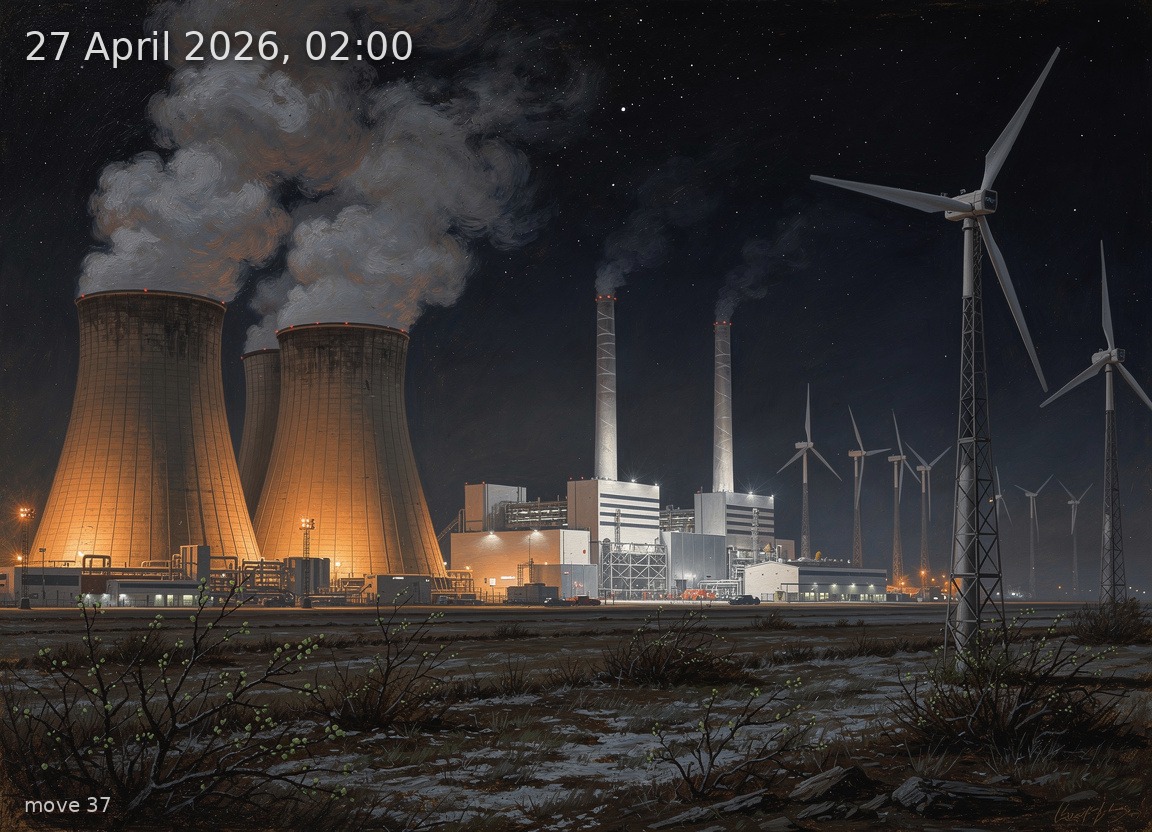
Brown coal and gas dominate a calm, cold spring night as low wind forces 12.3 GW of net imports.
Back
Generation mix
Wind onshore 16%
Wind offshore 1%
Biomass 15%
Hydro 4%
Natural gas 23%
Hard coal 12%
Brown coal 28%
37%
Renewable share
4.7 GW
Wind (on + offshore)
0.0 GW
Solar
27.8 GW
Total generation
-12.3 GW
Net import
112.7 €/MWh
Day-ahead price
3.4°C / 2 km/h
Temp / Wind speed
Open-Meteo, Kassel (51.3°N 9.5°E)
2.0% / 0.0 W/m²
Cloud cover / Radiation
435
gCO₂/kWh
Image prompt
Brown coal 7.8 GW dominates the left third of the scene as a massive lignite power station with four hyperbolic cooling towers emitting thick white-grey steam plumes lit from below by orange sodium lights; natural gas 6.4 GW occupies the centre-left as two compact CCGT units with tall single exhaust stacks venting translucent heat shimmer; onshore wind 4.5 GW appears across the centre-right as a row of tall three-blade turbines on lattice towers, blades nearly motionless in the still air, barely visible against the dark sky; biomass 4.2 GW is rendered as a medium-sized industrial plant with a wood-chip storage dome and a single smokestack with faint vapour, positioned right of centre; hard coal 3.3 GW appears as a smaller coal-fired station with a single cooling tower and conveyor belt infrastructure near the right side; hydro 1.2 GW is suggested by a concrete dam with dark water in the far right background; offshore wind 0.2 GW is omitted as negligible. The scene is set at 2 AM under a completely dark, deep-navy sky — no twilight, no sky glow — with a perfectly clear firmament showing crisp stars and the Milky Way faintly visible. The only illumination comes from sodium-orange industrial lighting on the power stations and a faint amber glow reflecting off the cooling tower steam. The landscape is a flat North German plain with early spring vegetation — bare branches and sparse pale-green buds on low scrub, frost glinting on the ground in the foreground. The air feels cold and heavy, oppressive for the high electricity price — a brooding, weighty atmosphere pervades the scene. Rendered as a highly detailed oil painting in the tradition of 19th-century German Romantic landscape painters such as Caspar David Friedrich, with rich dark colour palette of deep navy, burnt umber, and warm amber, visible impasto brushwork, dramatic chiaroscuro from the industrial lights against the black sky, atmospheric depth with haze around the distant cooling towers. Meticulous engineering detail on each technology: three-blade rotor nacelles, aluminium structural elements, hyperbolic concrete cooling tower profiles with visible ribbing. No text, no labels.