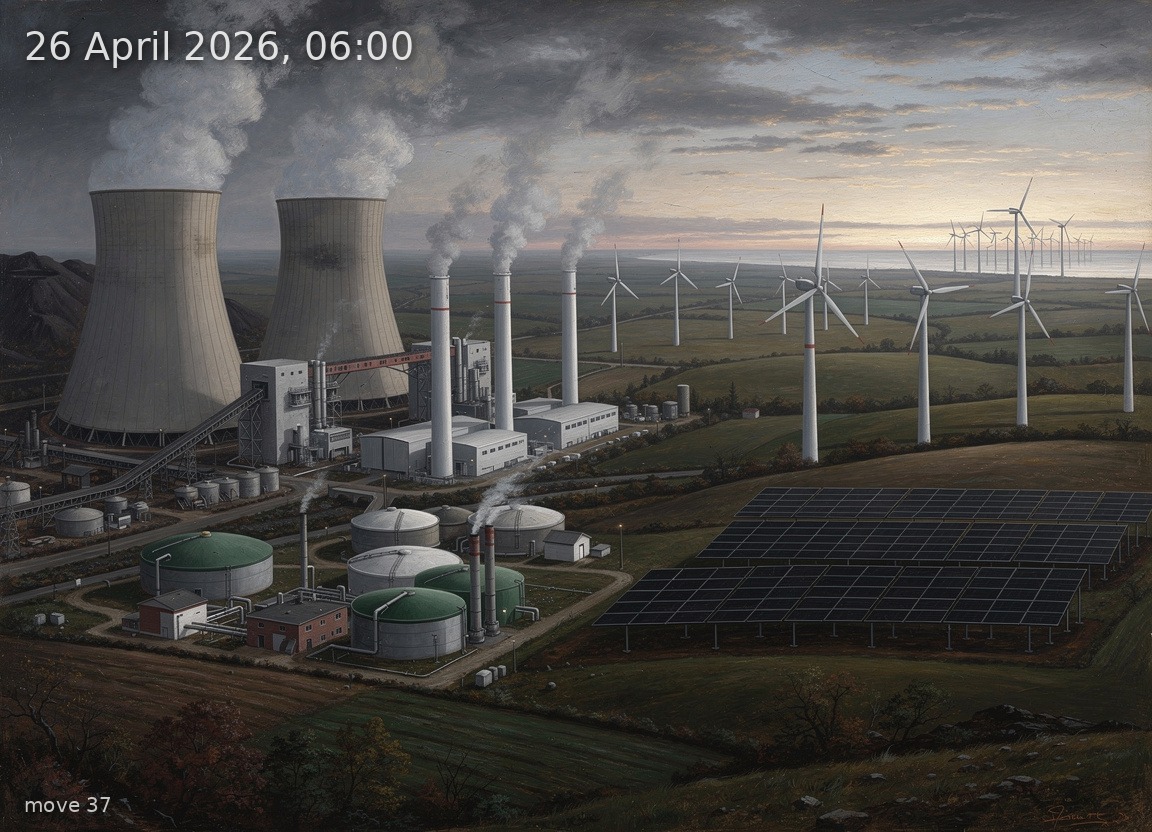
Wind leads generation at 10.8 GW but 14.6 GW net imports fill the gap on a cool, clear April dawn.
Back
Generation mix
Wind onshore 34%
Wind offshore 8%
Solar 6%
Biomass 16%
Hydro 4%
Natural gas 14%
Hard coal 5%
Brown coal 13%
69%
Renewable share
10.8 GW
Wind (on + offshore)
1.6 GW
Solar
25.7 GW
Total generation
-14.6 GW
Net import
94.2 €/MWh
Day-ahead price
4.2°C / 12 km/h
Temp / Wind speed
Open-Meteo, Kassel (51.3°N 9.5°E)
8.0% / 0.0 W/m²
Cloud cover / Radiation
206
gCO₂/kWh
Image prompt
Wind onshore 8.8 GW dominates the right half of the composition as dozens of tall three-blade turbines with white tubular towers and nacelles stretching across rolling farmland into the distance; wind offshore 2.0 GW appears as a distant cluster of offshore turbines on a grey-blue horizon line at far right. Brown coal 3.3 GW occupies the left foreground as a pair of massive hyperbolic cooling towers emitting pale steam plumes beside a conveyor-fed lignite plant with blocky industrial structures. Natural gas 3.5 GW sits left of centre as two compact CCGT power blocks with tall single exhaust stacks releasing thin heat shimmer. Biomass 4.2 GW appears centre-left as a cluster of mid-sized biogas facilities with rounded digesters and short chimneys with faint vapour. Solar 1.6 GW is represented by a modest field of aluminium-framed crystalline silicon panels in the centre-right middle ground, catching no direct light, panels dark and muted. Hard coal 1.2 GW is a smaller conventional power station with a single square stack behind the gas plant. Hydro 1.1 GW appears as a concrete run-of-river weir and small powerhouse beside a river in the foreground. Time of day is early dawn at 06:00 in late April: the sky is deep blue-grey with the faintest band of pale cold light along the eastern horizon, no direct sunlight, pre-dawn twilight only. Temperature is 4.2°C so the landscape shows early spring — bare branches mixed with first green buds, frost on grass. Cloud cover is only 8%, so the sky is mostly clear, showing stars fading in the upper portion. Wind at 12.5 km/h causes gentle motion in grass and slow rotation of turbine blades. The atmosphere feels heavy and expensive — a slight industrial haze hangs low across the scene, lending a brooding weight to the air. Style: highly detailed oil painting in the tradition of Caspar David Friedrich and Carl Blechen — rich saturated darks, visible impasto brushwork, dramatic atmospheric depth, meticulous engineering detail on every turbine nacelle, cooling tower fluting, and panel frame. No text, no labels.