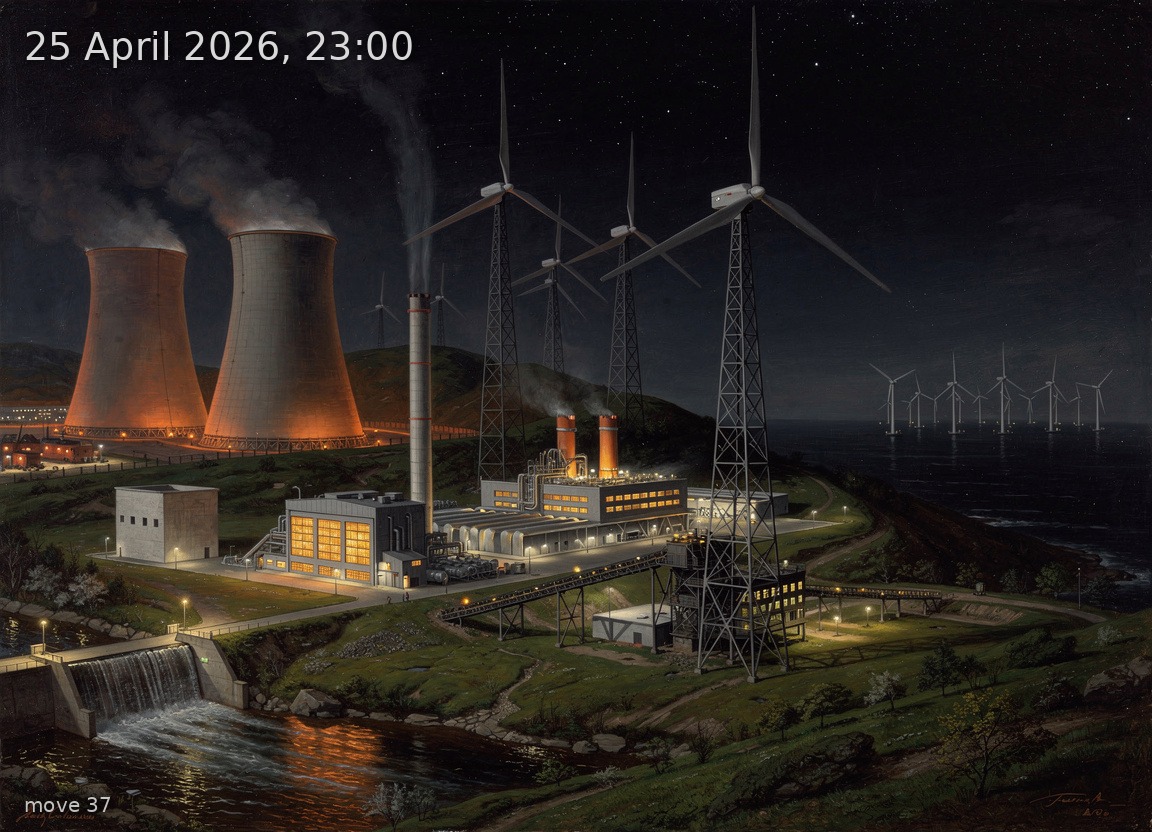
Strong onshore and offshore wind drives 83% renewable share at night, with 2.4 GW net export.
Back
Generation mix
Wind onshore 58%
Wind offshore 13%
Biomass 10%
Hydro 2%
Natural gas 8%
Hard coal 2%
Brown coal 7%
83%
Renewable share
32.9 GW
Wind (on + offshore)
0.0 GW
Solar
46.4 GW
Total generation
+2.4 GW
Net export
70.0 €/MWh
Day-ahead price
10.6°C / 17 km/h
Temp / Wind speed
Open-Meteo, Kassel (51.3°N 9.5°E)
0.0% / 0.0 W/m²
Cloud cover / Radiation
114
gCO₂/kWh
Image prompt
Wind onshore 27.0 GW dominates the scene as vast ranks of three-blade turbines on lattice towers stretching across rolling hills from centre to far right, their rotors spinning briskly in moderate wind; wind offshore 5.9 GW appears as a distant cluster of tall offshore turbines visible on a dark sea horizon at far right; biomass 4.5 GW is rendered as a mid-ground industrial plant with glowing furnace windows and a single tall stack emitting pale steam, positioned centre-left; natural gas 3.5 GW appears as a compact CCGT facility with twin exhaust stacks and warmly lit control buildings, placed left of centre; brown coal 3.4 GW occupies the left foreground as two hyperbolic cooling towers with faint steam plumes lit from below by sodium-orange industrial lights; hydro 1.1 GW is suggested by a small dam structure with spillway water catching artificial light in the lower left corner; hard coal 1.0 GW appears as a smaller coal plant with a single square cooling tower and conveyor belt silhouette, tucked behind the brown coal facility. Time is 23:00 — completely dark night sky, deep navy-black, no twilight, no sky glow, a scattering of stars visible through perfectly clear skies with zero cloud cover. All facilities are illuminated only by artificial light: sodium-yellow streetlamps, orange industrial floodlights, glowing windows. The April landscape has fresh green vegetation on the hills, just barely visible in the peripheral glow of the industrial lights. Temperature is mild at 10.6°C — no frost, no mist. The atmosphere carries a subtly heavy, warm quality reflecting the 70 EUR/MWh price — a faintly oppressive industrial haze hugging the thermal plants at left, contrasting with the cleaner air around the turbine fields at right. Painted in the style of a highly detailed 19th-century German Romantic oil painting — rich, deep colour palette dominated by dark blues, blacks, and warm industrial oranges; visible confident brushwork; dramatic atmospheric depth and chiaroscuro; meticulous engineering detail on every turbine nacelle, cooling tower, and exhaust stack. The composition evokes Caspar David Friedrich's sense of sublime scale but applied to an industrial-energy landscape. No text, no labels.