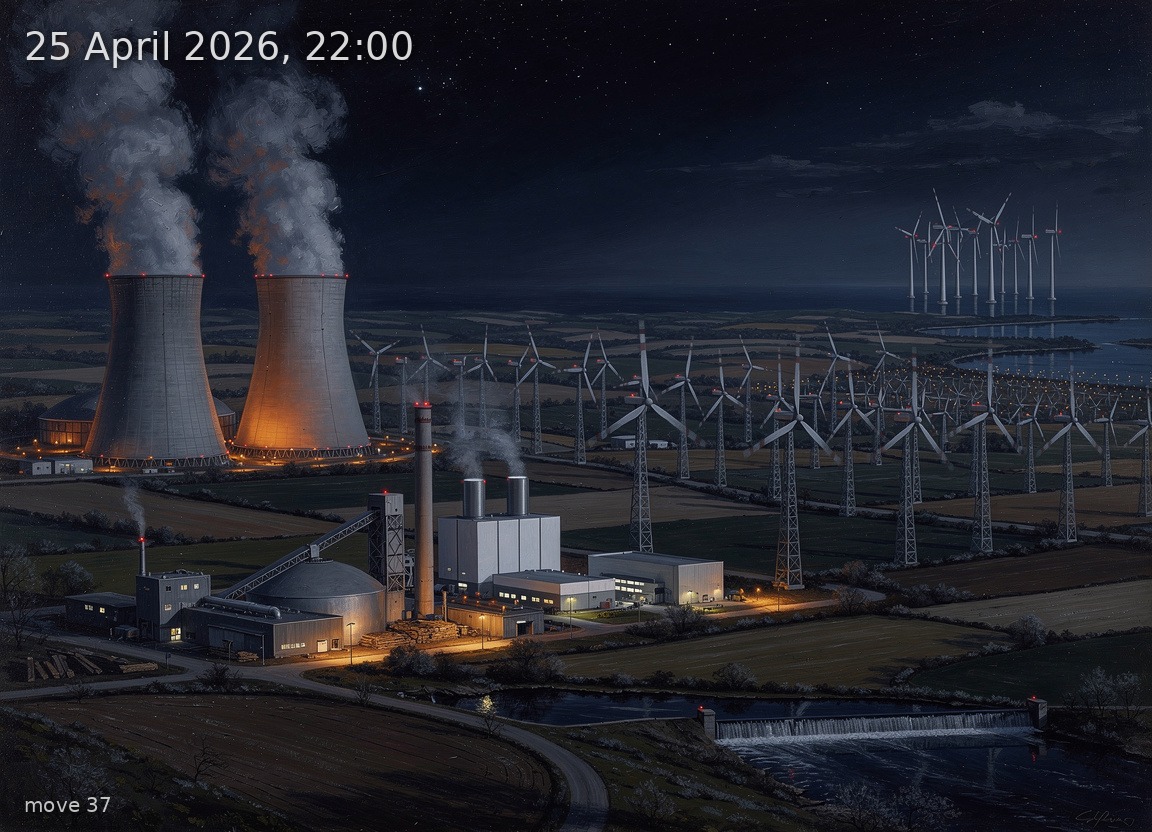
Strong onshore wind drives 83% renewable share at night, yielding a 1.7 GW net export with modest thermal backup.
Back
Generation mix
Wind onshore 59%
Wind offshore 12%
Biomass 10%
Hydro 2%
Natural gas 8%
Hard coal 2%
Brown coal 7%
83%
Renewable share
34.3 GW
Wind (on + offshore)
0.0 GW
Solar
48.2 GW
Total generation
+1.7 GW
Net export
72.7 €/MWh
Day-ahead price
10.8°C / 16 km/h
Temp / Wind speed
Open-Meteo, Kassel (51.3°N 9.5°E)
0.0% / 0.0 W/m²
Cloud cover / Radiation
111
gCO₂/kWh
Image prompt
Wind onshore 28.3 GW dominates the entire right two-thirds of the scene as vast ranks of three-blade turbines on lattice towers stretching deep into the distance across rolling central-German farmland, rotors spinning visibly in moderate wind; wind offshore 5.9 GW appears as a cluster of larger turbines on the far-right horizon above a faintly glinting river or distant sea inlet; biomass 4.6 GW occupies the centre-left as a mid-sized industrial plant with a wood-chip storage dome and a single squat smokestack emitting thin pale exhaust; natural gas 3.8 GW sits left of centre as two compact CCGT units with sleek single exhaust stacks releasing clean heat shimmer; brown coal 3.3 GW fills the far left as two hyperbolic cooling towers with thick white steam plumes rising into the night sky, lit from below by sodium-orange industrial lighting; hard coal 1.0 GW appears as a single smaller conventional boiler house with a thin stack beside the lignite plant; hydro 1.1 GW is a small run-of-river weir visible in the mid-ground with white water spilling over a low dam. TIME: 22:00 in late April — completely dark sky, deep navy-black, no twilight, no sky glow, stars faintly visible through perfectly clear 0% cloud cover; the only illumination is warm sodium streetlights along rural roads, orange and white industrial facility lighting, and the faint red aviation warning lights atop the endless rows of turbine nacelles blinking in unison. Spring vegetation: fresh green grass and budding deciduous trees barely visible in the artificial light, temperature around 11°C suggesting light mist near the river. ATMOSPHERE: despite heavy renewables the price is firm, so render the air with a slightly dense, close quality — not oppressive but weighty, with visible moisture in the beams of floodlights. STYLE: highly detailed oil painting in the tradition of Caspar David Friedrich and Carl Blechen — rich, deep colour palette of indigo, Prussian blue, warm amber, and cool grey; visible impasto brushwork in the steam plumes and turbine motion blur; meticulous engineering accuracy on turbine nacelles, three-blade rotors, aluminium-framed structures, and cooling tower hyperboloid geometry; atmospheric depth achieved through layered receding planes of turbines fading into the dark distance. No text, no labels.