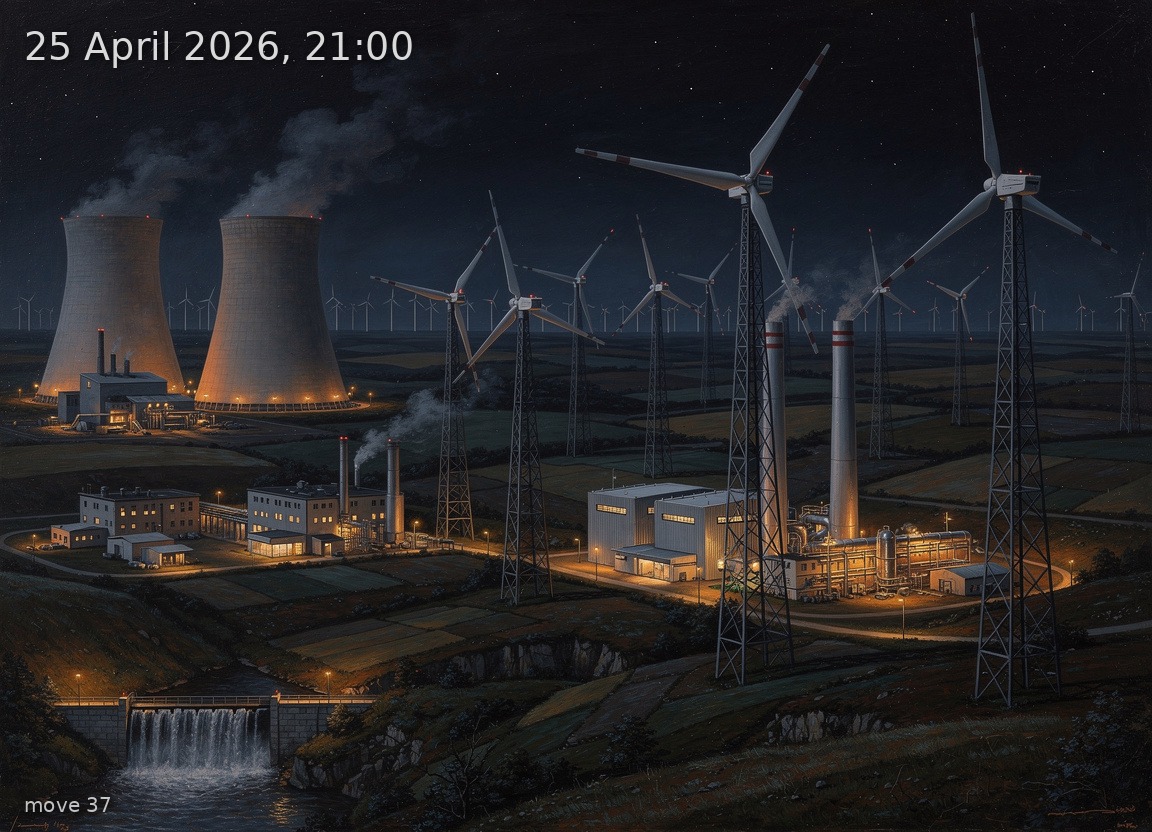
Strong onshore wind dominates a balanced nighttime grid at 84% renewables with minimal fossil backup.
Back
Generation mix
Wind onshore 60%
Wind offshore 12%
Biomass 10%
Hydro 2%
Natural gas 7%
Hard coal 2%
Brown coal 6%
84%
Renewable share
35.3 GW
Wind (on + offshore)
0.0 GW
Solar
49.0 GW
Total generation
+0.4 GW
Net export
72.0 €/MWh
Day-ahead price
12.4°C / 17 km/h
Temp / Wind speed
Open-Meteo, Kassel (51.3°N 9.5°E)
0.0% / 1.0 W/m²
Cloud cover / Radiation
105
gCO₂/kWh
Image prompt
Wind onshore 29.4 GW dominates the scene as vast ranks of three-blade turbines with lattice towers stretching across rolling central-German hills, filling roughly 60% of the canvas from centre to right; wind offshore 5.9 GW appears as a distant line of tall monopile turbines silhouetted on a far northern horizon, occupying about 12% of the composition; biomass 4.7 GW is rendered as a cluster of modest industrial plants with short chimneys and warm amber-lit windows in the mid-left, about 10% of the scene; natural gas 3.7 GW sits as a compact pair of CCGT units with single tall exhaust stacks releasing thin heat shimmer, placed left of centre, roughly 7%; brown coal 3.0 GW occupies the far left as two hyperbolic cooling towers with faint white steam plumes lit from below by sodium lights, about 6%; hard coal 1.2 GW appears as a single smaller stack facility adjacent to the lignite towers, about 2%; hydro 1.2 GW is suggested by a small illuminated dam spillway at the painting's lower-left edge. TIME OF DAY: fully dark, 21:00 in late April—black sky with scattered stars visible through perfectly clear skies (0% cloud cover), no twilight glow whatsoever, deep navy-to-black heavens. All structures lit only by warm sodium-orange industrial lighting and small white navigation beacons blinking on turbine nacelles. Spring vegetation: fresh green grass and budding deciduous trees faintly visible under artificial light. Moderate wind conveyed through slightly bent grass and blurred blade tips on the turbines. The atmosphere is subtly heavy and warm-toned to reflect an elevated electricity price—a faint industrial haze near the thermal plants casts amber haloes around their lights. Style: highly detailed oil painting in the tradition of Caspar David Friedrich and Carl Blechen, rich dark palette of deep prussian blue, warm amber, and cool silver, visible impasto brushwork, dramatic chiaroscuro between the dark sky and glowing industrial facilities, meticulous engineering detail on every turbine nacelle, cooling tower curvature, and gas-turbine exhaust stack. No text, no labels.