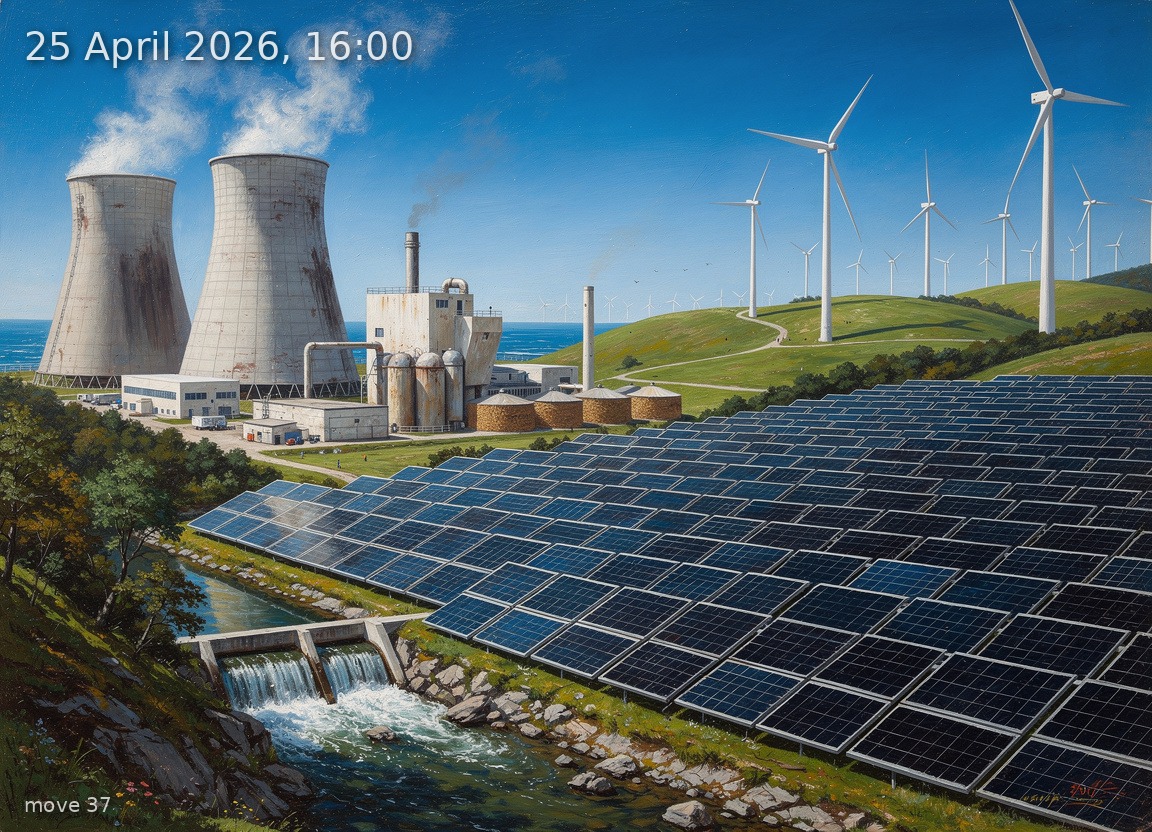
Solar at 34.7 GW and wind at 17.8 GW drive 12.2 GW net exports and deeply negative prices.
Back
Generation mix
Wind onshore 24%
Wind offshore 4%
Solar 56%
Biomass 7%
Hydro 2%
Natural gas 2%
Hard coal 1%
Brown coal 3%
94%
Renewable share
17.8 GW
Wind (on + offshore)
34.7 GW
Solar
61.5 GW
Total generation
+12.2 GW
Net export
-54.0 €/MWh
Day-ahead price
17.3°C / 15 km/h
Temp / Wind speed
Open-Meteo, Kassel (51.3°N 9.5°E)
0.0% / 592.0 W/m²
Cloud cover / Radiation
44
gCO₂/kWh
Image prompt
Solar 34.7 GW dominates the scene as a vast expanse of crystalline silicon photovoltaic arrays stretching across more than half the canvas from centre to right, their aluminium frames gleaming under intense direct sunlight; wind onshore 15.0 GW appears as dozens of tall three-blade turbines with white tubular towers arrayed across rolling green hills in the upper-right background, blades turning steadily in moderate breeze; wind offshore 2.8 GW is suggested by a cluster of turbines visible on the distant horizon above a thin strip of sea; biomass 4.1 GW is rendered as a mid-sized wood-chip power station with a rectangular stack and wood-pellet storage silos in the left-centre middle ground; brown coal 1.9 GW appears as a pair of hyperbolic cooling towers at the far left with thin, almost idle steam plumes; natural gas 1.5 GW sits as a compact combined-cycle gas turbine plant with a single slim exhaust stack beside the cooling towers, its output minimal; hydro 1.0 GW is depicted as a small dam with spillway in the lower-left foreground among wooded slopes; hard coal 0.5 GW is a single small conventional stack barely visible behind the lignite towers, emitting a faint wisp. The sky is completely clear, deep blue, zero clouds, late-afternoon full daylight with the sun at roughly 35 degrees elevation in the west casting long warm golden light. Spring vegetation: fresh bright-green grass, blossoming apple and cherry trees with white and pink petals, wildflowers in meadows. Temperature feels mild — no heat haze, crisp air. The atmosphere is open, calm, expansive — reflecting the deeply negative electricity price. Rendered as a highly detailed oil painting in the tradition of 19th-century German Romantic landscape painters such as Caspar David Friedrich and Carl Blechen, with rich saturated colour, visible impasto brushwork, luminous atmospheric depth, and meticulous engineering accuracy for every technology shown. No text, no labels.