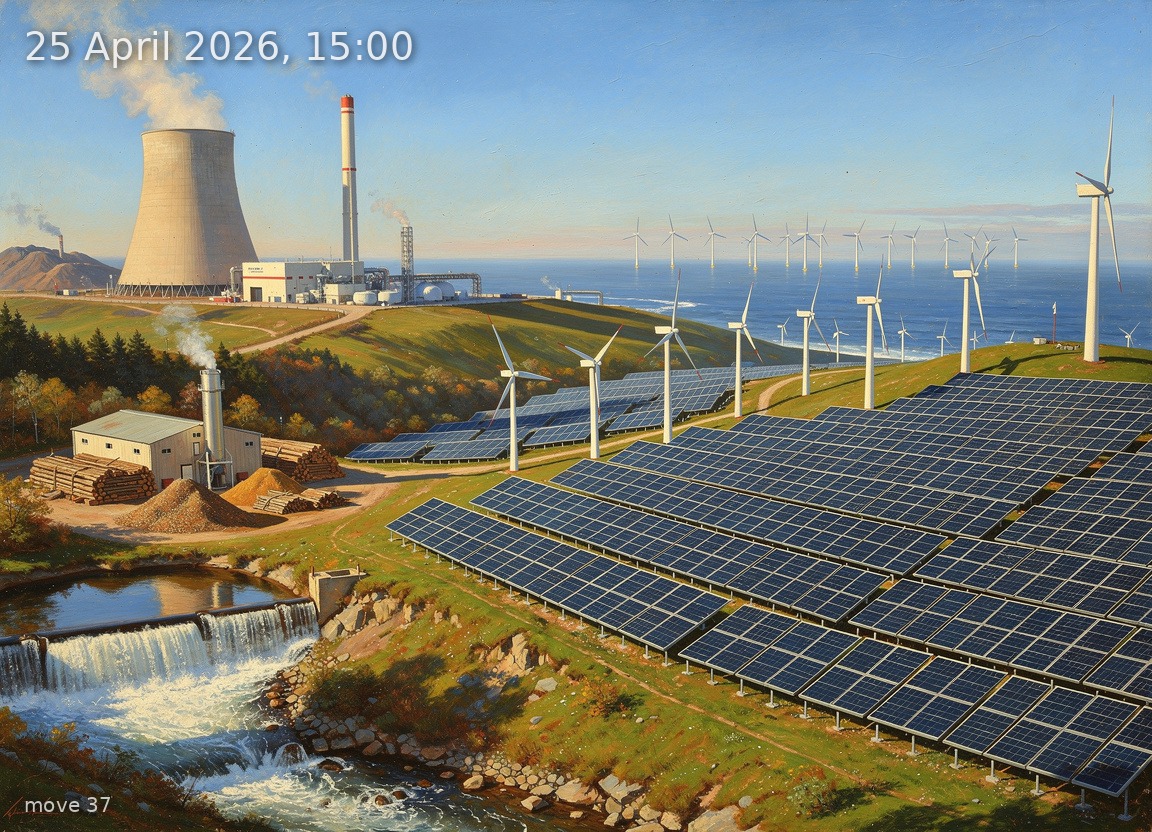
Solar at 42.7 GW under clear skies drives 16.8 GW net export and deeply negative prices.
Back
Generation mix
Wind onshore 18%
Wind offshore 4%
Solar 64%
Biomass 6%
Hydro 2%
Natural gas 2%
Hard coal 1%
Brown coal 3%
94%
Renewable share
14.6 GW
Wind (on + offshore)
42.7 GW
Solar
66.3 GW
Total generation
+16.7 GW
Net export
-133.8 €/MWh
Day-ahead price
17.0°C / 14 km/h
Temp / Wind speed
Open-Meteo, Kassel (51.3°N 9.5°E)
0.0% / 659.0 W/m²
Cloud cover / Radiation
40
gCO₂/kWh
Image prompt
Solar 42.7 GW dominates the entire centre and right of the scene as vast fields of aluminium-framed crystalline silicon photovoltaic panels stretching across gentle green spring hills, their blue-black surfaces gleaming under intense afternoon sun; wind onshore 12.0 GW appears as dozens of tall three-blade turbines with white tubular towers and nacelles arrayed along ridgelines in the mid-ground, blades turning steadily in moderate wind; wind offshore 2.6 GW is visible as a distant cluster of larger turbines on the far horizon above a silver sliver of the North Sea; biomass 4.1 GW is rendered as a mid-sized wood-chip power station with a modest stack emitting thin white exhaust near a timber yard at the left edge; brown coal 1.9 GW appears as a single lignite plant with one large hyperbolic cooling tower trailing a wispy steam plume, set in the far left background; natural gas 1.5 GW is a compact CCGT unit with a single tall exhaust stack and minimal visible emissions beside the lignite plant; hydro 1.0 GW is suggested by a small reservoir dam with cascading water in the lower left foreground; hard coal 0.5 GW is a barely visible small stack beyond the gas unit. The sky is completely cloudless, a luminous cerulean blue with the sun at roughly 50 degrees elevation in the southwest casting strong, warm afternoon light with crisp shadows. The atmosphere is calm and expansive, evoking serenity and abundance. Spring vegetation: fresh bright-green deciduous leaves on scattered oaks, wildflowers dotting meadows, temperature around 17°C suggesting comfortable warmth. Highly detailed oil painting in the tradition of 19th-century German Romantic landscape painters such as Caspar David Friedrich and Carl Blechen—rich saturated colour, visible impasto brushwork, luminous atmospheric depth, golden-hour warmth even at 3 PM due to the radiant clarity—but with meticulous technical accuracy on every turbine nacelle, every PV cell grid-line, every cooling tower's hyperbolic concrete curve. The scene feels like a masterwork panoramic industrial landscape painting. No text, no labels.