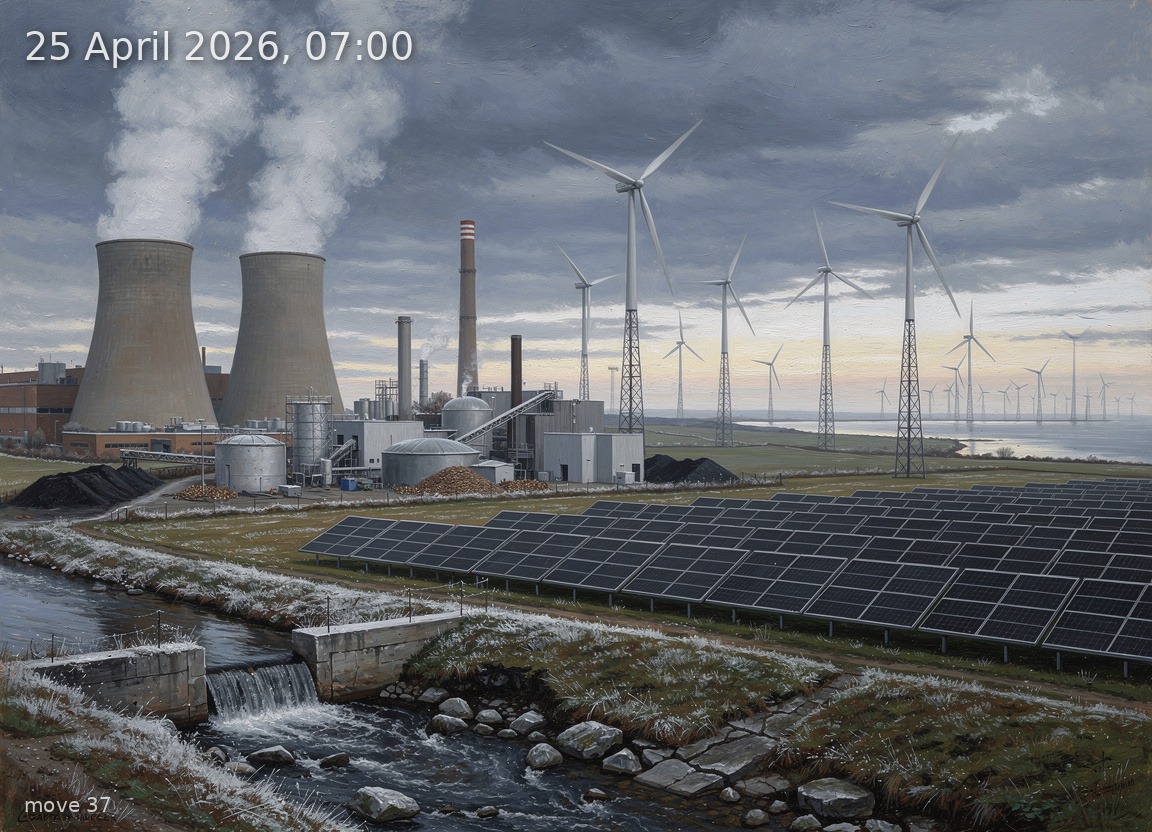
Wind power leads at 21.8 GW under full overcast; brown coal and gas fill the gap as solar ramps slowly at dawn.
Back
Generation mix
Wind onshore 39%
Wind offshore 9%
Solar 15%
Biomass 10%
Hydro 3%
Natural gas 10%
Hard coal 3%
Brown coal 11%
76%
Renewable share
21.7 GW
Wind (on + offshore)
7.0 GW
Solar
45.2 GW
Total generation
-1.5 GW
Net import
71.4 €/MWh
Day-ahead price
3.7°C / 8 km/h
Temp / Wind speed
Open-Meteo, Kassel (51.3°N 9.5°E)
100.0% / 0.0 W/m²
Cloud cover / Radiation
162
gCO₂/kWh
Image prompt
Wind onshore 17.5 GW dominates the right half and background as dozens of tall three-blade turbines on lattice towers stretching across rolling green-brown spring fields, rotors turning slowly in light wind. Wind offshore 4.3 GW appears as a distant cluster of larger turbines on the far-right horizon over a grey sea inlet. Brown coal 5.1 GW occupies the left foreground as a massive lignite power station with two hyperbolic cooling towers emitting thick white steam plumes rising vertically into still air. Biomass 4.5 GW sits left-centre as a cluster of medium industrial plants with tall chimneys and wood-chip storage domes. Natural gas 4.3 GW appears centre-left as a pair of compact CCGT units with sleek single exhaust stacks releasing thin transparent heat shimmer. Solar 7.0 GW is rendered centre-right as expansive fields of aluminium-framed crystalline silicon panels, their surfaces dark and matte, reflecting no sunlight whatsoever under the thick overcast. Hard coal 1.4 GW appears as a smaller coal plant behind the gas units with a single stack and conveyor belt. Hydro 1.2 GW is a small concrete run-of-river weir visible along a stream in the lower foreground. TIME: early dawn at 07:00 in late April—the sky is a deep blue-grey pre-dawn wash transitioning to pale cold silver near the eastern horizon, absolutely no direct sunlight, no warm tones; the entire sky is blanketed in 100% low stratus cloud. The temperature is near freezing at 3.7°C; frost clings to grass and bare branches of trees just beginning to bud. The atmosphere is heavy, slightly oppressive, with muted tones reflecting a 71.4 EUR/MWh price tension. Vegetation is early-spring sparse—pale green shoots on grey-brown earth, leafless birches and oaks. Rendered as a highly detailed oil painting in the tradition of 19th-century German Romantic landscape painters—Caspar David Friedrich's atmospheric depth merged with Adolph Menzel's industrial precision. Rich impasto brushwork in the steam plumes, delicate glazing in the leaden sky, meticulous engineering detail on every turbine nacelle, every panel frame, every cooling tower's parabolic curve. No text, no labels, no human figures.