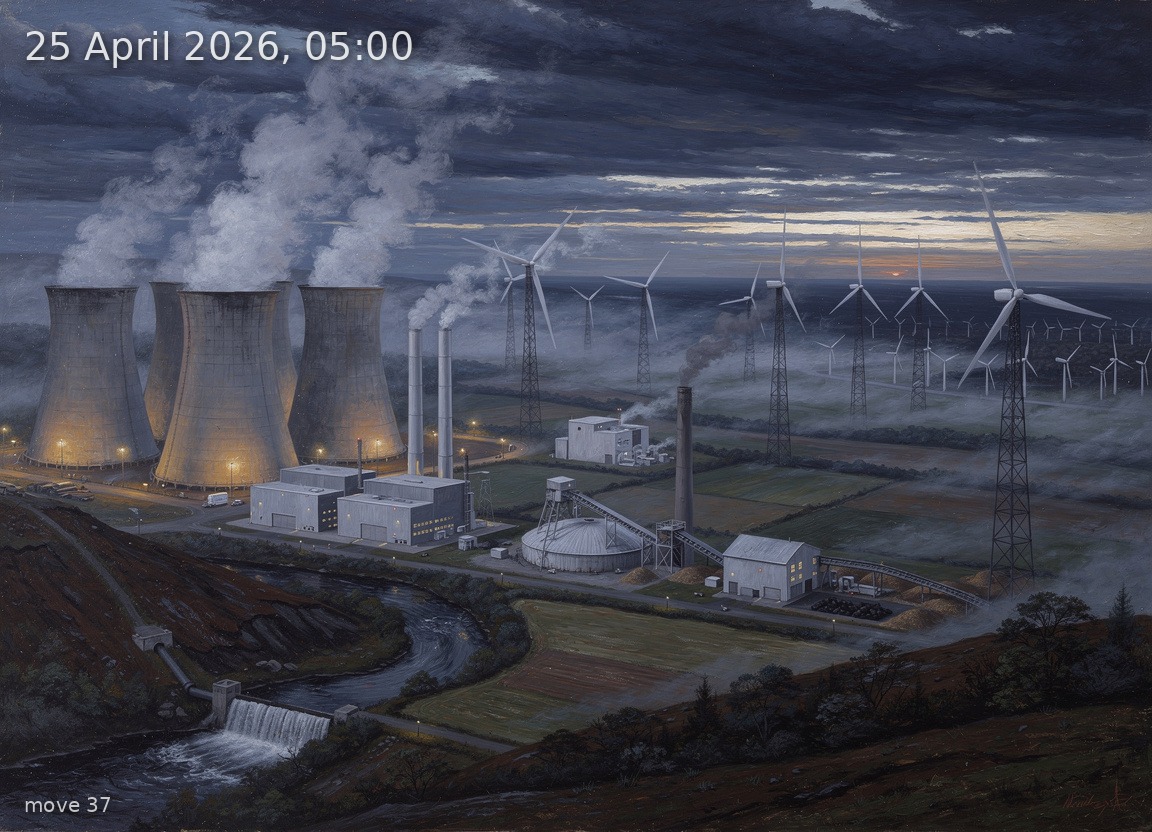
Wind leads at 21.4 GW with brown coal and gas filling the gap; net imports cover a 4.4 GW shortfall before dawn.
Back
Generation mix
Wind onshore 44%
Wind offshore 12%
Solar 0%
Biomass 11%
Hydro 3%
Natural gas 11%
Hard coal 3%
Brown coal 16%
70%
Renewable share
21.4 GW
Wind (on + offshore)
0.0 GW
Solar
38.0 GW
Total generation
-4.4 GW
Net import
88.0 €/MWh
Day-ahead price
4.7°C / 9 km/h
Temp / Wind speed
Open-Meteo, Kassel (51.3°N 9.5°E)
100.0% / 0.0 W/m²
Cloud cover / Radiation
205
gCO₂/kWh
Image prompt
Wind onshore 16.8 GW dominates the right two-thirds of the scene as dozens of tall three-blade turbines with lattice towers stretching across rolling fields into the distance; wind offshore 4.6 GW appears as a row of larger turbines on the far-right horizon over a dark strip of sea. Brown coal 6.0 GW occupies the left foreground as a cluster of massive hyperbolic cooling towers emitting thick white steam plumes, lit from below by amber sodium lamps. Natural gas 4.0 GW sits centre-left as two compact CCGT plant blocks with slim exhaust stacks venting thin vapour. Biomass 4.2 GW is rendered as a mid-ground wood-chip-fed CHP facility with a gently smoking stack and a fuel-storage dome. Hard coal 1.2 GW appears as a single smaller coal plant behind the gas units, with a square boiler house and conveyor belt. Hydro 1.2 GW is suggested by a small dam structure and penstock visible in a valley depression at far left. No solar panels anywhere — zero solar generation. The sky is deep blue-grey pre-dawn, 05:00 in late April: the faintest pale steel band on the eastern horizon hints at approaching sunrise, but no direct sunlight yet; overhead the sky is nearly black, blanketed by 100% cloud cover pressing low. Temperature is near freezing — bare birch and beech trees with only the earliest spring buds, patches of frost on the grass. Wind is moderate, turbine blades caught mid-rotation, clouds streaking. The atmosphere feels heavy and oppressive, reflecting an elevated electricity price — a brooding weight to the overcast. Transmission pylons carrying high-voltage lines recede toward the borders, subtly evoking net power imports. Style: highly detailed oil painting in the tradition of 19th-century German Romantic landscape painters such as Caspar David Friedrich and Carl Blechen — rich, deep colour palette of indigo, slate, amber, and bone-white; visible impasto brushwork; atmospheric depth with misty layers; meticulous engineering detail on every turbine nacelle, cooling tower, and stack. No text, no labels.