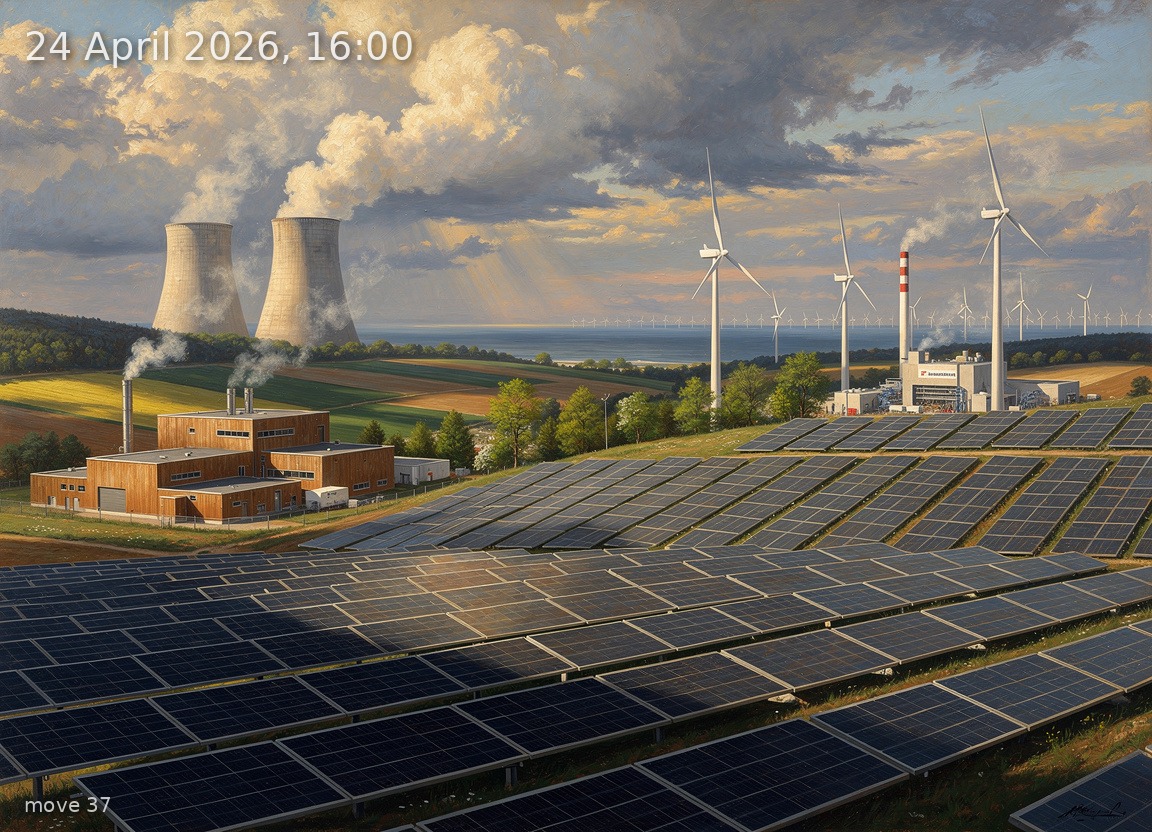
Solar at 36.7 GW and wind at 14.1 GW drive 90% renewables, pushing prices negative with 6.2 GW net export.
Back
Generation mix
Wind onshore 19%
Wind offshore 4%
Solar 59%
Biomass 7%
Hydro 2%
Natural gas 3%
Hard coal 2%
Brown coal 5%
90%
Renewable share
14.2 GW
Wind (on + offshore)
36.7 GW
Solar
62.1 GW
Total generation
+6.2 GW
Net export
-1.6 €/MWh
Day-ahead price
14.4°C / 12 km/h
Temp / Wind speed
Open-Meteo, Kassel (51.3°N 9.5°E)
81.0% / 436.0 W/m²
Cloud cover / Radiation
68
gCO₂/kWh
Image prompt
Solar 36.7 GW dominates the composition, filling nearly 60% of the scene as vast fields of aluminium-framed crystalline silicon photovoltaic panels stretching across gently rolling mid-German farmland in the foreground and middle ground, their glass surfaces catching strong afternoon light filtering through broken cumulus clouds. Wind onshore 11.8 GW appears as dozens of tall three-blade turbines with white tubular towers and nacelles scattered across ridgelines in the middle distance, rotors turning moderately in 12 km/h winds. Wind offshore 2.3 GW is visible as a faint line of turbines on a far horizon suggesting the North Sea coast. Biomass 4.1 GW is represented by a cluster of timber-clad biomass CHP plants with modest rectangular stacks and small steam plumes on the left edge. Brown coal 2.8 GW appears as two hyperbolic concrete cooling towers releasing thin white steam plumes in the far left background, dwarfed by the renewable infrastructure. Natural gas 1.9 GW shows as a compact CCGT plant with a single tall exhaust stack and minimal heat shimmer, tucked behind a row of trees. Hard coal 1.2 GW is a single dark industrial boiler house with a narrow chimney barely visible at the far left margin. Hydro 1.1 GW appears as a small concrete run-of-river weir with turbine house visible along a river cutting through the valley floor. The sky at 16:00 in late April shows full afternoon daylight, 81% cloud cover as a dramatic broken overcast with towering cumulus clouds, sunbeams breaking through gaps and casting moving pools of golden light across the solar fields, the atmosphere is calm and open suggesting low electricity prices. Spring vegetation: fresh green grass, budding deciduous trees, scattered wildflowers. Temperature is mild at 14°C. Style: highly detailed oil painting in the tradition of 19th-century German Romantic landscape painters such as Caspar David Friedrich and Carl Blechen — rich saturated colour palette, visible impasto brushwork, deep atmospheric perspective with aerial haze softening distant elements, dramatic chiaroscuro from the broken cloud lighting. Meticulous engineering accuracy on all technology details: individual PV cell grids visible on nearby panels, turbine blade pitch mechanisms, cooling tower parabolic geometry, CCGT heat recovery units. The overall mood is one of abundant, almost overwhelming renewable plenty — a landscape transformed yet serene. No text, no labels, no human figures prominent.