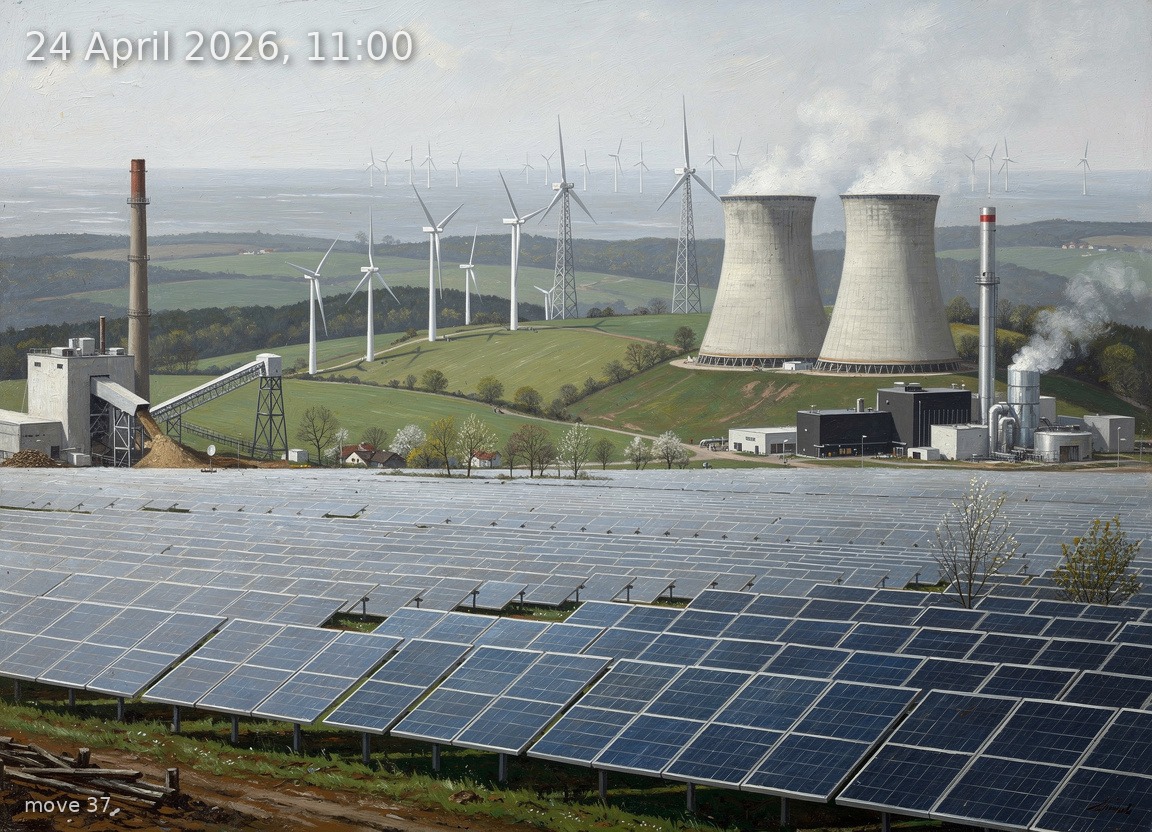
Solar at 43.2 GW drives 89.8% renewable share and 3.6 GW net export at near-zero prices.
Back
Generation mix
Wind onshore 12%
Wind offshore 3%
Solar 65%
Biomass 7%
Hydro 2%
Natural gas 4%
Hard coal 2%
Brown coal 5%
90%
Renewable share
10.4 GW
Wind (on + offshore)
43.2 GW
Solar
66.0 GW
Total generation
+3.6 GW
Net export
-0.0 €/MWh
Day-ahead price
8.4°C / 19 km/h
Temp / Wind speed
Open-Meteo, Kassel (51.3°N 9.5°E)
88.0% / 102.0 W/m²
Cloud cover / Radiation
71
gCO₂/kWh
Image prompt
Solar 43.2 GW dominates the scene as a vast plain of aluminium-framed crystalline silicon photovoltaic panels stretching across roughly two-thirds of the composition, their blue-grey surfaces reflecting a bright but overcast sky; wind onshore 8.2 GW appears as dozens of tall three-blade turbines with white nacelles on lattice and tubular towers arrayed across rolling green hills in the middle distance, blades turning briskly in moderate wind; wind offshore 2.3 GW is visible far in the background as a cluster of offshore turbines on a grey-silver sea horizon; biomass 4.3 GW is rendered as a mid-sized industrial plant with a tall stack and wood-chip conveyors at the left edge; brown coal 3.1 GW appears as a pair of large hyperbolic cooling towers with thin, lazy steam plumes rising from them, set behind the solar field; natural gas 2.3 GW is a compact CCGT facility with a single polished exhaust stack emitting a faint heat shimmer; hard coal 1.3 GW is a smaller coal plant with a rectangular boiler house and a short smokestack releasing a wisp of grey; hydro 1.3 GW is depicted as a concrete run-of-river weir with water cascading through turbine outlets along a river in the foreground. The lighting is full late-morning daylight at 11:00 in central Germany, but heavily diffused through dense 88% cloud cover — the sky is a luminous pale grey with no visible sun disc, light is soft and shadowless, consistent with 102 W/m² direct radiation. The landscape shows early spring: fresh green grass, budding deciduous trees, bare patches of brown earth, temperature around 8°C suggesting cool dampness. The atmosphere is calm and open, reflecting the zero electricity price — no oppressive haze, no dramatic storm clouds, just a vast quiet industrial pastoral. Style: highly detailed oil painting in the tradition of 19th-century German Romantic landscape painters such as Caspar David Friedrich and Carl Blechen — rich layered colour, visible confident brushwork, atmospheric aerial perspective with misty distances, but with meticulous modern engineering detail on every turbine nacelle, every PV module frame, every cooling tower's parabolic curve. The scene conveys the quiet enormity of renewable infrastructure at scale. No text, no labels.