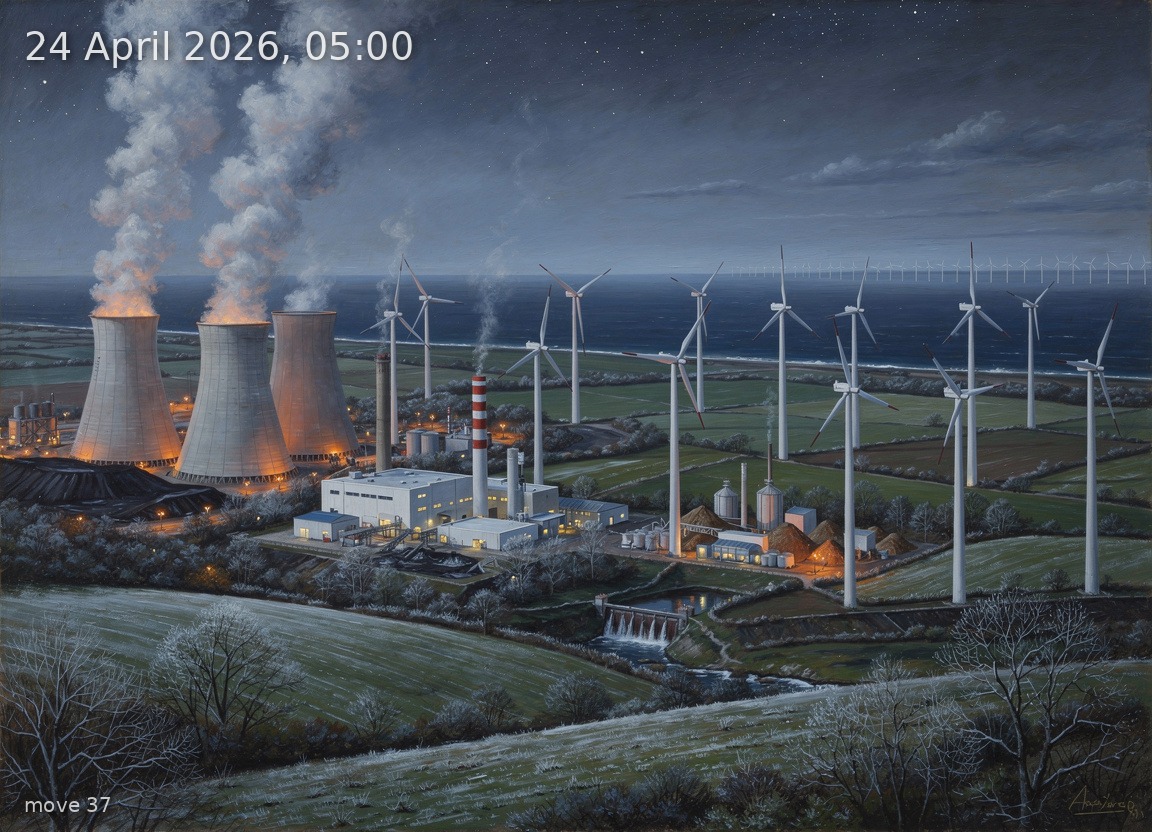
Wind leads at 19.7 GW but zero solar and 8.3 GW net imports keep thermal plants and prices elevated before dawn.
Back
Generation mix
Wind onshore 36%
Wind offshore 13%
Solar 0%
Biomass 10%
Hydro 3%
Natural gas 14%
Hard coal 8%
Brown coal 16%
62%
Renewable share
19.7 GW
Wind (on + offshore)
0.0 GW
Solar
40.2 GW
Total generation
-8.3 GW
Net import
116.3 €/MWh
Day-ahead price
4.3°C / 5 km/h
Temp / Wind speed
Open-Meteo, Kassel (51.3°N 9.5°E)
2.0% / 0.0 W/m²
Cloud cover / Radiation
256
gCO₂/kWh
Image prompt
Wind onshore 14.4 GW dominates the right half of the scene as dozens of tall three-blade turbines with white tubular towers and detailed nacelles stretching across rolling farmland into the distance; wind offshore 5.3 GW appears as a faint line of turbines on a dark North Sea horizon at far right. Brown coal 6.3 GW occupies the left foreground as a massive lignite power station with three hyperbolic concrete cooling towers emitting thick white steam plumes rising vertically in the still air, lit from below by orange sodium lamps. Natural gas 5.7 GW sits centre-left as a compact CCGT plant with tall slender exhaust stacks topped by heat shimmer and small vapour trails. Hard coal 3.2 GW appears behind the gas plant as a smaller station with a single large smokestack and coal conveyors. Biomass 4.2 GW is rendered as a medium-sized industrial facility with wood-chip silos and a modest chimney with pale exhaust, placed centre-right among the turbine field. Hydro 1.2 GW is suggested by a small dam and reservoir visible in a valley in the middle distance. No solar panels anywhere — zero solar generation. Time is 05:00 in late April: the sky is deep blue-grey pre-dawn, the faintest hint of pale steel-blue light at the eastern horizon but no sun visible, stars fading overhead, the landscape mostly dark and lit by industrial sodium-orange and white facility lighting. Temperature is 4.3°C: thin frost on the spring grass, bare-branched hedgerows beginning to leaf out, patches of green emerging. Cloud cover is only 2%: the sky is nearly clear, showing deep indigo with a few faint stars. Wind speed is low at ground level: the turbine blades turn slowly but steadily. The atmosphere feels heavy and oppressive despite the clear sky, reflecting the high electricity price — a brooding, weighty stillness. Highly detailed oil painting in the tradition of 19th-century German Romantic landscape painters — Caspar David Friedrich meets industrial sublime — rich deep blues, warm sodium oranges, visible confident brushwork, atmospheric depth and chiaroscuro, meticulous engineering detail on every turbine nacelle, cooling tower, and exhaust stack. No text, no labels.