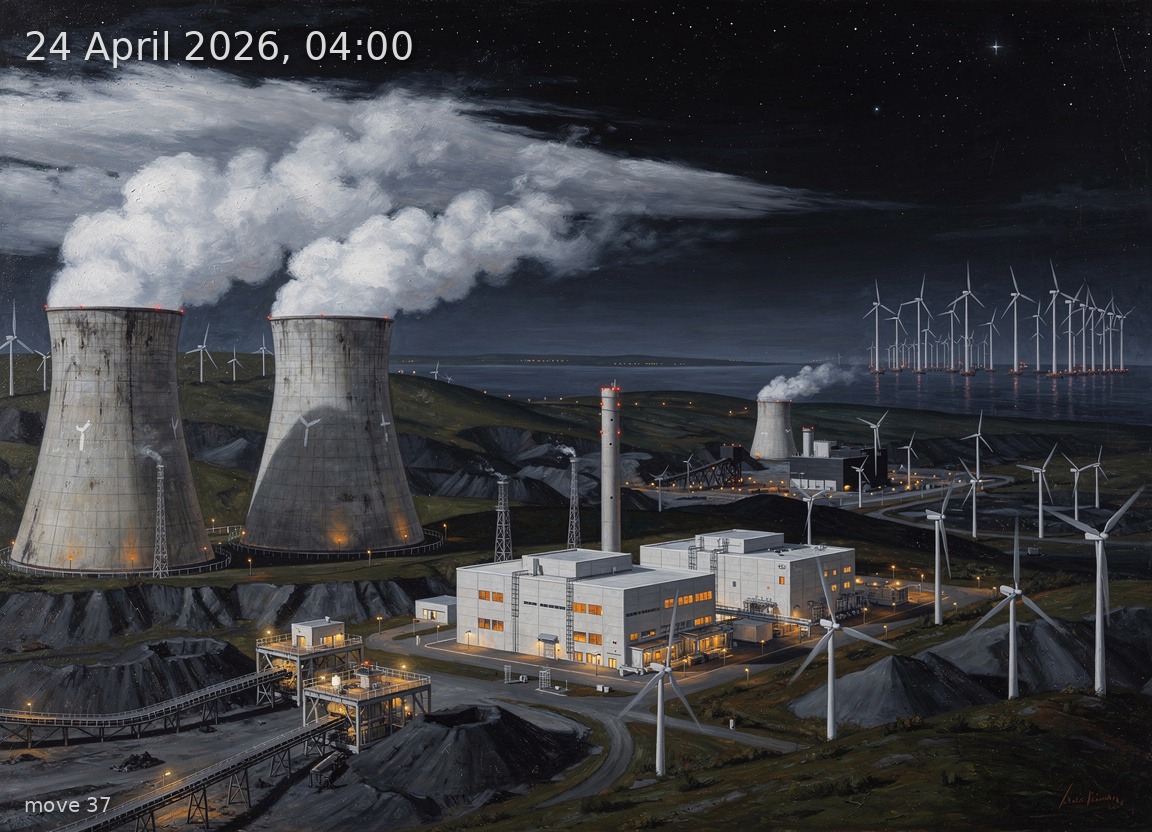
Wind dominates at 20.6 GW but thermal plants and net imports of 5.6 GW are needed to meet pre-dawn demand.
Back
Generation mix
Wind onshore 38%
Wind offshore 13%
Biomass 10%
Hydro 3%
Natural gas 14%
Hard coal 7%
Brown coal 14%
65%
Renewable share
20.6 GW
Wind (on + offshore)
0.0 GW
Solar
40.0 GW
Total generation
-5.5 GW
Net import
105.4 €/MWh
Day-ahead price
5.2°C / 6 km/h
Temp / Wind speed
Open-Meteo, Kassel (51.3°N 9.5°E)
1.0% / 0.0 W/m²
Cloud cover / Radiation
238
gCO₂/kWh
Image prompt
Wind onshore 15.4 GW dominates the right half and background as dozens of three-blade turbines on lattice and tubular towers stretching across rolling hills into the distance; wind offshore 5.2 GW appears as a distant cluster of tall offshore turbines on the far-right horizon above a dark river; brown coal 5.7 GW occupies the left foreground as three massive hyperbolic cooling towers with thick white steam plumes rising into the black sky, flanked by conveyor belts and ash-grey lignite stockpiles; natural gas 5.4 GW sits centre-left as two compact CCGT power blocks with tall single exhaust stacks emitting thin translucent heat shimmer; hard coal 3.0 GW appears as a smaller coal plant behind the gas units with a single squat cooling tower and a coal bunker; biomass 4.1 GW is rendered as a mid-sized industrial facility centre-right with a cylindrical wood-chip silo and low steam vent; hydro 1.2 GW is a small dam structure visible in the middle distance near the river. TIME: 04:00 — completely dark, black sky with faint stars visible through perfectly clear atmosphere (1% cloud cover), no twilight, no sky glow; all structures lit only by orange sodium streetlights, industrial floodlights, and glowing control-room windows. The atmosphere feels heavy and oppressive despite the clear sky — a psychological weight suggesting high electricity prices — achieved through dense steam from cooling towers pressing low and spreading across the scene, and a subtle amber industrial haze near ground level. Bare early-spring trees with tiny buds suggest 5°C April cold; frost glints on metal structures. Turbine blades show gentle rotation. Style: highly detailed oil painting in the tradition of 19th-century German Romantic landscape painters such as Caspar David Friedrich and Carl Blechen — rich impasto brushwork, dramatic chiaroscuro between sodium-lit industrial forms and the enveloping darkness, atmospheric depth with receding layers of turbines fading into deep blue-black. Meticulous engineering detail on every technology: visible nacelle housings, three-blade rotors, aluminium cable trays on CCGT stacks, riveted steel on the dam. The painting evokes the sublime tension between industrial power and the vast silent night. No text, no labels.