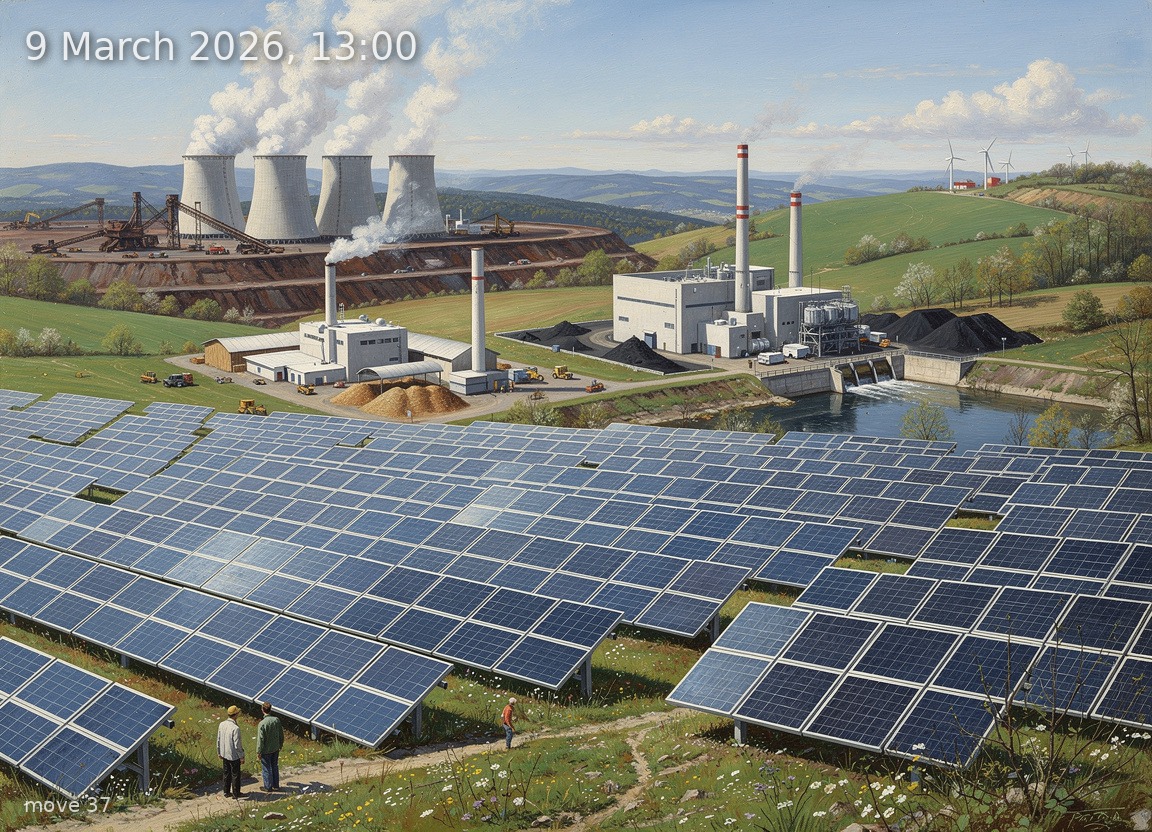
Solar dominates at 37.8 GW under cloudless skies; brown coal persists at 8.1 GW despite 74% renewables; wind nearly absent.
Back
Generation mix
Wind onshore 2%
Wind offshore 0%
Solar 63%
Biomass 7%
Hydro 2%
Natural gas 6%
Hard coal 6%
Brown coal 13%
74%
Renewable share
1.3 GW
Wind (on + offshore)
37.8 GW
Solar
60.1 GW
Total generation
+1.5 GW
Net export
67.3 €/MWh
Day-ahead price
14.5°C / 10 km/h
Temp / Wind speed
Open-Meteo, Kassel (51.3°N 9.5°E)
0% / 434.0 W/m²
Cloud cover / Radiation
186
gCO₂/kWh
Image prompt
Solar 37.8 GW dominates the entire foreground and middle ground as vast expanses of crystalline silicon PV panels — thousands of aluminium-framed modules arrayed across rolling early-spring fields with fresh green grass and early wildflowers, catching brilliant direct sunlight and casting crisp geometric shadows. Brown coal 8.1 GW occupies the left background as a cluster of massive hyperbolic cooling towers emitting thick white steam plumes rising into the clear sky, with conveyor belts and open-pit mine terraces visible at their base. Biomass 4.0 GW appears as a wood-chip-fed CHP plant with a tall stack and modest steam in the center-left middle distance. Natural gas 3.8 GW is rendered as a compact CCGT power station with twin exhaust stacks and a small cooling unit positioned center-right behind the solar fields. Hard coal 3.6 GW shows as a traditional coal plant with a single large chimney and coal stockpiles to the right of the brown coal complex. Hydro 1.5 GW appears as a small dam and reservoir nestled in gentle hills at the far right. Wind onshore 1.2 GW is represented by just two or three distant three-blade turbines on a ridge, their rotors barely turning in the still air. Wind offshore 0.1 GW is essentially invisible — no offshore turbines shown. The sky is completely cloudless, a luminous blue washed with warm spring light; the midday sun at 13:00 is high and intense, casting short shadows. Temperature of 14.5°C is reflected in light jackets on tiny figures near the solar arrays and in the fresh but not lush vegetation — early budding trees, pale green meadows. The atmosphere carries a faintly warm, slightly hazy quality suggesting moderate electricity price tension — not oppressive but with industrial weight from the thermal plants' emissions drifting across the horizon. Highly detailed oil painting in the tradition of 19th-century German Romantic landscape painters — rich saturated colour, visible confident brushwork, atmospheric aerial perspective with depth receding to distant blue hills. Each energy technology rendered with meticulous engineering accuracy: turbine nacelles with three-blade rotors on lattice or tubular towers, aluminium-framed PV modules with visible cell grids, lignite cooling towers with correct hyperbolic geometry, CCGT exhaust stacks with heat shimmer. The scene feels like a monumental masterwork painting of Germany's energy transition — the ancient power of coal yielding ground to an ocean of solar glass under a radiant spring sky. No text, no labels.