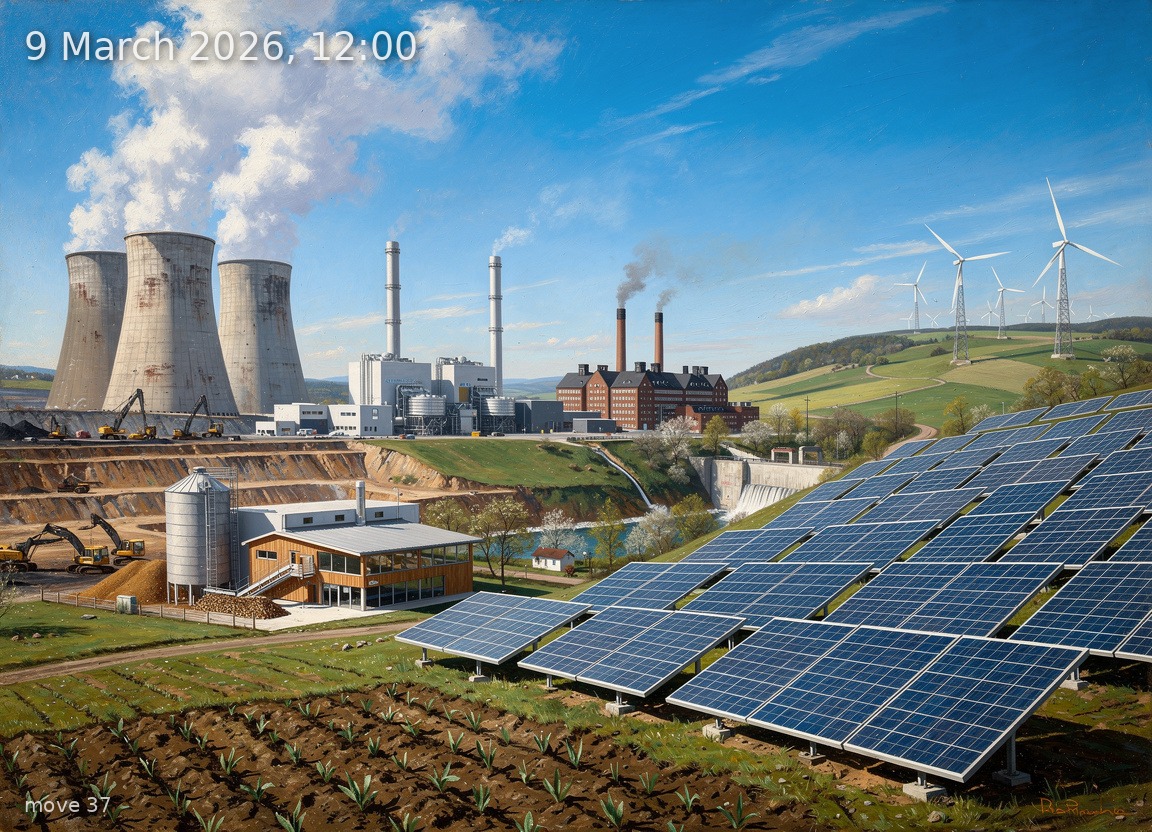
Solar at 40.6 GW dominates a calm, cloudless March noon while coal and gas provide 15.8 GW of thermal baseload.
Back
Generation mix
Wind onshore 2%
Wind offshore 0%
Solar 65%
Biomass 6%
Hydro 2%
Natural gas 7%
Hard coal 6%
Brown coal 13%
75%
Renewable share
1.1 GW
Wind (on + offshore)
40.6 GW
Solar
62.9 GW
Total generation
+2.1 GW
Net export
67.7 €/MWh
Day-ahead price
12.1°C / 6 km/h
Temp / Wind speed
Open-Meteo, Kassel (51.3°N 9.5°E)
1% / 396.0 W/m²
Cloud cover / Radiation
179
gCO₂/kWh
Image prompt
Solar 40.6 GW dominates the entire right two-thirds of the composition as vast rolling fields and rooftop arrays of crystalline silicon PV panels glinting under brilliant midday sun, their aluminium frames catching white highlights. Brown coal 8.0 GW occupies the far left as a cluster of massive hyperbolic cooling towers with thick white steam plumes rising vertically in the still air, beside open-pit excavators. Natural gas 4.2 GW appears as two compact CCGT plants with sleek single exhaust stacks and modest heat shimmer just left of centre. Hard coal 3.6 GW sits as a dark gabled power station with twin chimneys emitting thin grey smoke behind the gas plant. Biomass 4.1 GW is rendered as a timber-clad combined heat and power facility with a tall cylindrical silo and wood-chip conveyor near centre-left. Hydro 1.4 GW appears as a small concrete dam and penstock nestled in a green valley fold in the middle distance. Wind onshore 1.0 GW is represented by a handful of tall three-blade turbines on a distant ridge, their rotors barely turning. The sky is almost perfectly clear — a luminous cerulean dome with only the faintest wisp of cirrus — flooded with direct noon sunlight casting short, crisp shadows. The March landscape shows early spring: fresh green shoots on brown fields, budding deciduous trees, temperature around 12°C giving a cool crispness to the light. The atmosphere carries a faintly oppressive industrial warmth from the moderately high electricity price, with a slight amber-tinted haze near the coal installations contrasting the crystalline clarity over the solar fields. Style: highly detailed oil painting in the tradition of 19th-century German Romantic landscape painters — rich saturated colour, visible impasto brushwork, dramatic atmospheric depth — but with meticulous engineering accuracy for every technology: turbine nacelles with three-blade rotors on lattice/tubular towers, aluminium-framed monocrystalline PV modules in neat rows, lignite hyperbolic cooling towers with realistic concrete texture and condensation plumes, gas CCGT with cylindrical HRSG units and exhaust stacks. The painting conveys the grandeur and tension of an industrial landscape undergoing transformation. No text, no labels.