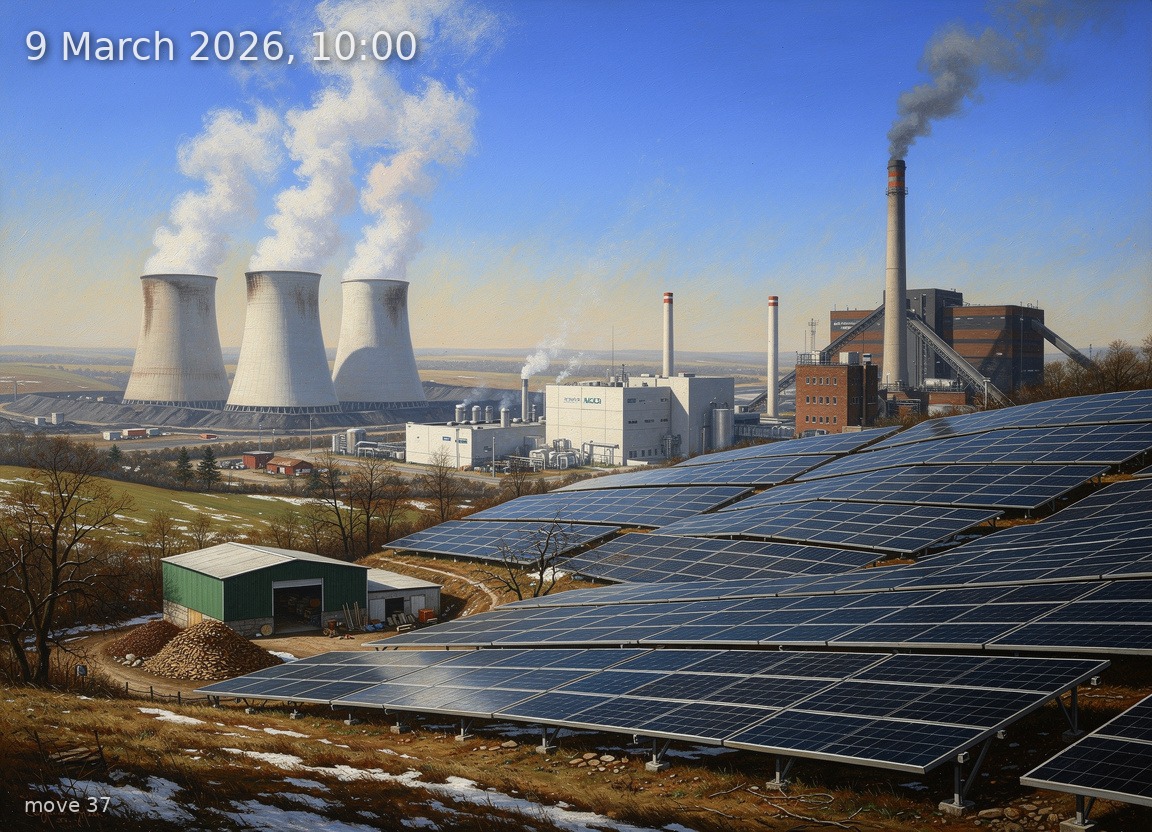
Massive 34.2 GW solar dominates under clear skies, but near-zero wind forces 20 GW of thermal generation and elevated prices.
Back
Generation mix
Wind onshore 2%
Wind offshore 0%
Solar 56%
Biomass 7%
Hydro 2%
Natural gas 10%
Hard coal 8%
Brown coal 15%
68%
Renewable share
1.6 GW
Wind (on + offshore)
34.2 GW
Solar
61.3 GW
Total generation
-1.1 GW
Net import
101.1 €/MWh
Day-ahead price
5.0°C / 4 km/h
Temp / Wind speed
Open-Meteo, Kassel (51.3°N 9.5°E)
0% / 99.8 W/m²
Cloud cover / Radiation
230
gCO₂/kWh
Image prompt
Solar 34.2 GW dominates the right two-thirds of the scene as vast rolling fields of aluminium-framed crystalline silicon PV panels stretching across gentle hills, their blue-black surfaces glinting sharply under a brilliant cloudless March sun at mid-morning (10:00 Berlin time, full daylight, sun moderately high in the east-southeast, hard shadows). Brown coal 9.2 GW occupies the left background as a massive lignite power station complex with four hyperbolic cooling towers pouring thick white steam plumes that rise vertically in the still air. Natural gas 5.9 GW appears as two compact CCGT plants with tall slender exhaust stacks and modest heat-shimmer exhaust, positioned centre-left. Hard coal 4.9 GW is rendered as a dark-brick coal station with conveyor belts and a single large chimney trailing grey smoke, slightly behind the gas plants. Biomass 4.2 GW appears as a medium-sized wood-chip facility with a green-roofed warehouse and short stack with faint white vapour, positioned in the mid-ground. Hydro 1.3 GW is depicted as a small concrete dam with spillway visible in a valley at far left. Wind onshore 1.3 GW is shown as just two or three tall three-blade turbines on a distant ridge, their rotors almost completely still. Wind offshore 0.3 GW is barely suggested as tiny turbine silhouettes on a hazy horizon line. The sky is perfectly clear, deep cerulean blue, but the atmosphere carries an oppressive heaviness—a faint yellowish industrial haze hanging low near the thermal plants, reflecting the high electricity price. Early spring landscape: bare deciduous trees with only the faintest buds, dry brown grass, patches of frost in shadows, temperature around 5°C lending a crisp bite. Virtually no wind—smoke and steam rise straight up, flags hang limp, no ripple on water surfaces. Highly detailed oil painting in the tradition of 19th-century German Romantic landscape painters—Caspar David Friedrich meets industrial realism—rich saturated colour, visible confident brushwork, deep atmospheric perspective, dramatic light and shadow contrasts between the luminous solar fields and the brooding thermal stations. Meticulous engineering accuracy on all technology. No text, no labels.