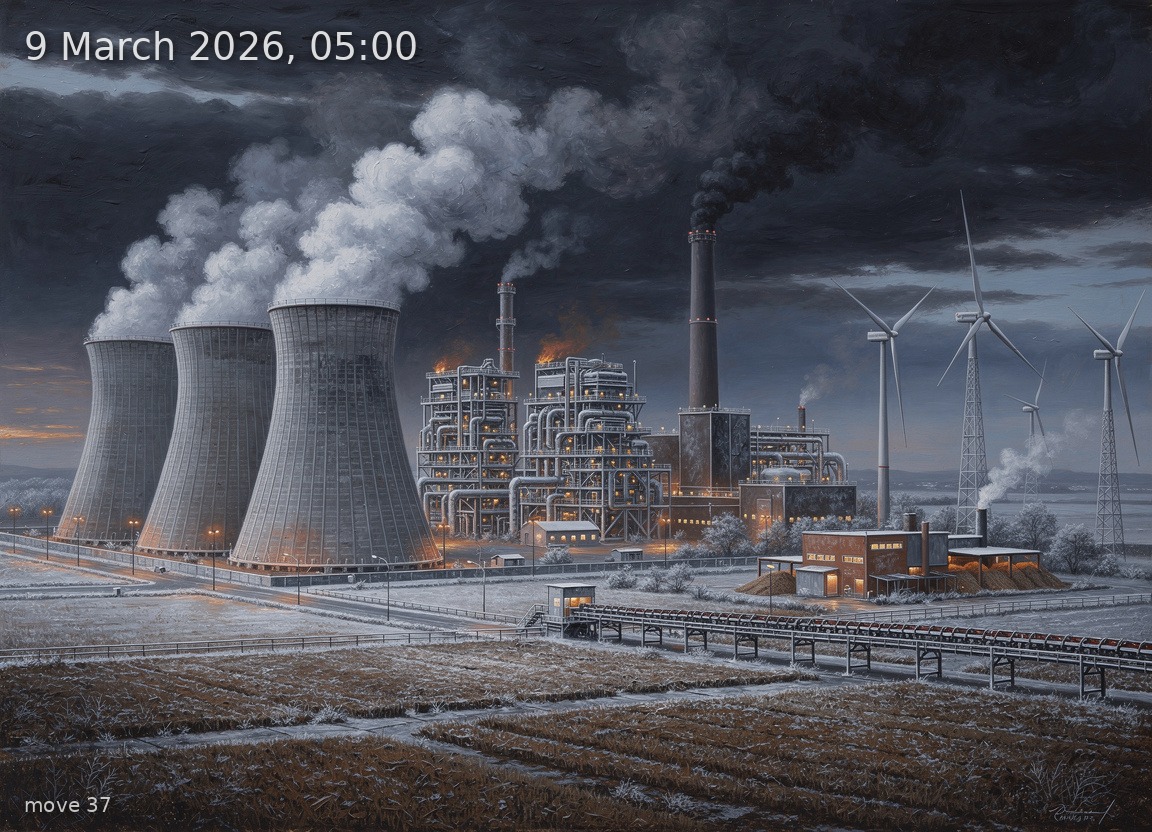
Brown coal, gas, and hard coal dominate as near-zero wind and no solar force heavy imports at 9.7 GW.
Back
Generation mix
Wind onshore 17%
Wind offshore 1%
Biomass 11%
Hydro 4%
Natural gas 21%
Hard coal 14%
Brown coal 32%
33%
Renewable share
6.9 GW
Wind (on + offshore)
0.0 GW
Solar
38.1 GW
Total generation
-9.7 GW
Net import
137.0 €/MWh
Day-ahead price
1.5°C / 0 km/h
Temp / Wind speed
Open-Meteo, Kassel (51.3°N 9.5°E)
100% / 0.0 W/m²
Cloud cover / Radiation
473
gCO₂/kWh
Image prompt
Brown coal 12.4 GW occupies the left third of the scene as a massive lignite power complex with four hyperbolic cooling towers emitting thick white steam plumes rising into the black sky; natural gas 8.0 GW fills the centre-left as two compact CCGT power blocks with tall single exhaust stacks venting shimmering heat haze; hard coal 5.3 GW appears centre-right as a coal-fired station with a single large smokestack and conveyor belt feeding a coal bunker; onshore wind 6.4 GW spans the right quarter as a row of tall three-blade turbines on lattice towers, their rotors completely still in dead-calm air; biomass 4.1 GW appears as a wood-chip-fed CHP plant with a modest chimney and steam wisp near the wind turbines; hydro 1.4 GW is represented by a small dam and powerhouse nestled in a valley at far right; offshore wind 0.5 GW is a faint silhouette of two turbines on the distant horizon line. The time is 05:00 pre-dawn in early March: the sky is deep blue-grey with the faintest pale suggestion of coming light along the eastern horizon, but no direct sunlight — everything is illuminated by sodium-orange industrial lighting from the power plants, casting long warm glows across frozen ground. No solar panels anywhere. The landscape is flat central-German lowland with frost-covered brown stubble fields and bare skeletal trees. Temperature is near freezing — frost crystals glint on metal structures, visible breath-like condensation near warm exhausts. Complete overcast: a heavy, oppressive low cloud ceiling trapping the steam and industrial haze, giving the atmosphere a suffocating, weighty feel reflecting the extreme 137 EUR/MWh price. Rendered as a highly detailed oil painting in the tradition of 19th-century German Romantic landscape painters — Caspar David Friedrich meets industrial sublime — with rich impasto brushwork, deep chiaroscuro contrasts between the glowing industrial fires and the cold dark sky, atmospheric depth with layered mist and steam, meticulous engineering detail on each turbine nacelle, cooling tower reinforced concrete ribbing, CCGT exhaust diffusers, and conveyor mechanisms. The mood is somber, monumental, oppressive. No text, no labels.